Blue-winged Teals take flight. (Photo by Sam Zhang, Macaulay Library-ML363398841)
In the Caribbean we are blessed with more than 30 species of ducks, with resident species joined by migratory visitors in fall and winter — with the occasional (exciting) ‘rare’ bird showing up too! Male ducks in breeding plumage typically sport colorful features that make identification easier, even when species look similar.
But, what about females, immatures, and males out of breeding plumage (known as ‘eclipse males’)? Fear not — we’re here to help you identify the tricky ‘brown ones’. Read on for some great tips!
In this guide we’ll focus on females of five common migratory ducks that pass through or winter in the Caribbean, with ‘bonus’ tips on four additional, less common species. We will also touch on some of the rarer species that visit the Caribbean which can be easily mixed up with the common ones.
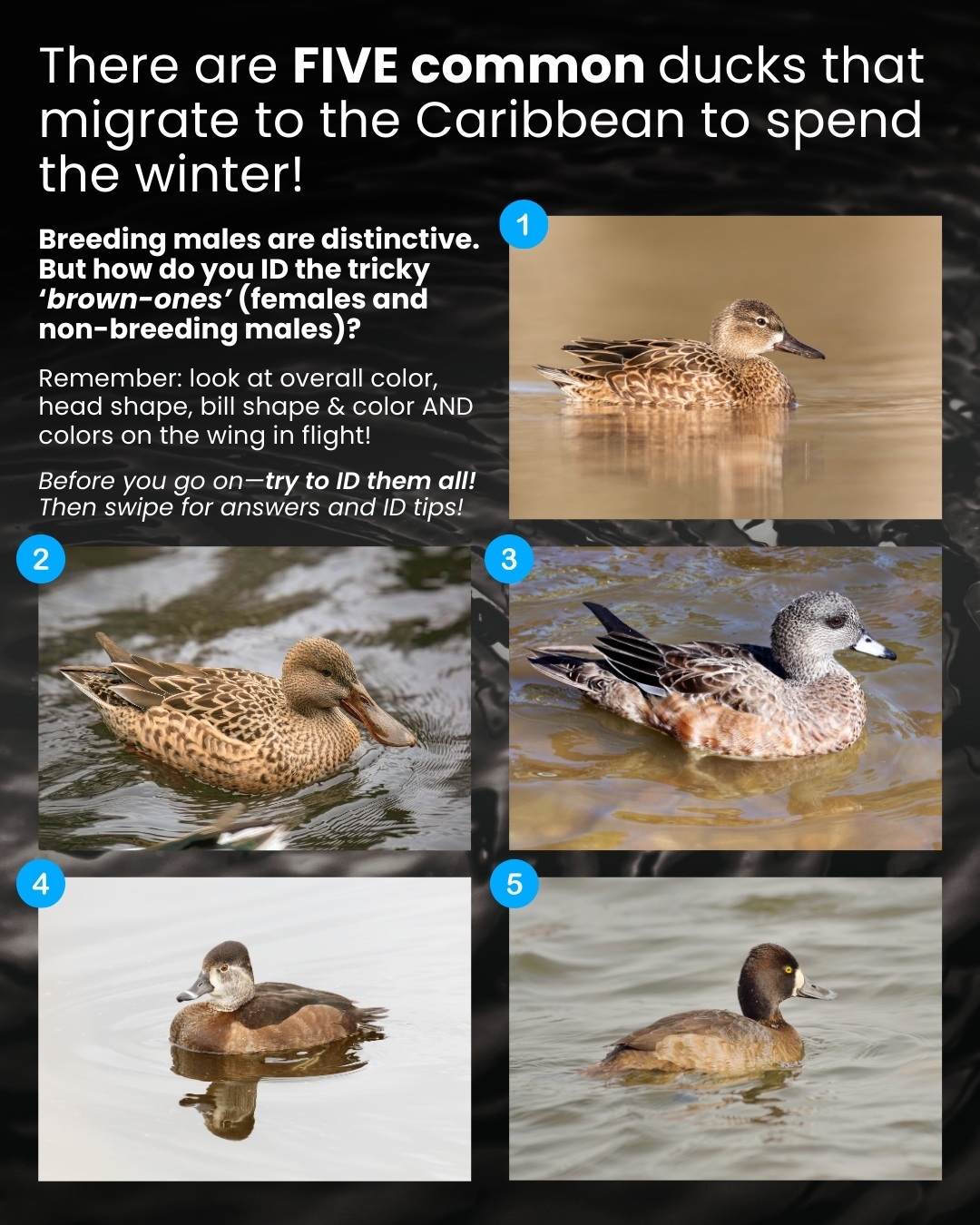
Before you dive in — take a look and see how many of our five species you can already identify!
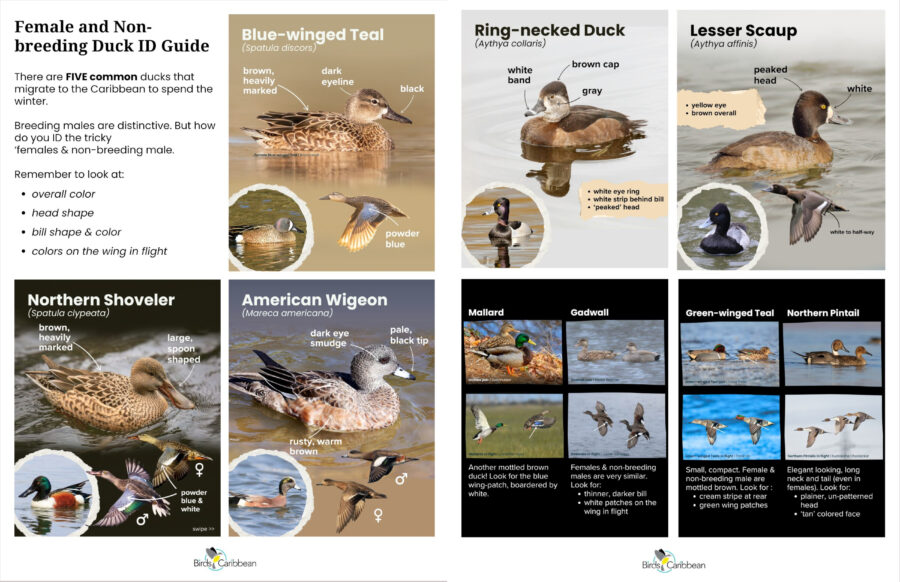
Blue-winged Teal
These are one of the most common duck visitors to the Caribbean! Even females are often unmistakable in flight thanks to the powder-blue on the wing. This is shared by Northern Shoveler (see next), but the blue for the shoveler is less extensive and they also have bold white on the wing — which the teals lack.
When swimming look for the dark eye-line and black bill. Males in eclipse plumage may also show a faint ‘ghost’ of the white ‘crescent’ mark behind the bill, seen when they are in breeding plumage.
While similar, Green-winged Teal females (see below) are a warmer brown, and have a cream stripe at the rear. You may also spot some of the green on the wing, even when they are swimming.
Northern Shoveler
This duck might be known as the ‘Hollywood Mallard’ for the male’s flashy looks — but females are more demure. Like many female ducks, they show heavily marked brown-buff plumage — but their large spoon-shaped bill is a dead giveaway.
You can also look for a wash of powder blue on the leading edge of the wing in flight, combined with a white stripe.
American Wigeon
Breeding male American Wigeons bring glamour to the wetland! With a green eye patch and white crown, males are hard to mis-identify. Females and non-breeding males are more subtle, but you can recognize these short-billed ducks from the rusty, warm brown tones of their body plumage.
Females look plainer and less mottled than other female brown ducks, with a gray-brown head with that dark smudge around the eyes. Look also for the pale bill with a black tip.
The similar Eurasian Wigeon is a rare visitor to the Caribbean and can cause confusion. Breeding male American and Eurasian Wigeons look quite different. The American Wigeon shows a striking green stripe behind the eye, has a gray brown head and white cap. In contrast Eurasian males have a chestnut head and buff cap. However, females can be hard to separate. Look for the grayer, ‘colder’ colored head in the American Wigeon — and in flight, American Wigeons show white under the wing, whilst Eurasians are silvery gray.
A Quick Feeding Tip!
The way ducks feed can also help narrow down your ID. The ducks above are all ‘dabbling ducks’ — you’re likely to see them in shallow water, tipping head down, tail up in the air.
The next two species are ‘diving ducks’ — they dive head-first underwater when feeding, completely disappearing beneath the surface.
Ring-necked Duck
Despite the name, the male’s chestnut collar across its black neck is hard to see in the field—so don’t rely on it! Females have a brown-gray body, and pale white feathers around the base of the bill. Their heads feature a brown cap that contrasts with its gray face and white eye-ring.
Their bills are also helpful: look for the distinctive white a white band across it near the tip. Males in eclipse plumage display a brown plumage with brown-black head, breast, and back. They can be distinguished from females by their bright yellow eyes and lack of an eye-ring.
Lesser Scaup
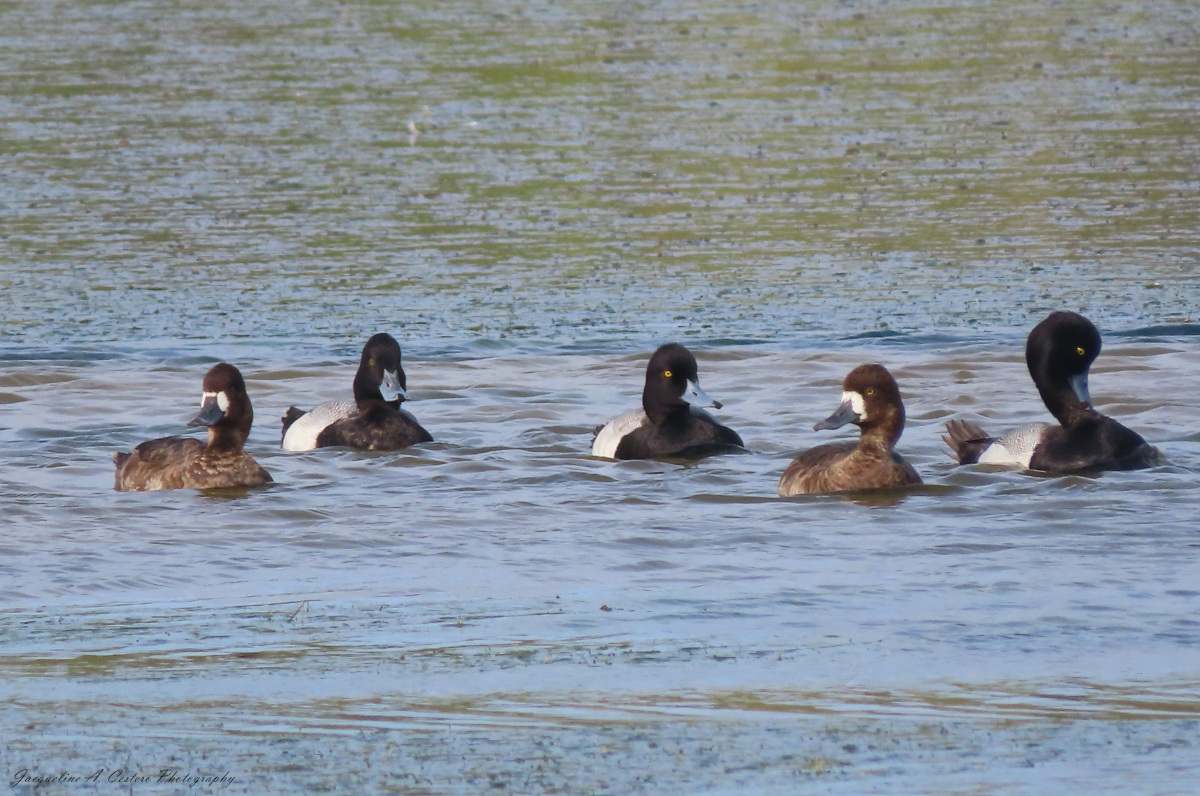
Female Less Scaups are a warm chocolate brown. Unlike the Ring-necked Duck, their head and face is almost entirely brown, with a white patch that varies in size just behind the bill, and yellow eyes.
Males have black heads with purple/green iridescence, a black neck and breast, white sides, and greyish marbled looking backs. Both sexes have a white wing-stripe, which runs half-way along the trailing edge of the upper wing, and is visible in flight.
This species is very similar to the far rarer Greater Scaup. The best way to tell them apart is by head shape — the Lesser Scaup’s head is narrower and egg-shaped with a peak near the back of the head, while the head of the Greater Scaup is more rounded. In addition, the sides and back of the Greater Scaup are lighter.
And the rest…
We’ve covered the five most common species of migratory ducks found in the Caribbean — let’s now consider a few less common but noteworthy species.
The Mallard is what most people think of when they picture a duck. Males have a distinctive glossy green head, yellow bill, and bright orange legs and feet. Females and young males are mottled brown, with a dark bill. They may resemble female shovelers but lack the massive bill! In flight, look for the blue wing-patch bordered with white.
Gadwalls are subtly patterned and can look dull at first glance. Females can resemble female mallards, but have a thinner, darker bill and no blue-wing patch. In flight, look for small, white wing patches that are a distinctive feature of this species .
Male Green-winged Teals have a green stripe behind the eye, similar to American Wigeons, but lack the white ‘forehead’ and are MUCH smaller. Females can look like female blue-winged Teals, but again are smaller (see above). Remember, you can look for the cream stripe at the rear of Green-winged Teals — and in flight, as the name suggests, they have green wing patches.
Finally, let’s consider the Northern Pintail. This duck has a distinctive elegant silhouette that sets both the males and females apart. They are long necked and long tailed. Even though the female is brown, her silhouette distinguishes her from other ‘brown ducks’. Whilst she does not have the VERY long tail of the male, she still appears longer in the tail than other ducks. She also has a chestnut-coloured face that is less patterned and plainer looking than other female ducks.
We hope this guide has set you on the path of duck ID enlightenment! There are of course several other species of duck that are found in the region, either as year-round residents or rarer visitors. We highly recommend using your field guide, taking photos when possible, and exploring resources like Birds of the World, which is free to access in the Caribbean thanks to our partnership with the Cornell Lab of Ornithology. For trickier, rarer migrants, be sure to check out the All About Birds pages from Cornell, where you can compare similar species side-by-side.
Good luck and happy duck spotting!
You can view all the graphics, plus a ‘bonus’ quiz in this pdf booklet:
We’ve made an ID card that you can download, print as a two-sided 8.5×11 page, and laminate for easy reference in the field.
BirdsCaribbean’s Caribbean Motus Collaboration program is excited to invite applications for a 5-day Motus Tagging Training Workshop. In partnership with the Puerto Rico Department of Natural and Environmental Resources, this hands-on training will be held at the Jobos Bay National Estuarine Research Reserve in Salinas, Puerto Rico, from 2-6 March 2026.
What is Motus?
The Motus Wildlife Tracking System is a global collaborative research network that uses automated radio telemetry to track the movements of small animals. The network is centrally managed by Birds Canada (motus.org), and consists of thousands of receiving stations worldwide that detect tagged animals as they move through the landscape.
Motus station at Holywell Park in the Blue and John Crow Mountains National Park, Jamaica; installed in collaboration with the Jamaica Conservation and Development Trust in March 2023 (Photo by Holly Garrod).
When the Caribbean Motus Collaboration (CMC) was launched in 2021, there were no permanent Motus receiving stations in the insular Caribbean. Thanks to the efforts of many regional and international partners, the Caribbean Motus network is growing rapidly—there are now 24 active stations in the region, with plans for many more!
Motus Stations in the Caribbean.
Why do we need to tag birds in the Caribbean?
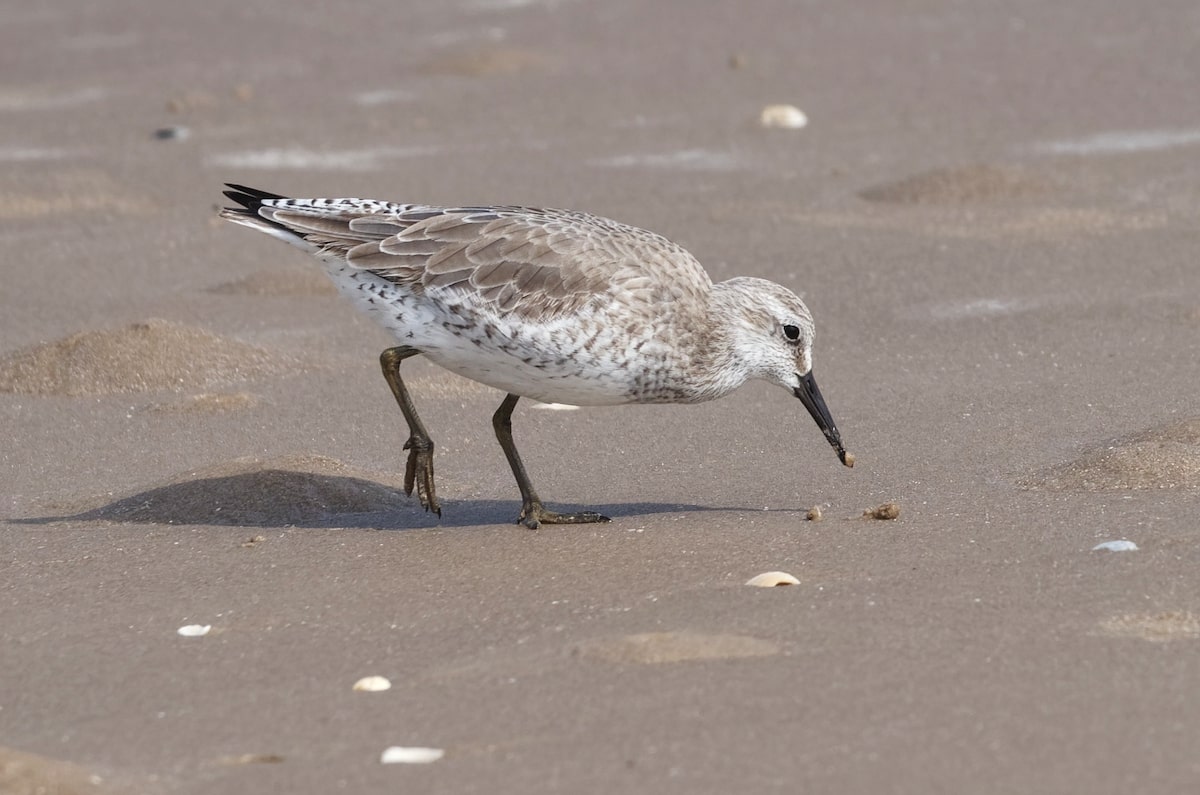
As this critical geographical gap in the Motus network is filled, migratory birds tagged outside the Caribbean are increasingly being detected at Caribbean stations and providing valuable new insights into migration routes, timing, and stopover use across the region. For example, this Red Knot—a species of conservation concern experiencing significant population declines—was one of many tagged in Argentina and later detected at a Caribbean station during its long journey to breeding grounds in the Arctic.
This Red Knot was tagged in Argentina and detected by a Motus station in Barbados while migrating back to its breeding ground in North America.
Red Knot stopping over in Barbados on its long migration. (photo by John Webster)
Tagging birds within the Caribbean allows us to better understand populations that depend on the islands for all or part of their life cycles. For migratory species, this includes information on movement patterns, stopover duration, departure decisions, and carry-over effects—how conditions in one part of the bird’s life cycle (such as the quality of non-breeding habitat) influence its health, survival, and breeding success later on. Motus tracking is being used to study overwintering populations of species of conservation concern such as Bicknell’s Thrush in the Dominican Republic. Motus can also fill important knowledge gaps for resident species, including movements within and between islands, dispersal distances, and habitat use.
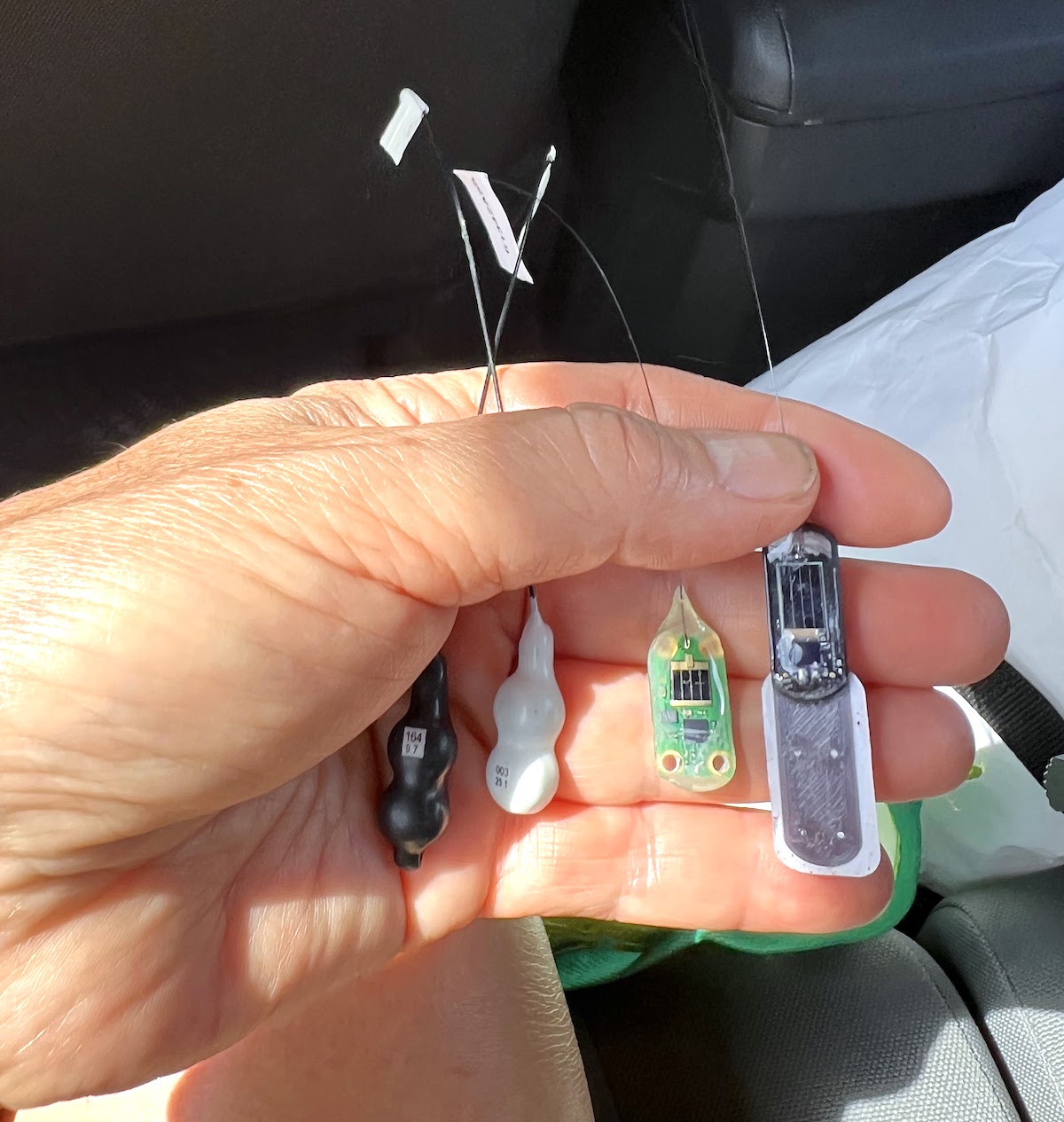
The various types of Motus tags that can be attached to animals to track their movement. (Photo by Lisa Sorenson)
New Motus stations and tagging projects are continually being developed across the region, and we are only beginning to tap into the full potential of this powerful research network. Now is the time to build regional capacity to use Motus data and contribute meaningfully to collaborative tracking efforts.
About the workshop
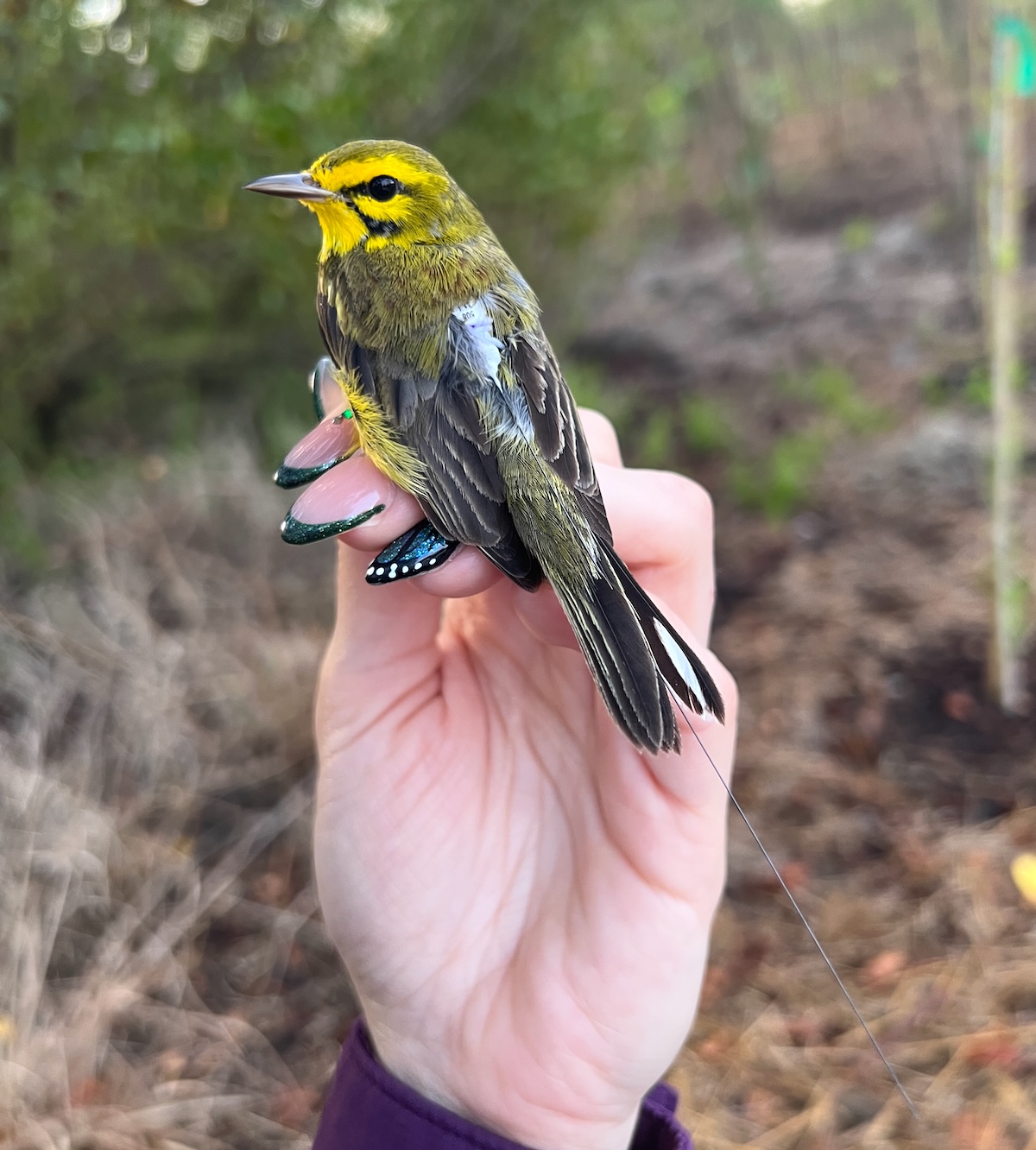
Prairie Warbler wearing a new Motus tag, attached with a leg loop harness, in Puerto Rico. (Photo by Holly Garrod)
The Motus Tagging Training Workshop workshop is designed for Caribbean wildlife professionals who are interested in actively participating in Motus research on birds in the insular Caribbean, and have the capacity to apply this training through ongoing or planned projects.
This bilingual (English/Spanish) workshop will focus on tagging landbirds, with an emphasis on passerines. We hope to provide training opportunities for other bird groups in the future.
The workshop will provide hands-on training in:
Safely attaching Motus tags using approved harness methods
Activating tags in the field
Deploying tags within projects on the Motus network
Data management and best practices for collaborative tracking studies.
Because tag attachment requires careful handling and manipulation of birds in the hand, prior experience withbird handling and banding (particularly passerines) is required.
Who should apply?
This workshop is best suited for wildlife professionals, researchers, and conservation practitioners who are:
Based in the insular Caribbean (especially in Puerto Rico and the U.S. Virgin Islands)
Actively involved in existing or planned Motus projects, or have a clear pathway to becoming involved
Experienced with bird banding and handling, especially with passerines (priority will be given to applicants who have handled 300+ birds)
Committed to applying this training as well as networking with the Caribbean conservation community to support long-term research and conservation in the region
Funding and logistics
We anticipate selecting approximately 15 participants. BirdsCaribbean has funding available for a limited number of need and merit-based scholarships to help cover travel and participation costs. Applicants who are able to cover part or all of their costs help us to include additional participants, but financial ability will not determine selection.
Participants should plan to arrive in Puerto Rico by 1 March and depart on 7 March, 2026.
How to apply
If you are interested in participating, please complete the application form by 20 January 2026.
Oportunidad de capacitación: Taller de etiquetado Motus
El programa Caribbean Motus Collaboration de BirdsCaribbean se complace en invitar a presentar solicitudes para un taller de formación sobre el marcado con Motus de 5 días de duración. En colaboración con el Departamento de Recursos Naturales y Ambientales de Puerto Rico, esta formación práctica se llevará a cabo en la Reserva Nacional de Investigación Estuarina de la Bahía de Jobos, en Salinas, Puerto Rico, del 2 al 6 de marzo de 2026.
¿Qué es Motus?
El sistema de seguimiento de fauna silvestre Motus es una red de investigación colaborativa global que utiliza telemetría automática por radio para rastrear los movimientos de pequeños animales. La red está gestionada de forma centralizada por Birds Canada (motus.org) y consta de miles de estaciones receptoras en todo el mundo que detectan a los animales marcados a medida que se desplazan por el terreno.
Cuando se puso en marcha la Colaboración Motus del Caribe (CMC) en 2021, no había estaciones receptoras Motus permanentes en el Caribe insular. Gracias a los esfuerzos de muchos socios regionales e internacionales, la red Motus del Caribe está creciendo rápidamente: ahora hay 24 estaciones activas en la región, ¡y hay planes para muchas más!
¿Por qué necesitamos marcar aves en el Caribe?
A medida que se va llenando este vacío geográfico crítico en la red Motus, las aves migratorias marcadas fuera del Caribe se detectan cada vez más en las estaciones caribeñas y proporcionan nuevos y valiosos conocimientos sobre las rutas migratorias, los tiempos y el uso de las escalas en toda la región. Por ejemplo, este Calidrus canutus, una especie de interés para la conservación que está experimentando un importante descenso de su población, fue uno de los muchos marcados en Argentina y posteriormente detectados en una estación caribeña durante su largo viaje hacia las zonas de reproducción en el Ártico.
El marcado de aves en el Caribe nos permite comprender mejor las poblaciones que dependen de las islas durante todo o parte de su ciclo de vida. En el caso de las especies migratorias, esto incluye información sobre los patrones de movimiento, la duración de las escalas, las decisiones de partida y los efectos de arrastre, es decir, cómo las condiciones en una parte del ciclo de vida de las aves (como la calidad del hábitat no reproductivo) influyen en su salud, supervivencia y éxito reproductivo posterior. El seguimiento con Motus se está utilizando para estudiar las poblaciones invernantes de especies de interés para la conservación, como Catharus bicknellien la República Dominicana. Motus también puede llenar importantes lagunas de conocimiento sobre las especies residentes, incluidos los movimientos dentro y entre las islas, las distancias de dispersión y el uso del hábitat.
Se están desarrollando continuamente nuevas estaciones Motus y proyectos de marcado en toda la región, y apenas estamos empezando a aprovechar todo el potencial de esta potente red de investigación. Ahora es el momento de desarrollar la capacidad regional para utilizar los datos de Motus y contribuir de manera significativa a los esfuerzos de seguimiento colaborativo.
Acerca del taller
El taller de formación sobre el marcado con Motus está diseñado para profesionales de la fauna silvestre del Caribe que estén interesados en participar activamente en la investigación de Motus sobre las aves en el Caribe insular y que tengan la capacidad de aplicar esta formación a través de proyectos en curso o previstos.
Este taller bilingüe (inglés/español) se centrará en el marcado de aves terrestres, con especial énfasis en los paseriformes. Esperamos poder ofrecer oportunidades de formación para otros grupos de aves en el futuro.
El taller proporcionará formación práctica sobre:
La colocación segura de etiquetas Motus utilizando métodos de arnés aprobados.
La activación de etiquetas sobre el terreno.
El despliegue de etiquetas en proyectos de la red Motus.
La gestión de datos y las mejores prácticas para estudios de seguimiento colaborativos.
Dado que la colocación de las etiquetas requiere un manejo cuidadoso de las aves en la mano, se requiere experiencia previa en el manejo y anillamiento de aves (en particular paseriformes).
¿Quiénes pueden inscribirse?
Este taller es ideal para profesionales de la vida silvestre, investigadores y conservacionistas que:
Residan en el Caribe insular (especialmente en Puerto Rico y las Islas Vírgenes de los Estados Unidos).
Participen activamente en proyectos Motus existentes o previstos, o tengan una vía clara para participar.
Tengan experiencia en el anillamiento y manejo de aves, especialmente de paseriformes (se dará prioridad a los solicitantes que hayan manejado más de 300 aves).
Estén comprometidos con la aplicación de esta formación, así como con la creación de redes con la comunidad conservacionista del Caribe para apoyar la investigación y la conservación a largo plazo en la región.
Financiación y logística
Prevemos seleccionar aproximadamente 15 participantes. BirdsCaribbean dispone de fondos para un número limitado de becas basadas en las necesidades y los méritos, con el fin de ayudar a cubrir los gastos de viaje y participación. Los solicitantes que puedan cubrir parte o la totalidad de sus gastos nos ayudan a incluir a más participantes, pero la capacidad financiera no determinará la selección.
Los participantes deben planificar su llegada a Puerto Rico antes del 1 de marzo y su salida el 7 de marzo de 2026.
Solicitudes
Si estás interesado en participar en este taller, llena este formulario antes del 20 de enero de 2026.
Grenada Dove—endemic to Grenada and Critically Endangered. The cinnamon-brown plumage and white stripe in front of the wing are key field marks to distinguish the Grenada Dove from other dove species on the island. (Photo by Arthur Daniel)
Just after sunrise, the dry forest of Mt. Hartman stirs to life with rustling leaves and, if you’re lucky, the soft, descending “hoooo” of the Grenada Dove. But that call is heard less and less each year. With its habitat shrinking and predators encroaching, Grenada’s national bird is hanging by a thread. Determined to change the dove’s fate, conservationists, government agencies, and community groups gathered this October for a workshop focused on creating a unified plan to protect the species and its last remaining habitat. Read on to find out what’s being done—and what still must happen— to secure a future for this iconic bird.
The Grenada Dove (Leptotila wellsi)—a shy, cinnamon-brown Critically Endangered national bird of Grenada—is perilously close to extinction. Fewer than 200 individuals remain, confined to just two pockets of dry forest on the island’s southwest and west coasts. Habitat loss, development pressure, invasive predators, and gaps in policy and enforcement continue to erode the species’ last refuges. Without decisive action, this iconic species could disappear forever.
A species on the brink
The most recent island-wide survey (2013) estimated the population at around 160 birds (range: 107–229), a level that has remained dangerously low since surveys began in the mid-1980s. The dove now survives in just two small areas: dry forest on the southwest coast (Mt. Hartman Estate, Petit Bouc, Woodlands, Lower Woburn) and on the west coast (Perseverance, Woodford, Beausejour, Grenville Vale Estates, and Black Bay). Once connected, these populations are now separated by nearly 9 km of urban development, including the capital, St. George’s. Mt. Hartman National Park has long supported nearly half of all remaining birds.
In 1996, the government legally established Mt. Hartman National Park and the Perseverance Dove Sanctuary. Management by the Forestry and National Parks Department has included patrols, boundary maintenance, rubbish removal, signage, and predator control. These efforts have reduced some local threats, but the protected areas cover less than 10% of the dove’s remaining range—leaving the species highly vulnerable to ongoing habitat loss and degradation.
Sign pointing the way to the Mt Hartman Dove Sanctuary.
The now defunct Mt. Hartman Visitor Centre at Mt. Hartman National Park.
Damaged bird sign at Mt. Hartman National Park Visitor Centre., Grenada.
Illegal dumping of rubbish at Mt. Hartman National Park and Dove Sanctuary..
Habitat destruction at Mt. Hartman.
Despite two previous recovery and action plans and a management plan for the Perseverance–Beausejour area, progress has been slow. Habitat at Mt. Hartman continues to be lost to development—sometimes even within areas assumed to be protected. Predator-control programs have been suspended due to staffing and funding shortages, allowing mongoose populations to surge. The dove’s limited genetic diversity, driven by its small population size, raises further concerns about long-term resilience and disease vulnerability.
Bringing stakeholders together
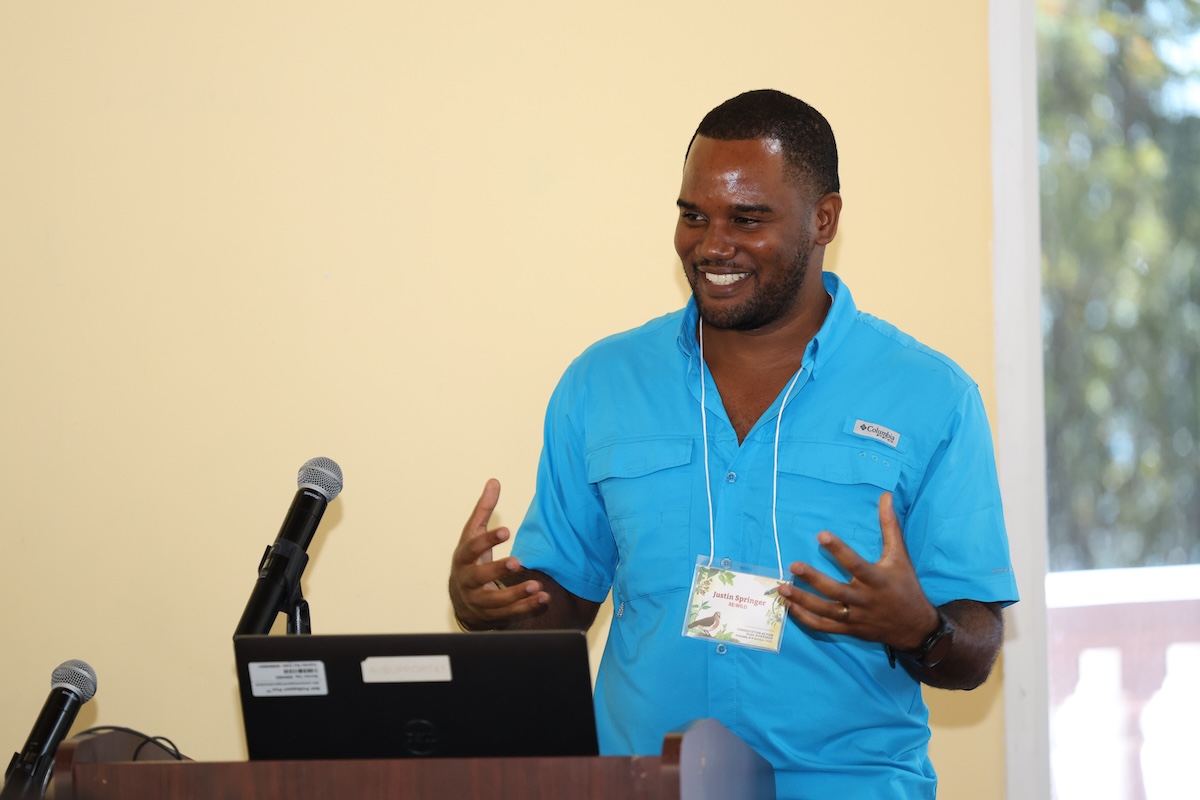
Workshop facilitator, Justin Springer, Re:Wild, introduces the agenda for our two days of workshop activities.
In response to this escalating crisis, more than 70 local and international experts, community members, conservation practitioners, government officials, and academics gathered in-person and online on October 8–9, 2025, for the Grenada Dove Conservation Action Planning (CAP) Workshop at St. George’s University. Organized by the Gaea Conservation Network and supported by American Bird Conservancy, BirdsCaribbean, and Re:wild, the workshop united diverse voices to assess threats, identify solutions, and chart a coordinated path forward for the dove’s recovery.
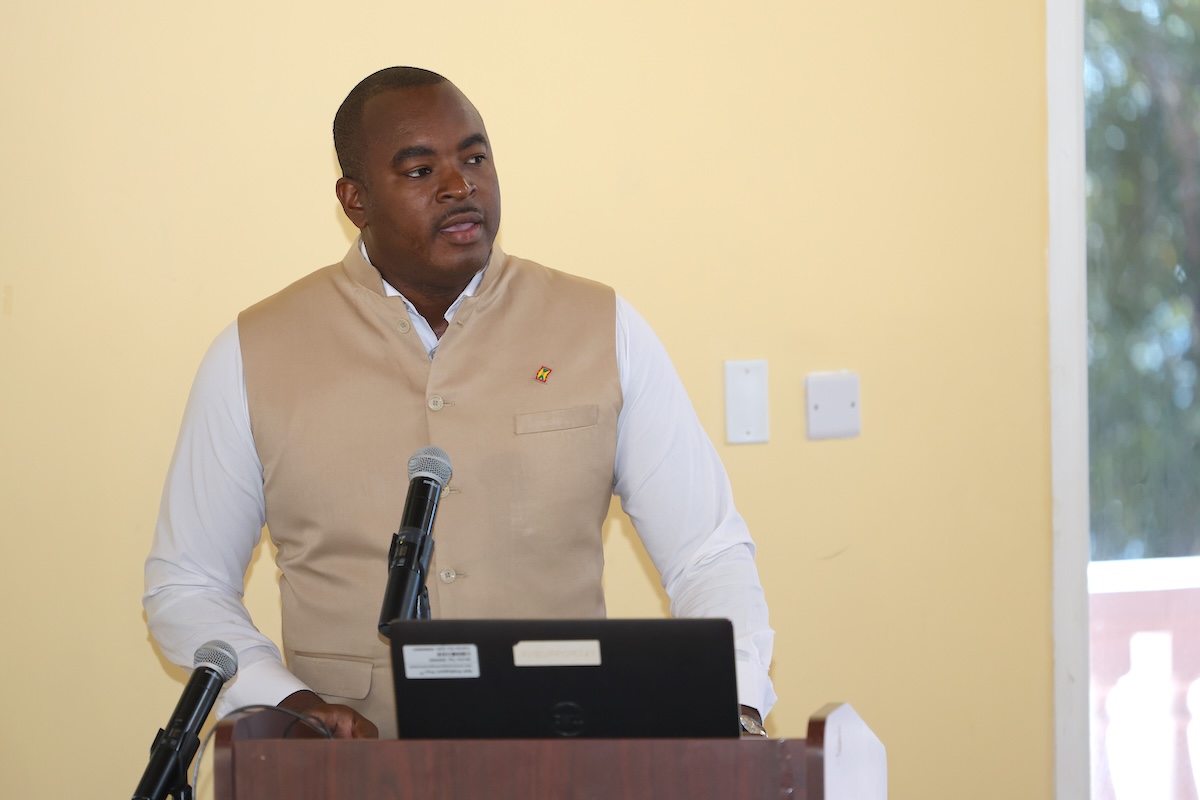
Honorable Andy Williams, Minister of Mobilization, Implementation, and Transformation, Parliamentary Representative for St. George South, gives Opening Remarks.
Wayne Smart, Executive Director of Gaea Conservation Inc. welcomes participants to the workshop.
Dr. Cristofre Martin, St. George’s University, gives his Opening Remarks at the workshop.
Dr. Patricia Rose giving her Opening Remarks at the workshop.
Ms. Aria St Louis, from the Ministry of Climate Resilience, the Environment, & Renewable Energy gives her Opening Remarks at the workshp.
Dr. Lisa Sorenson, Executive Director, BirdsCaribbean gives an opening presentation “Setting the Stage: Grenada Dove Conservation Challenges”
Participants included representatives from the Ministry of Climate Resilience, Forestry and National Parks Department, Grenada Fund for Conservation, Grenada Sustainable Development Trust Fund, Planning and Development Authority, Grenada Solid Waste Management Authority, St. George’s University, The Nature Conservancy, American Bird Conservancy, Re:wild, Fauna & Flora International, community and youth organizations.
Dillon Palmer, Grenada Forestry Department, talks about the Grenada Dove’s habitats, protection status, and current management challenges, including a lack of staff and resources to monitor and carry out predator control.
Facilitator Zoya Buckmire, Grenada Fund for Conservation, leads the icebreaker participant introduction activity.
Veterinarian, Dr. Kenrith Carter, has expertise in trapping invasive mongoose and will be leading trapping efforts on the island in 2026.
Jody Daniel, a Grenadian living near the island’s landfill adjacent to the Perseverance Dove Sanctuary talks about the issues caused by the dump.
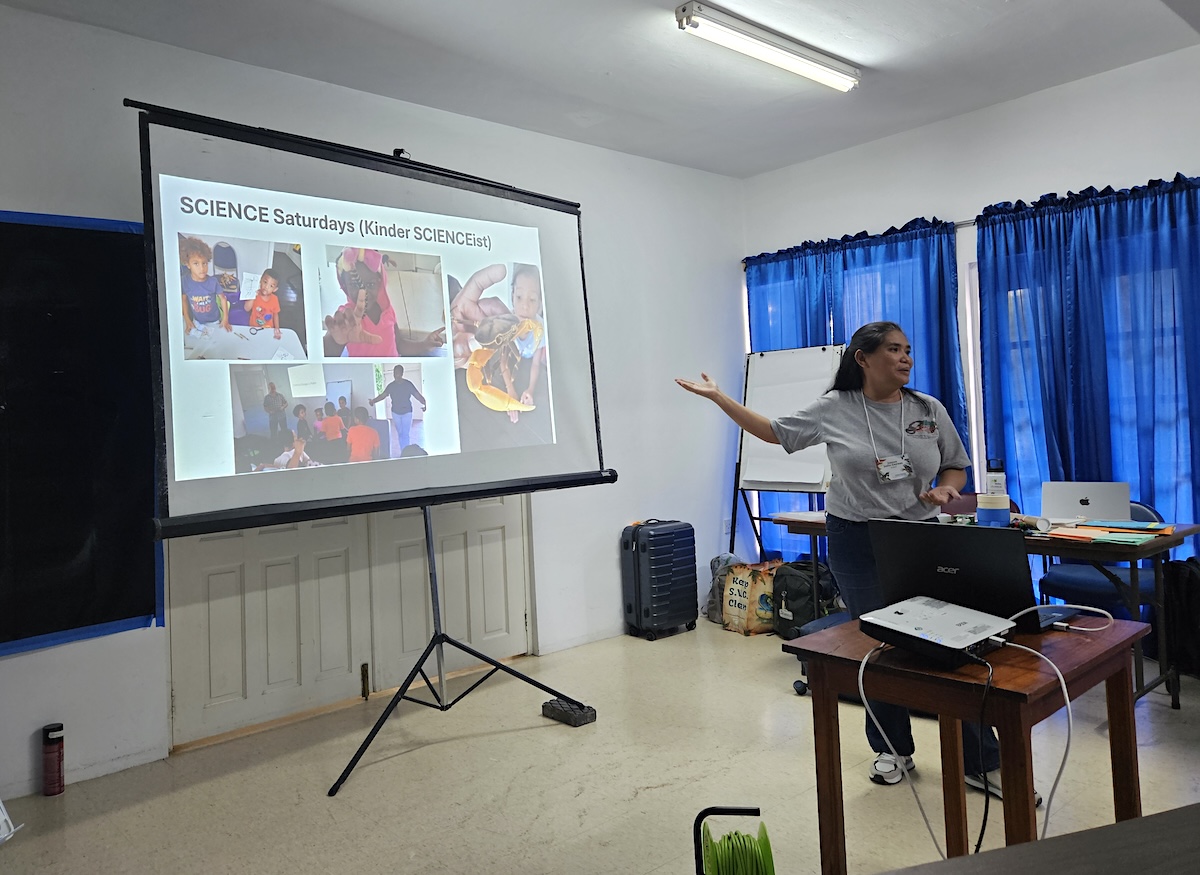
Betty-Ann Lazarus shares about her experiences carrying out a Grenada Dove education campaign with Bonnie Rusk (Grenada Dove Conservation Programme) many years ago.
The breadth of participation reflected the growing national concern for the species’ fate.
A moral responsibility to protect the Grenada Dove
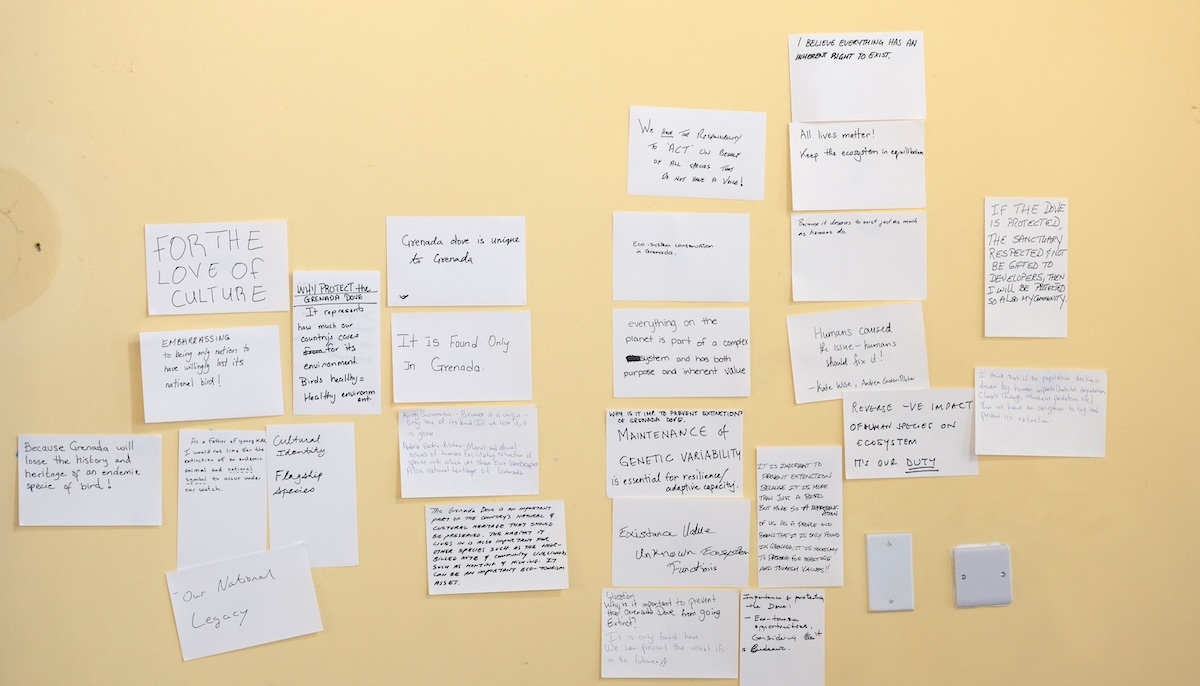
To frame the discussion, facilitator Justin Spring invited participants to answer one question: Why should we save the Grenada Dove? Their answers—rooted in ethics, ecology, heritage, and national pride—set a powerful tone for the workshop. Many emphasized the moral obligation to protect a species imperiled by human activity. “We have the responsibility to act on behalf of all species that do not have a voice,” and “Humans caused the problem – humans should fix it.”
Each participant shared why conserving the Grenada Dove is important.
Others spoke about the dove’s ecological role, its cultural and economic value, and the responsibility to future generations not to allow an endemic species and national symbol to disappear. “Everything on the planet is part of a complex system and has both purpose and inherent value,” and “It is important to prevent extinction because it is more than just a bird, but more so a representation of us as a people and being that it is only found in Grenada, it is necessary to preserve it for heritage and tourism values,” and “As a father of young kids, I would not like for the extinction of an endemic animal and national symbol to occur under our watch.”
The ecological, cultural and economical importance of the Grenada Dove highlighted by participants.
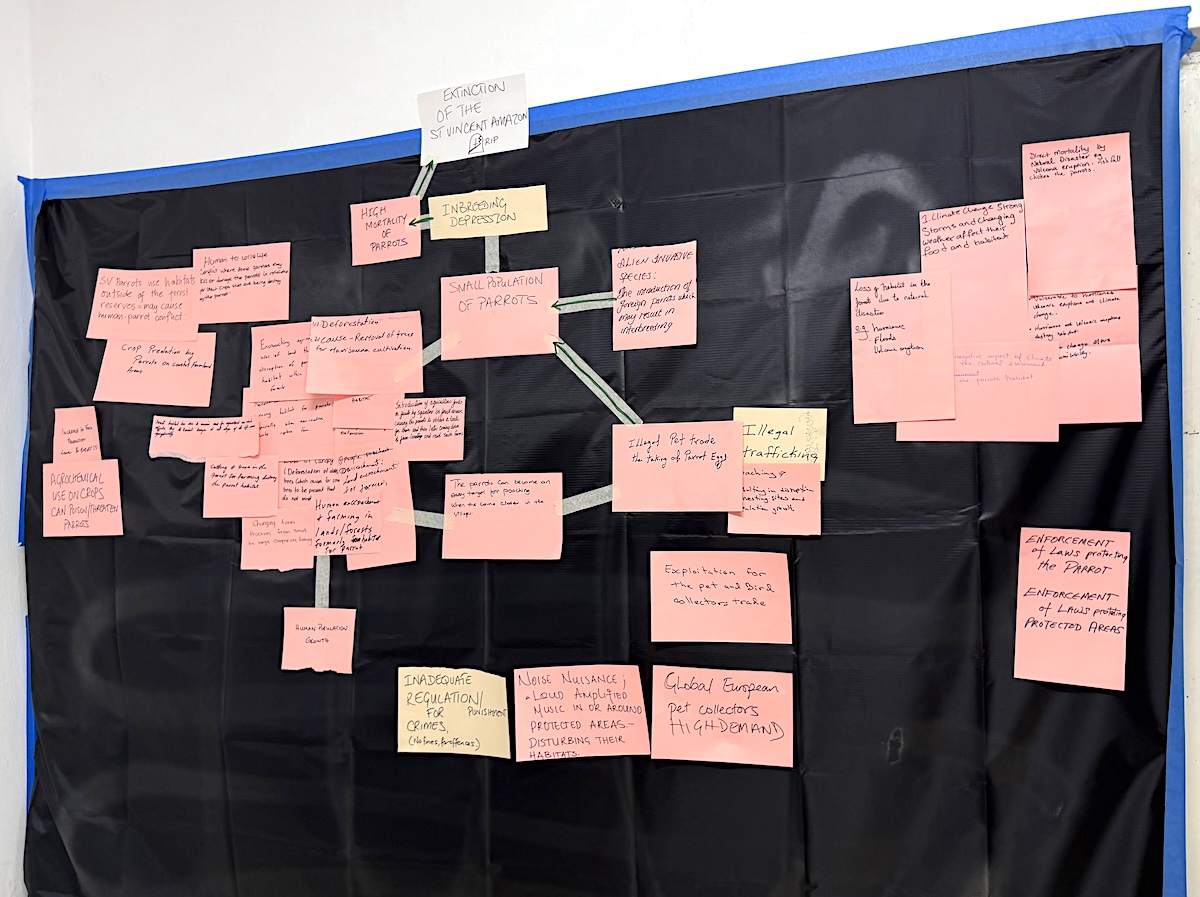
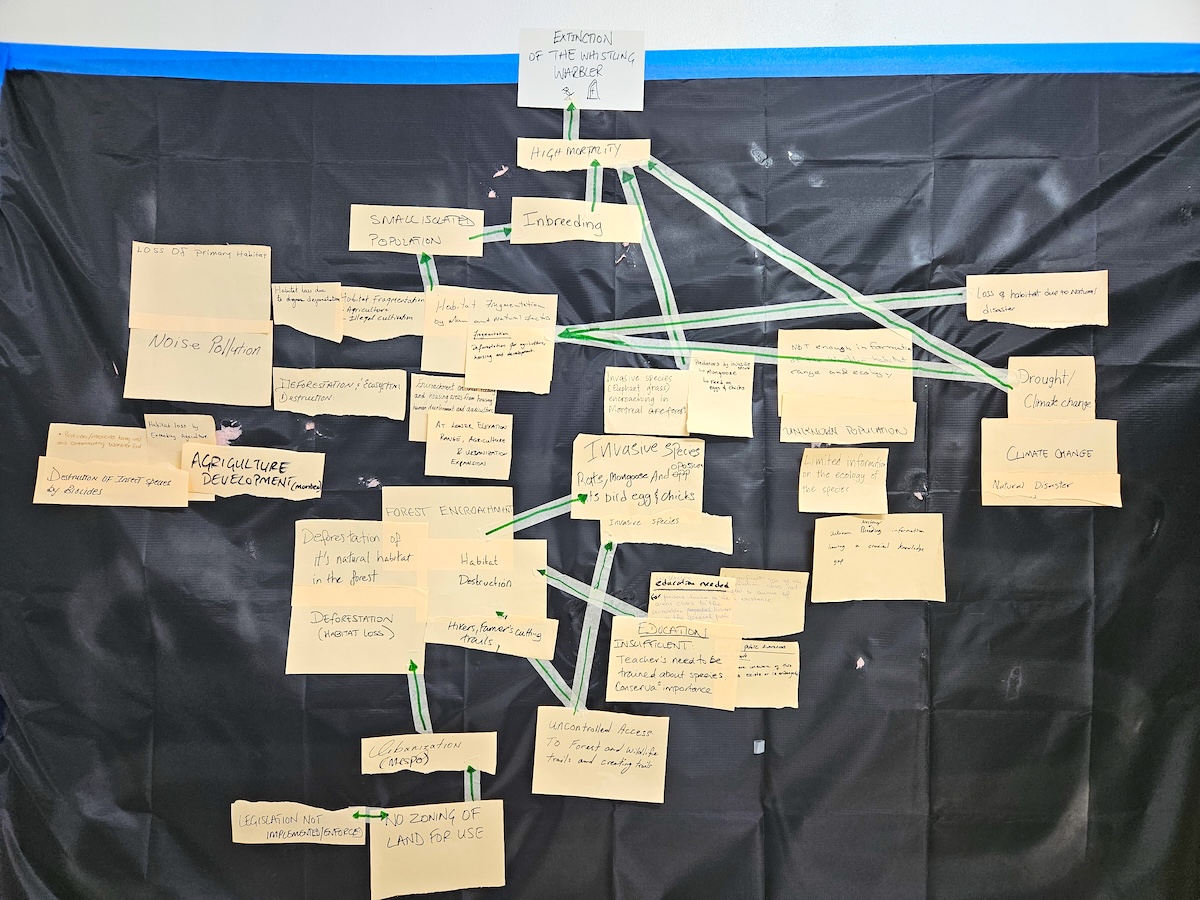
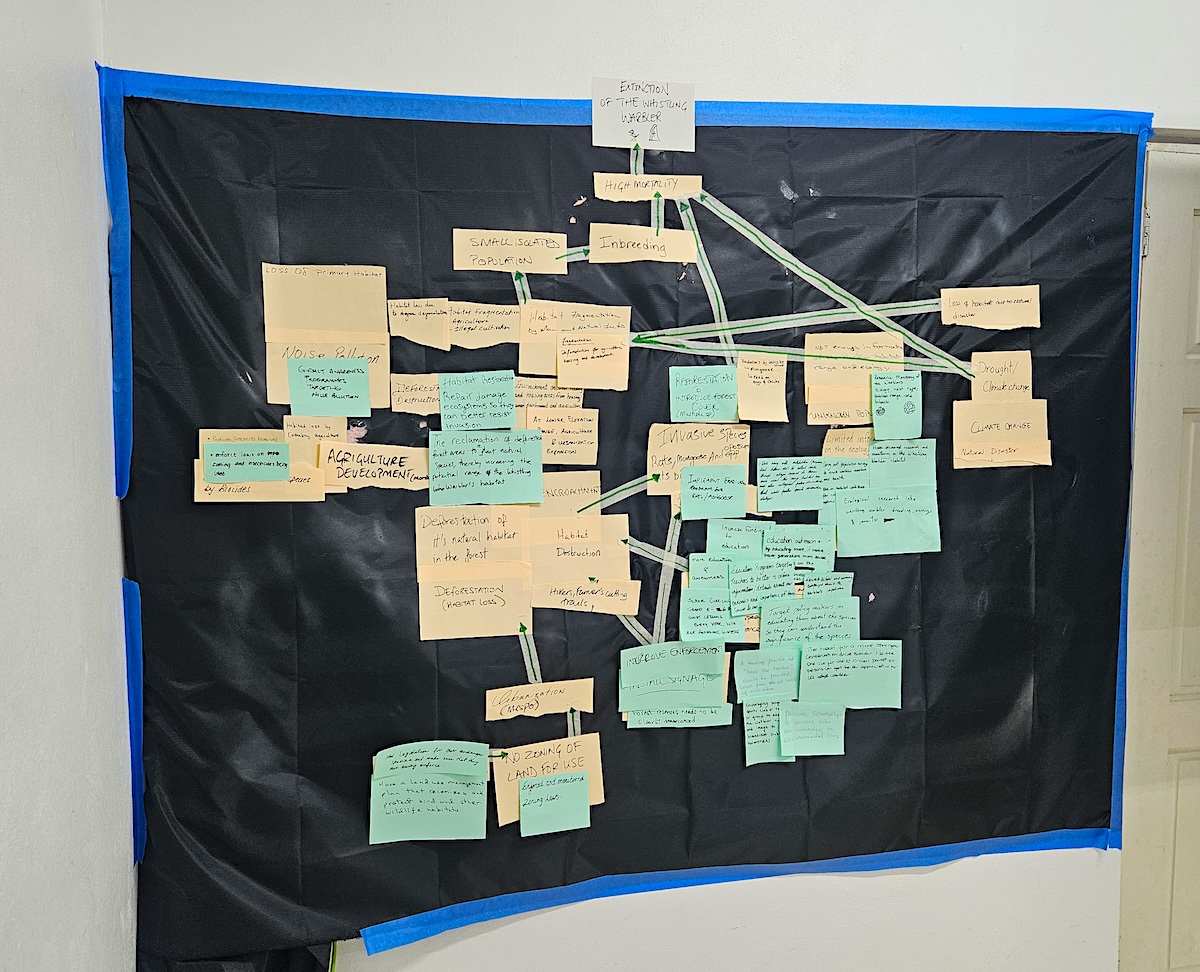
After a grounding session by Dr. Jody Daniel, President of Gaea Conservation Network, on dove ecology which covered identification, habitat needs, and current population status, participants engaged in a dynamic Fuzzy Cognitive Mapping (FCM) exercise. This visual, interactive tool helped stakeholders explore how threats overlap, amplify one another, and ultimately drive the species toward extinction.
Dr. Jody Daniel explains how environmental threats interact. (Photos by Gaea Conservation)
Major threats identified
Habitat Loss and Degradation emerged as the most urgent threat. Land sales within Mt. Hartman, unclear boundaries, unregulated development, quarrying, illegal dumping, farming, and cattle grazing continue to shrink and fragment dove habitat. The Perseverance Sanctuary is impacted by its proximity to the national landfill, including boundary encroachment and toxic fumes from persistent landfill fires.
Invasive Predators—particularly the small Indian mongoose—pose a major threat to eggs, chicks, and adults. Cats and rats add further pressure. Without consistent predator control, predation remains dangerously high.
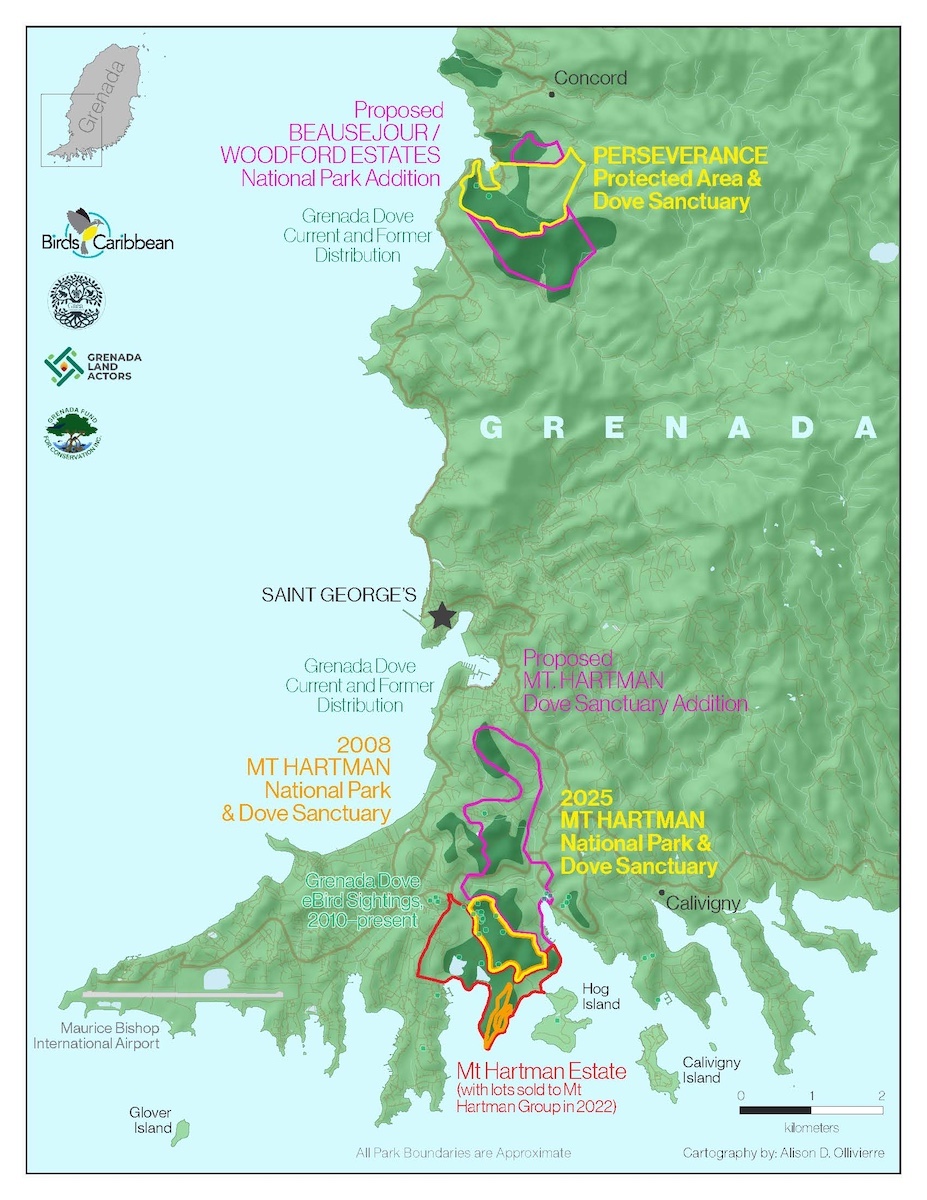
Map of southwest Grenada showing the current and former distribution of the Grenada Dove and current (approximate) and proposed Protected Areas. Note that part of the dove’s habitat and national park were sold to a developer in 2022 (outlined in red) and habitat destruction and development are ongoing. (cartography by Alison D. Ollivierre)
Lack of Enforcement and Policy Gaps were identified as a critical barrier. Although protections exist, they are not being enforced, and boundaries of Mt. Hartman National Park have become unclear—especially after the sale of part of the park in 2022 for resort development, a decision that shocked conservationists and the public. There is concern that even more of the land will be sold. Participants stressed the need for transparency, accountability, and public engagement to prevent further losses.
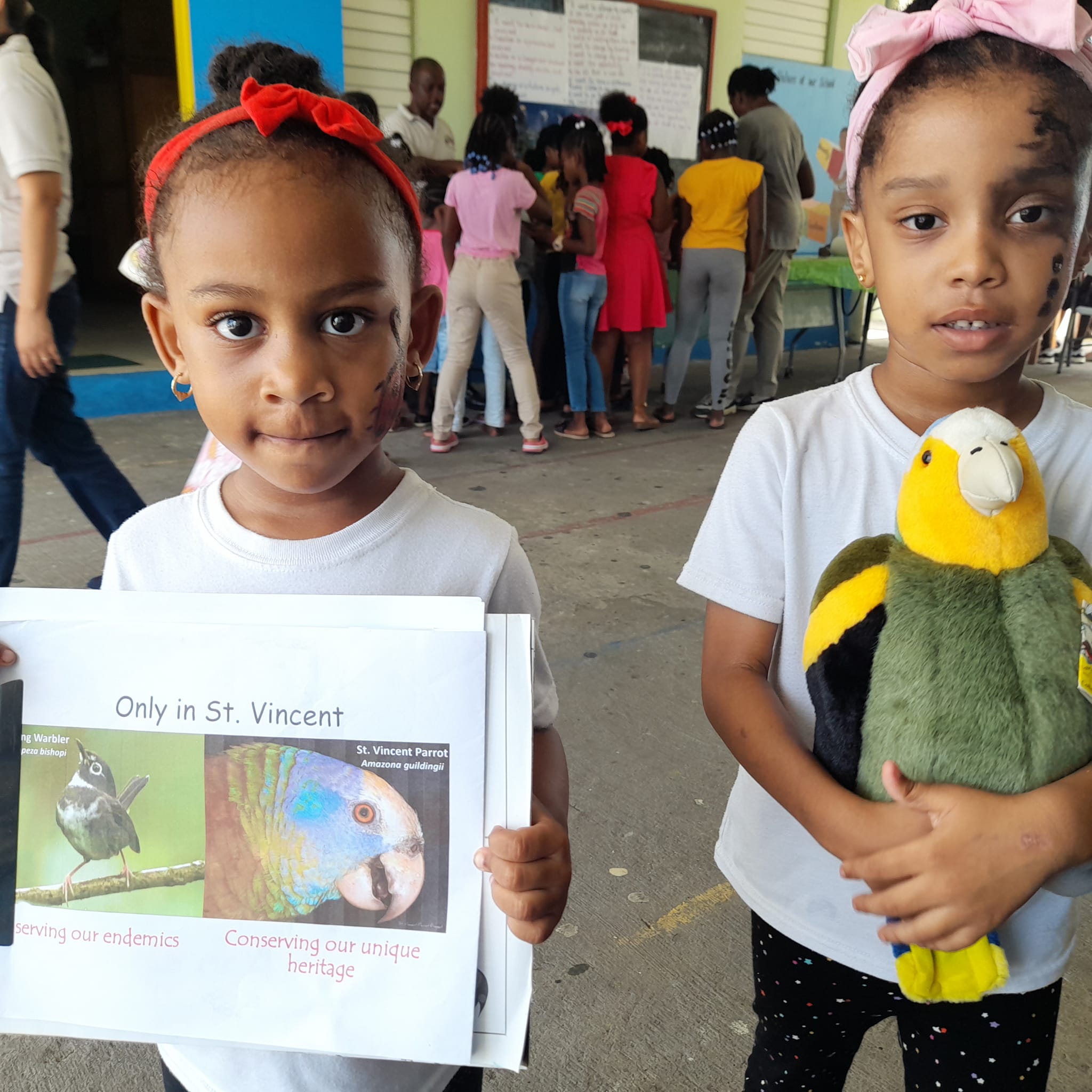
Limited Public Awareness about the Grenada Dove and it’s Critically Endangered status was flagged as a serious threat. Participants agreed that it was vital to educate youth and communities to foster pride and stewardship—to help secure the future of the Grenada Dove.
Climate change and extreme weather was identified as a growing threat to the species’ survival. More frequent and severe hurricanes, fires, and periods of drought are expected to further degrade dry-forest habitat, reduce food and cover, and increase water scarcity for the dove. These escalating pressures will intensify the challenges already facing the species and make recovery even more difficult without swift, coordinated action.
Limited Monitoring and Insufficient Data—including outdated surveys and incomplete reproductive data—hinder effective conservation.
Finally, low genetic diversity due to the dove’s small population size increases vulnerability to disease and environmental change.
The Small Indian Mongoose was introduced to the West Indies to control rat populations in sugarcane plantations. (Photo by J.N Stuart)
Drone shot of unsustainable development around Mt. Hartman.
Word clouds exercise to identify the biggest threats in the Climate Change and Severe Weather category.
Top priority threats to the survival of Grenada Dove. (Photo by Gaea Conservation)
A roadmap for solutions
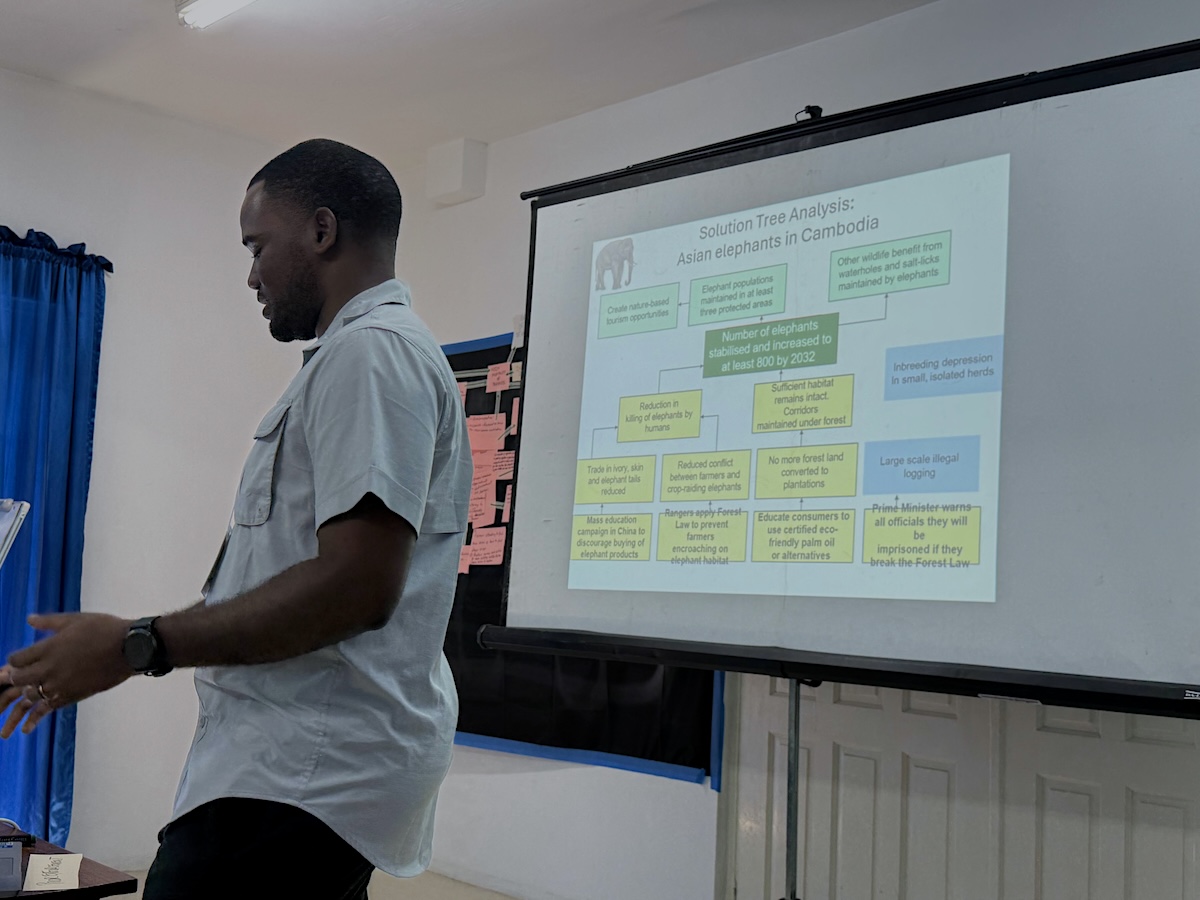
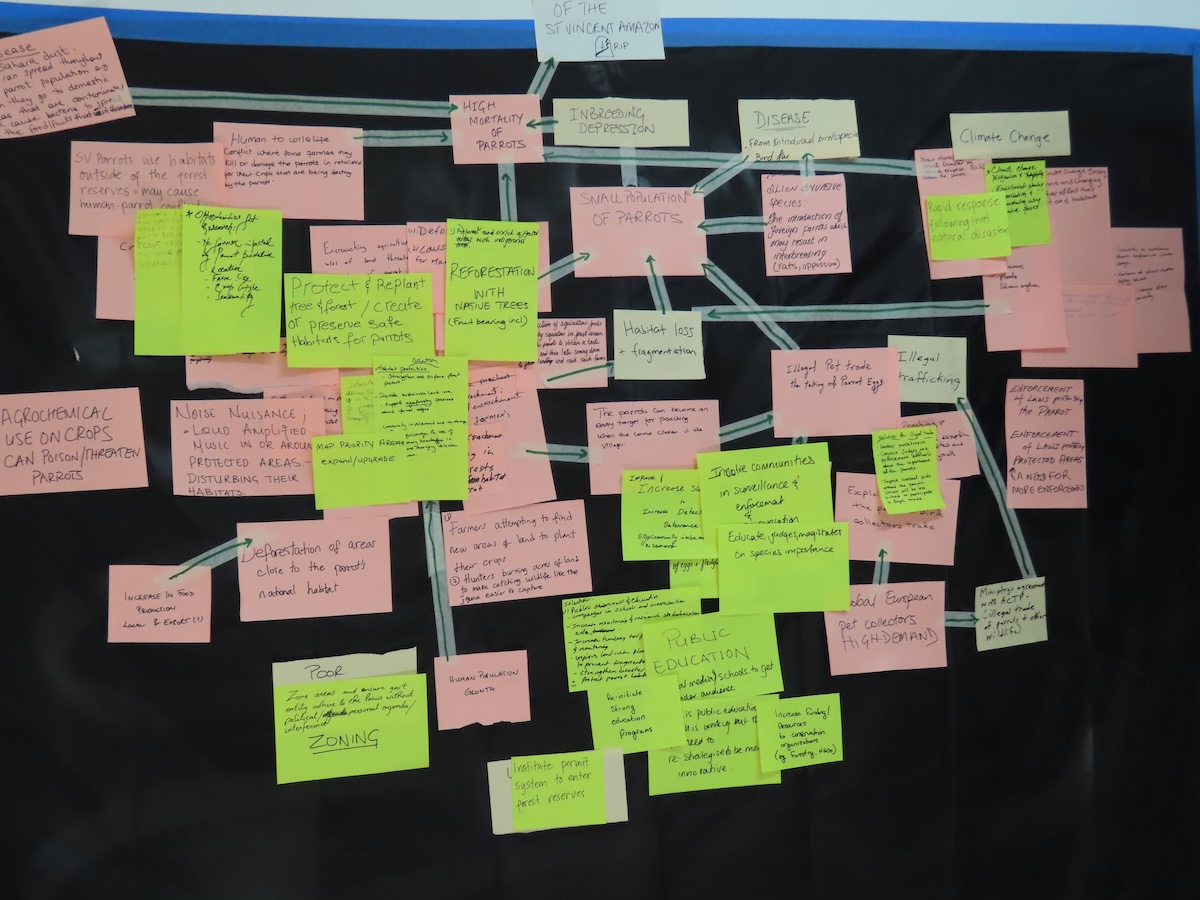
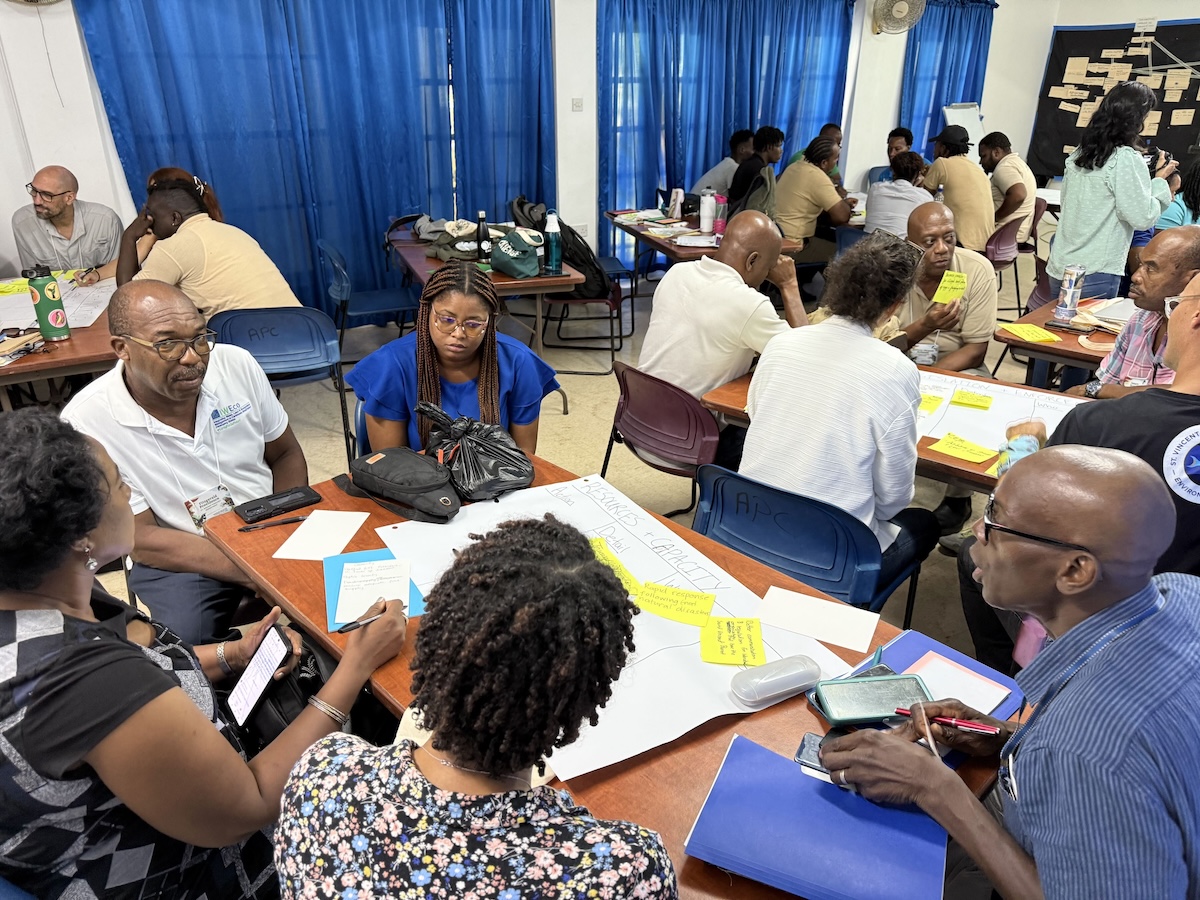
Participants then shifted to a Solutions Analysis, developing a “Solutions Tree” to match actions to each identified problem. These solutions formed the foundation of the 10-year goal, objectives, strategies, and actions of the forthcoming Grenada Dove Conservation Action Plan.
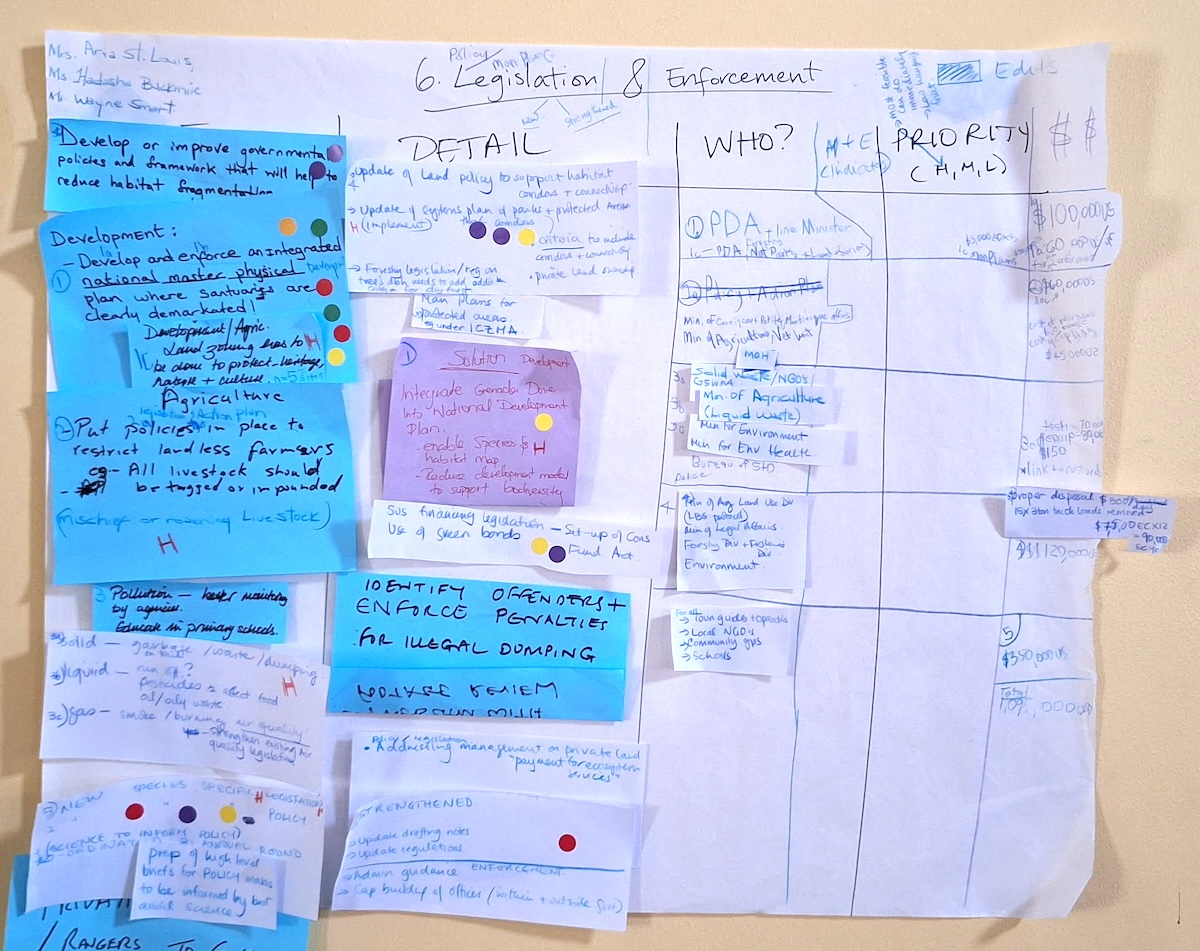
One of the highest priorities identified was improved legislation and enforcement to ensure the long-term conservation of the Grenada Dove and the protection of its habitat. Clarifying the boundaries and enforcing the protected status of Mt. Hartman National Park and the Perseverance Dove Sanctuary is essential for safeguarding remaining habitat. It’s also critical that no further dove habitat is lost to development. Participants also emphasized the need to expand protected dry-forest habitat, guided by recommendations in the Grenada Systems Plan, to increase the amount of habitat available to the dove.
Proposed actions for strengthening law and enforcement to protect the Grenada Dove. (Photo by Zoya Buckmire)
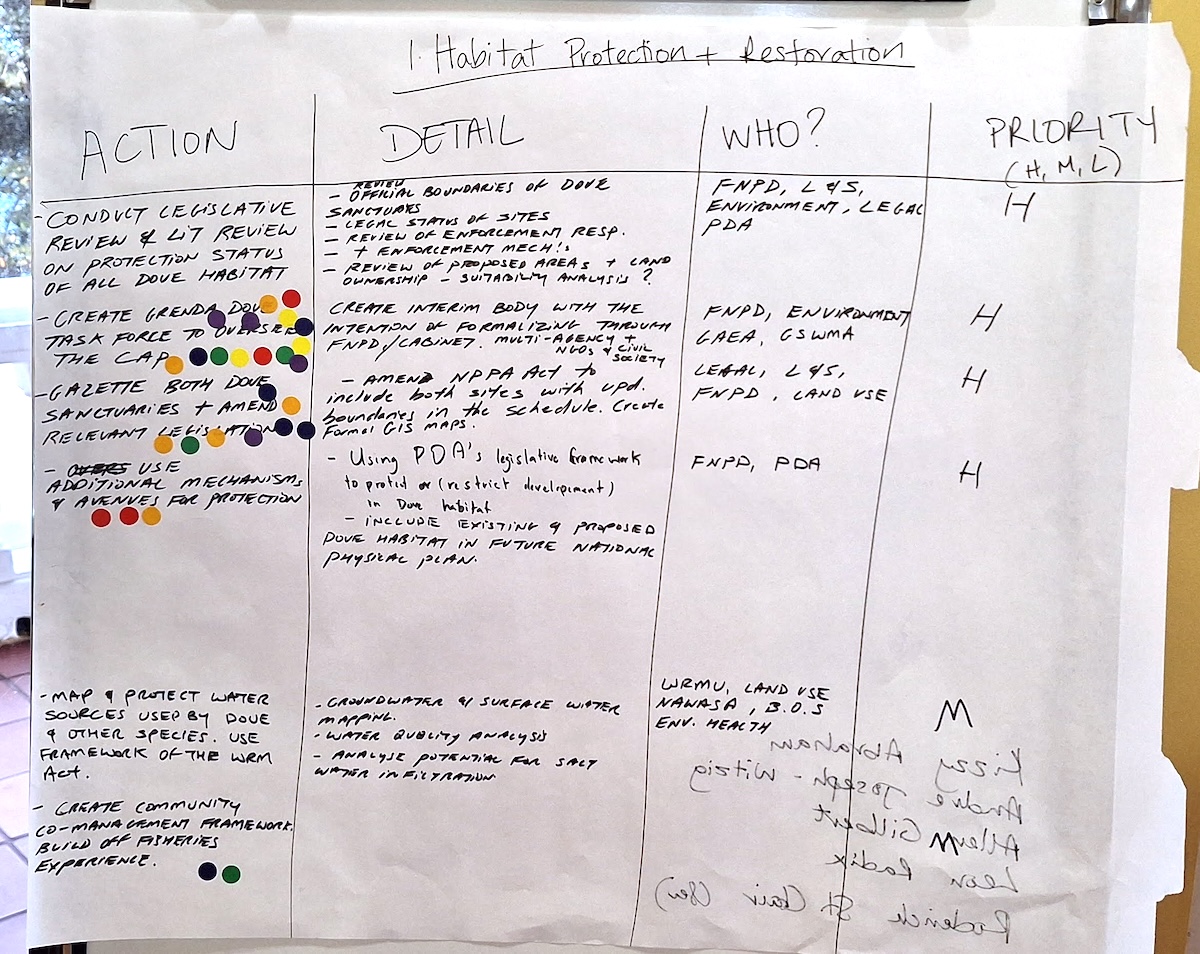
Participants proposed that by 2035, 50% of the Grenada Dove’s critical dry forest habitat is protected, restored, and effectively managed by strengthened enforcement. Restoring degraded dry forest and reconnecting fragmented patches were also key recommendations. Addressing uncontrolled grazing, illegal dumping, and unauthorized land clearing will help improve habitat quality and ecosystem resilience.
Proposed action for restoring Grenada Dove habitat. (Photo by Zoya Buckmire)
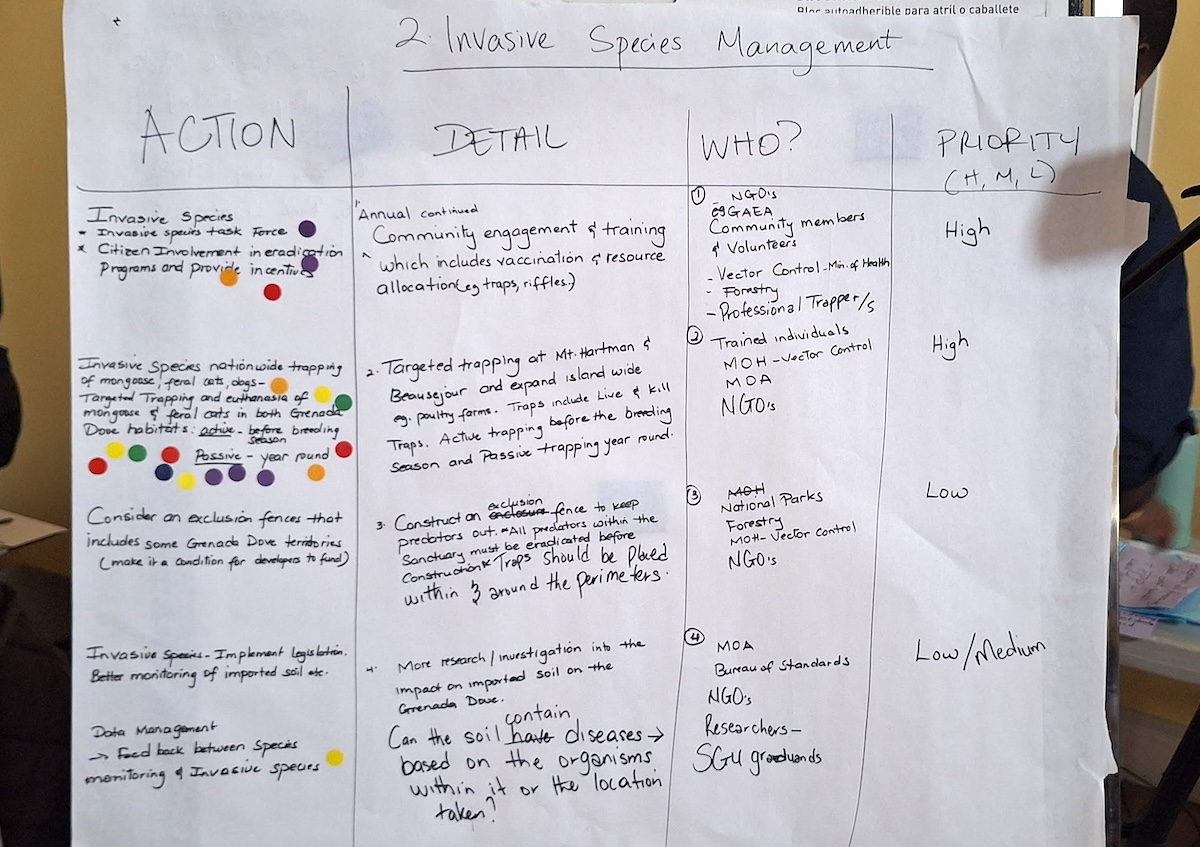
Reinstating invasive predator-control programs—particularly mongoose removal—was highlighted as essential to improving survival and reproductive success.
Proposed actions for eradicating invasive species. (Photo by Zoya Buckmire)
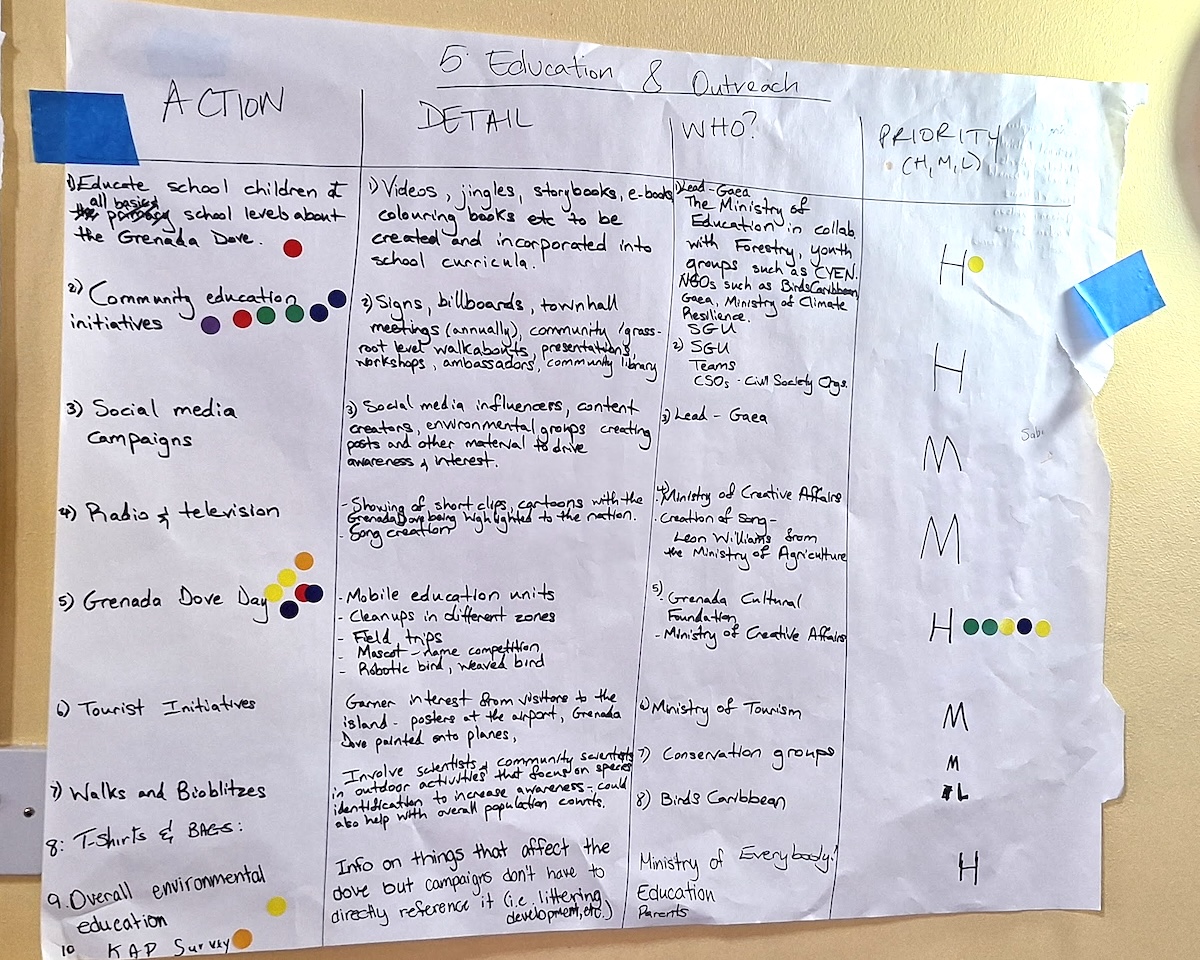
Education, empowerment, and local stewardship are essential. Participants recommended that targeted education and outreach programs should be developed to foster a culture of conservation and environmental stewardship, and to actively engage local communities, schools, and stakeholders in efforts to protect the dove and its habitat. Many community members expressed a desire to be more involved—especially youth groups eager to help protect their national bird.
Proposed actions for engaging the public. (Photo by Zoya Buckmire)
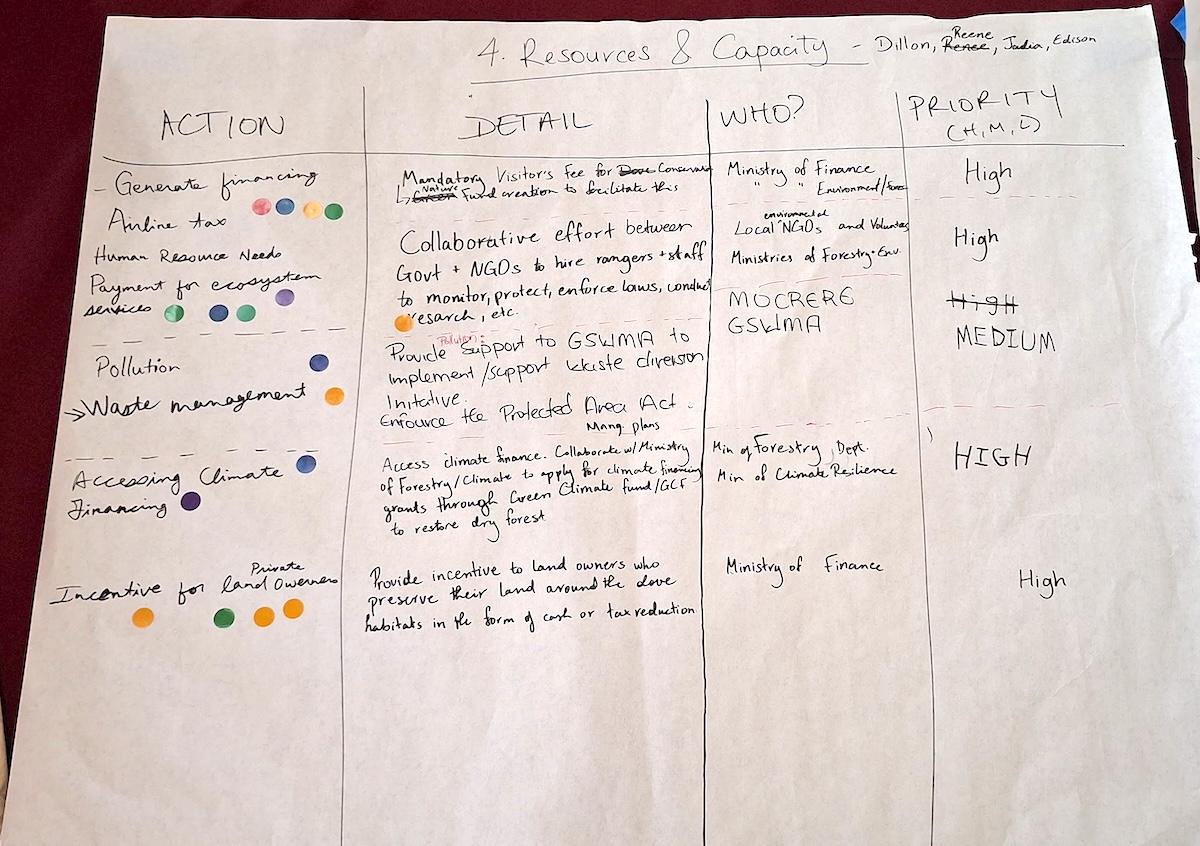
The group noted that the Forestry Dept and key public, private and civil society organizations will need to collaborate to secure the financial resources and human capacity required to conserve the Grenada Dove and its habitat.
Actions to obtain the resources and capacity to carry out the work in the CAP. (Photo by Zoya Buckmire)
Finally, participants agreed that research and long-term monitoring will be vital to the dove’s recovery. Regular population surveys, nest monitoring, and habitat-quality assessments will help conservationists track progress, assess the effectiveness of management actions, and identify emerging challenges. These data-driven approaches will support adaptive management and informed decision-making.
Proposed actions for Research and Monitoring. (Photo by Zoya Buckmire)
Participants vote with sticky dots on the highest priority actions for each objective.
A shared sense of urgency and hope
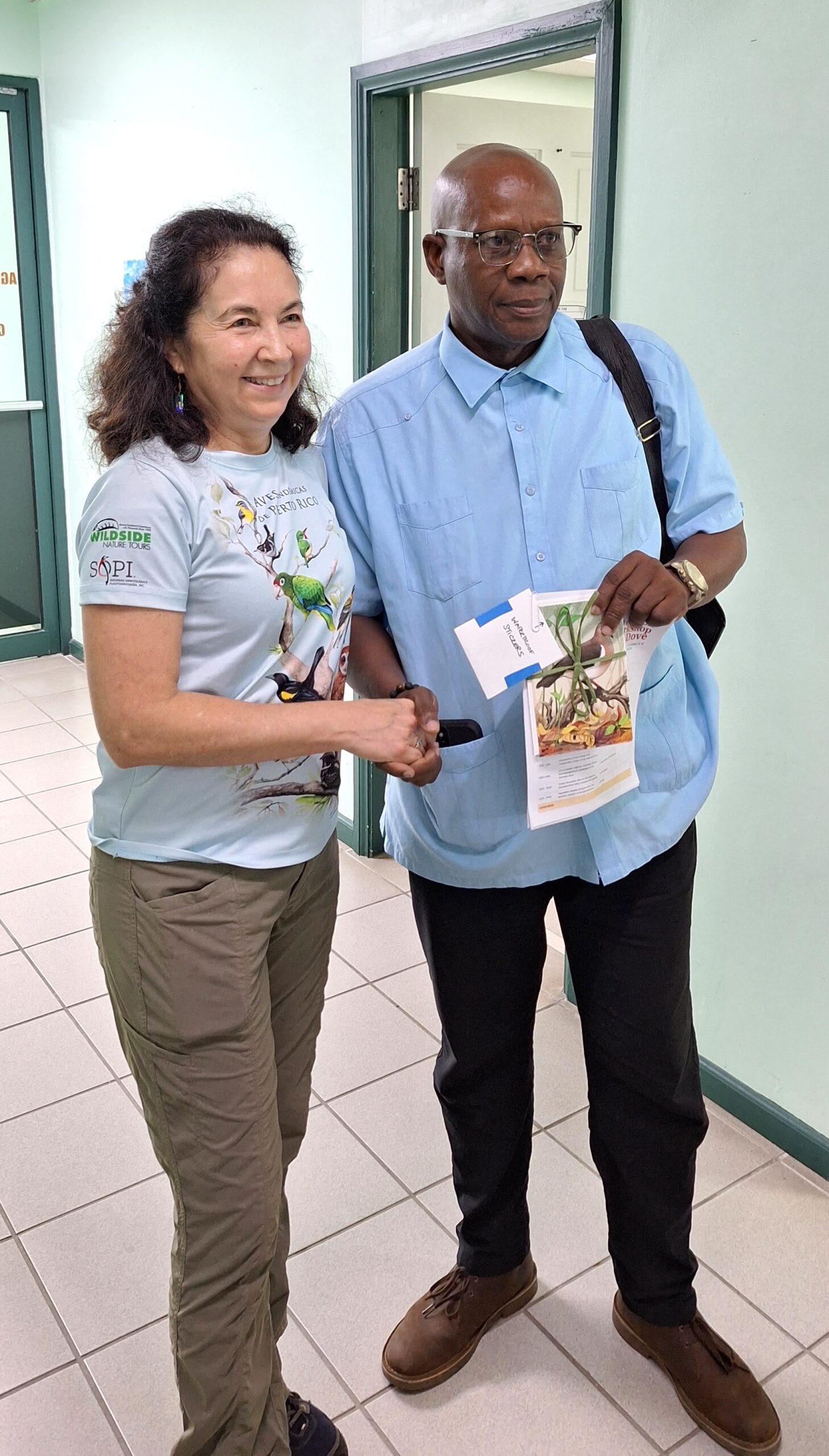
Meeting with the Honorable Lennox Andrews, Minister of Economic Development, Planning, Tourism, ICT, Creative Economy, Agriculture and Lands, Fisheries and Cooperatives to share information on the Grenada Dove CAP Workshop.
As the workshop closed, participants carried with them not only a sharper understanding of the dove’s precarious situation but also a renewed drive to act. The room was filled with a mix of urgency, excitement, and a growing sense of shared purpose—tempered by the recognition that saving the Grenada Dove will require sustained effort, collaboration, and significant resources.
As Lisa Sorenson, Executive Director of BirdsCaribbean, reminded participants: “The Grenada Dove is more than a rare bird—it’s a national treasure. Protecting it means defending the island’s dry forests, one of the most threatened ecosystems in the Caribbean.”
Jody Daniel, President of the Gaea Conservation Network, reinforced the power of partnerships: “Saving the Grenada Dove will take everyone—scientists, government, communities, and the tourism sector. We still have a chance, but only if we act decisively now.”
What comes next
A stakeholder committee—led by Gaea Conservation Network, the Ministry of Climate Resilience, Forestry and National Parks Department, BirdsCaribbean, and Re:wild—is now refining the workshop’s outcomes into a 10-year Conservation Action Plan (CAP). Once finalized and nationally endorsed, it will serve as Grenada’s roadmap for saving its national bird.
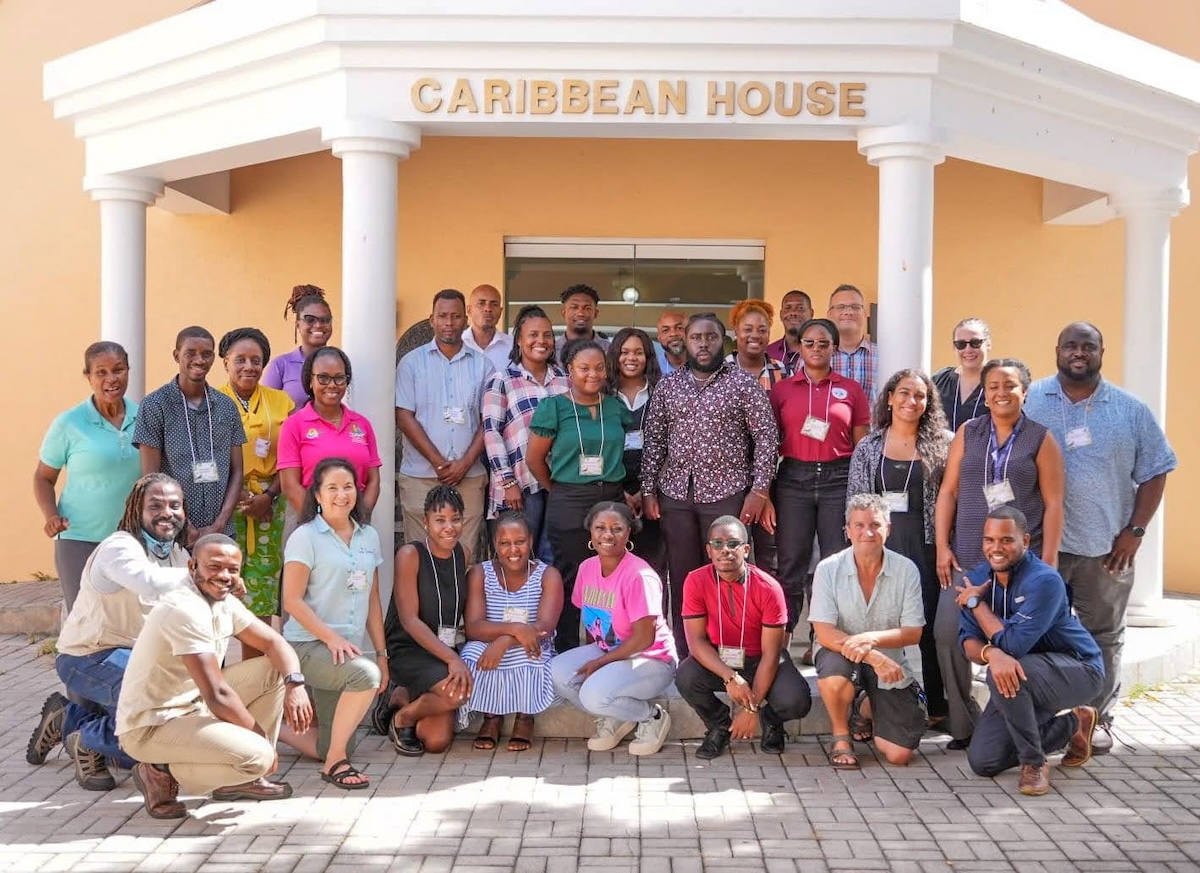
Group photo of the in-person participants at the Conservation Action Plan (CAP) Workshop for the Grenada Dove.
In the meantime, mongoose trapping will restart in January 2026, supported by the Mohammed Bin Zayed Foundation and UNDP. The committee is also working to raise funds for other high-priority actions, including education programs and monitoring to better understand current population status and reproductive ecology.
The Grenada Dove may be one of the world’s rarest birds, but its story is not yet finished. With united action, strong leadership, and community support, this gentle forest bird can still be pulled back from the brink.
Acknowledgements: The Grenada Dove Conservation Action Plan (CAP) Workshop was made possible through the generous support of our sponsors, including American Bird Conservancy, BirdsCaribbean, and Birding the Islands. The workshop organizing was led by Gaea Conservation Network, Re:Wild, Grenada Fund for Conservation Inc., St. George’s University, Fellows in Caribbean Academic Leadership, and BirdsCaribbean. We sincerely thank everyone who participated in the CAP Workshop—both in-person and online. Your time, enthusiasm, dedication, and numerous comments and insights were essential to completing the action planning process.
For updates on this and other BirdsCaribbean programs, join our mailing list. We promise to send only inspiring Caribbean bird news—no spam. Click here to sign up!
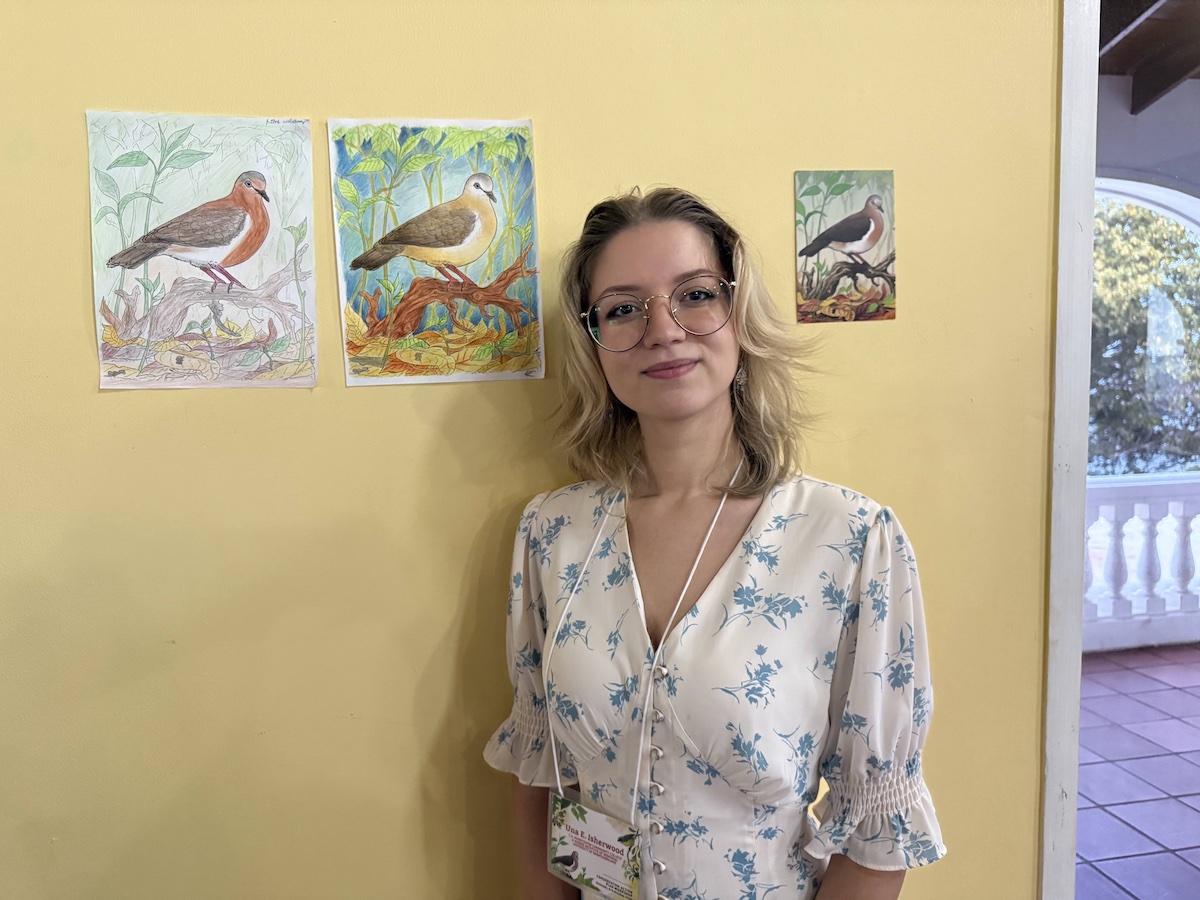
Winner of the Grenada Dove Coloring Competition! Participants enjoyed coloring in the line drawing, beautiful artwork created by the talented Cuban artist, Arnaldo Toledo.
Break out your life lists — the 66th supplement to the American Ornithological Society’s (AOS) Checklist of North and Middle American Birds, published in August 2025, brought several taxonomic changes that Caribbean birders will want to be aware of. We’re taking a closer look at the updates that matter most for our region.
Taxonomy — the science of naming and classifying organisms — is always evolving. The AOS maintains the official checklist for birds from the Arctic down to the Panama–Colombia border, including Bermuda, the West Indies, and the Hawaiian Islands. Each year, ornithologists review the list and evaluate proposals for taxonomic revisions.
Usually, the most attention-grabbing changes involve species level shifts: “splits,” where one wide-ranging species is divided into two or more localized ones; or “lumps,” where similar species are combined. But in this supplement, many changes affecting the Caribbean occur at higher taxonomic levels, offering new insights into evolutionary relationships rather than altering species counts.
Taxonomy 101
To understand what these AOS updates mean, let’s take a quick refresher on how taxonomy works!
When we’re birding, we usually rely on common names—think “Killdeer” or “Carib Grackle.” Depending on where you are in the Caribbean, you may even hear different local names for the same species. Bananaquits, for example, are called “sugarbirds” in Trinidad, “beeny birds” in Jamaica, and “see-see birds” in Grenada! But every species also has a universally recognized scientific name made up of two parts: the genus and the species epithet. These names are always italicized, a convention going back to Swedish biologist Carl Linnaeus, who wanted scientific names to stand out clearly in manuscripts.
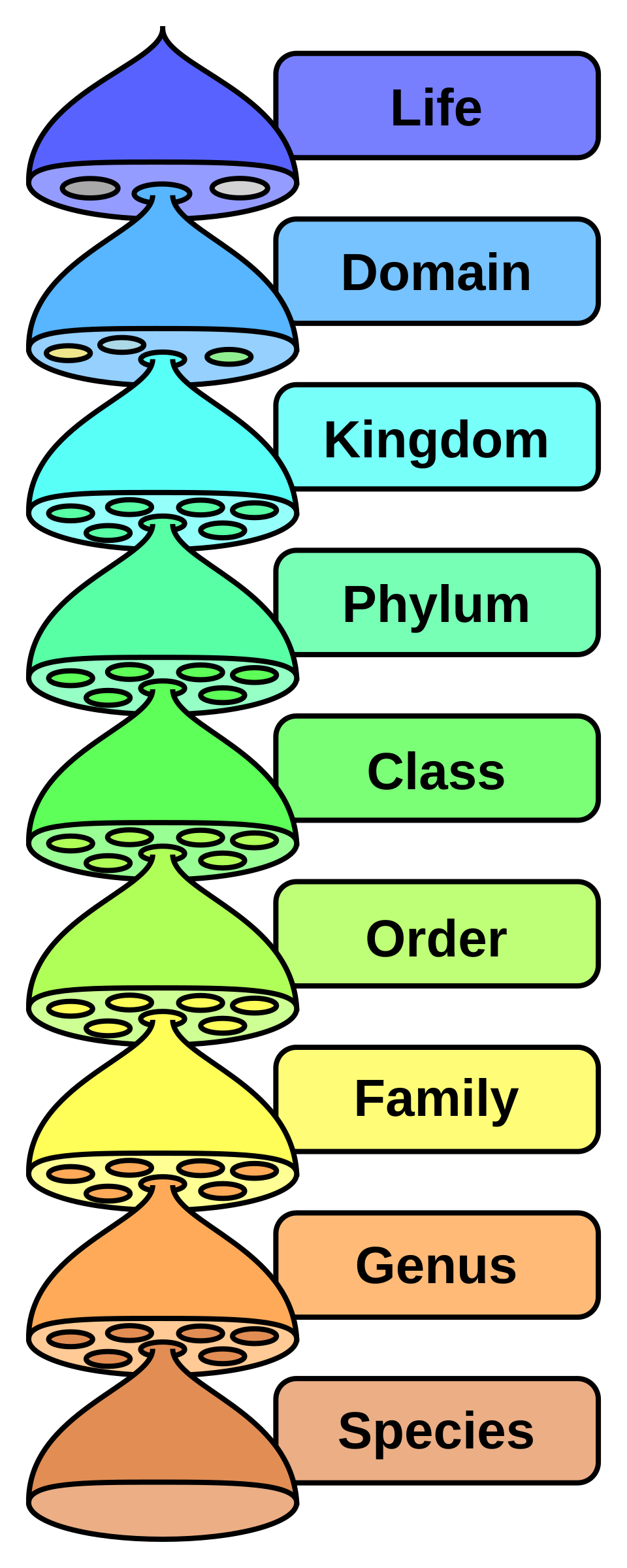
When categorizing organisms, the genus groups very closely related birds together; the species epithet distinguishes one species from another within that genus. When we zoom out, genera (the plural of genus) are grouped into families. Closely-related families are grouped into orders. And one level above that is the class, where all birds fall under Aves.
So the main taxonomic categories look like this:
Species – a single, distinct type of bird
Genus – a small group (sometimes just one!) of closely related species
Family – a group of related genera
Order – a group of related families
Class – the broad category that includes all birds (Aves)
A cool tip: In animal taxonomy, all family names end in “-idae”, and all bird orders end in “-iformes.” Once you spot those endings, you’ll know exactly where you are in the taxonomic hierarchy.
To illustrate further..
Let’s look at a familiar Caribbean species: the Least Tern or Sterna antillarum. The genus Sterna contains several tern species, but the species epithet ‘antillarum’ tells us we’re talking specifically about the Least Tern.
Least Tern in flight. (Photo by Sam Miller Macaulay Library-ML161558471)
If we think about birds similar to terns, gulls, noddies, and skimmers might come to mind — all of which belong to the avian family Laridae. And if we think further about birds similar to gulls and terns, other beach-going birds might come to mind, like shorebirds or plovers, and maybe other seabirds like skuas. All these birds (plus a few others) are grouped together within the avian order Charadriiformes. If you’re ever unsure where a bird fits taxonomically — just flip through your favorite field guide—most are arranged first by order, then by family.
Primer complete — and you passed with flying colors!
With that foundation, let’s turn back to the AOS checklist update. The changes in this supplement include moving species from one genus to another more closely related genus, shifting species between families, and revising the order-level placement of certain bird groups. These updates are almost always based on new genetic research — and they help refine our understanding of how birds are truly related.
Black morph of the Bananaquit in Grenada. (Photo by Paul Des Brisay)
Normal morph of the Bananaquit, photo from Jamaica. (Photo by Stuart Reeves)
In the Caribbean, many species remain understudied, so each AOS supplement often brings valuable new insights. Sometimes a species that appears widespread across multiple islands turns out to comprise several distinct island endemics — especially if birds rarely move between islands and can no longer interbreed. Over time, isolated populations can evolve unique traits, such as the melanism seen in Bananaquits from the Lesser Antilles.
Just last year, two major taxonomic splits added six new endemic species to the Caribbean, underscoring the region’s extraordinary biodiversity. And, as always, continued study will undoubtedly reveal even more.
So — with your refreshed understanding of taxonomy, are you ready to explore the latest in Caribbean bird updates?
Breaking news — our Caribbean tanagers are more related than we thought!
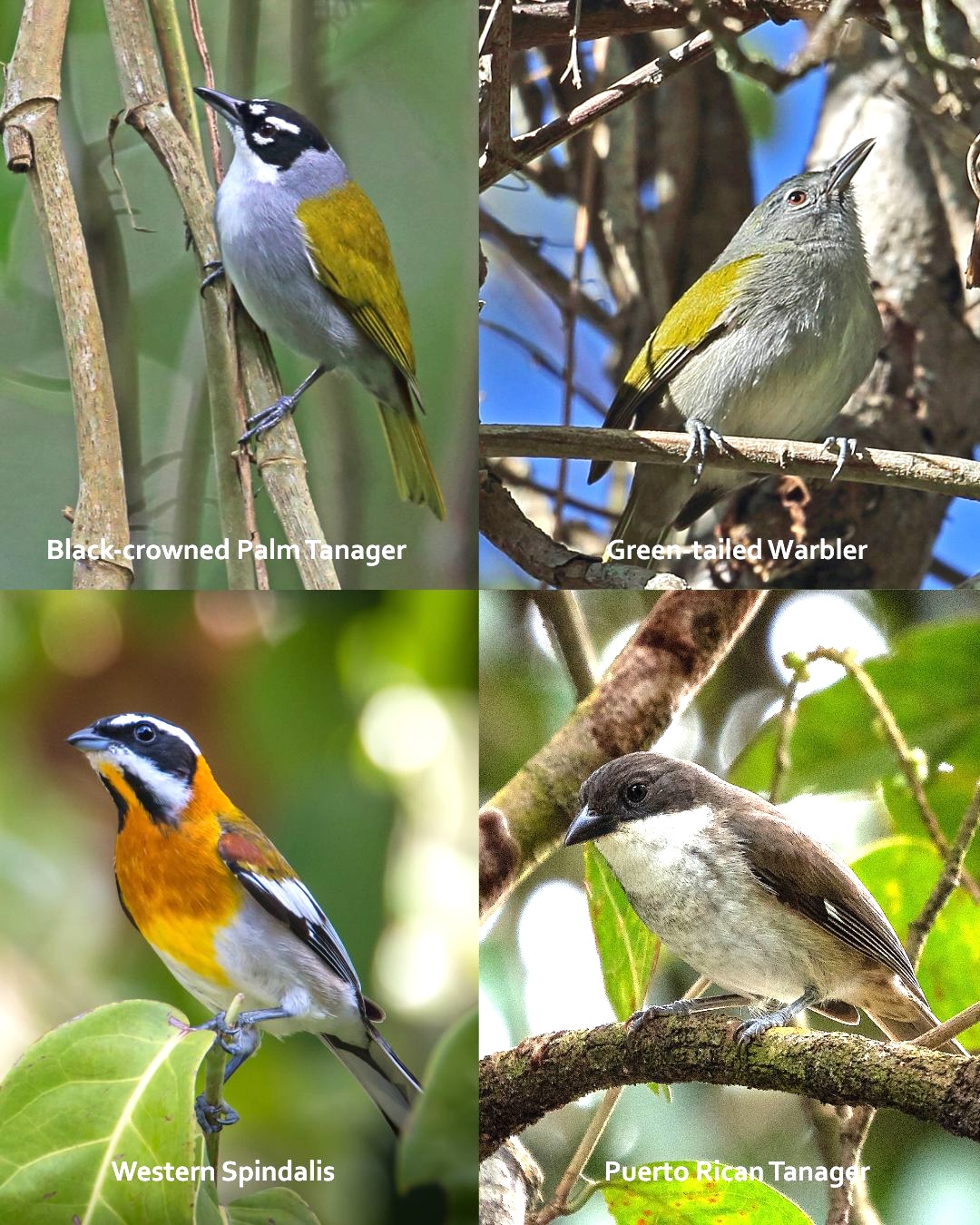
These endemic tanagers have all been lumped into the Phaenicophilidae family.
Until now, Caribbean tanagers were split across three different families: the Spindalidae (Spindalis), Phaenicophilidae (Hispaniolan tanagers such as the Gray-crowned and Black-crowned Palm-Tanagers, White-winged Warbler, and Green-tailed Warbler), and Nesospingidae (Puerto Rican Tanager). But new genetic research shows they are much more closely related than previously believed. All of these species are now united under one family: Phaenicophilidae, also known as the Greater Antillean Tanagers.
Don’t worry — they haven’t lost all their individuality. Spindalis species and the Puerto Rican Tanager now form the subfamily Spindalinae, while the Hispaniolan tanagers fall within Phaenicophilinae. Subfamilies group genera that share more characteristics than the broader family, so this nuance helps keep their evolutionary story intact.
Importantly, our Caribbean tanagers remain a family entirely endemic to the Caribbean, and still very much distinct from the New World tanagers in the large and diverse family Thraupidae.
In short: while we originally thought all the Greater Antillean Tanagers were distinct enough to reside in their own families, this new genetic data shows that they are actually one happy Caribbean family!
What are you hawking about?
Next up: hawks. We also have a division within the familiar hawk genus, Accipiter. Accipiters are known for their long tails and shorter wings, making them agile forest predators who often seek out small songbirds for lunch. While Accipiter hawks were all thought to be closely related, new research has revealed that there’s more to the story — and a new genus of hawks, Astur, has emerged.
Cuban Sharp-shinned Hawk. (Photo by Roberto Jovel)
Sharp-shinned Hawk in Puerto Rico. (Photo by Skyler Bol ML559082281)
For those familiar with birding in North America, you may have struggled telling apart Sharp-shinned and Cooper’s Hawks due to their similarities. But these similarities have actually arisen not due to them being closely related — but through convergence. This is an evolutionary process where unrelated species evolve to be very similar, usually attributed to them filling a similar ecological niche. Cooper’s Hawks have now been reassigned to the genus Aster while Sharp-shinned Hawks remain in the Accipiter genus.
What does this mean for the Caribbean? Our own Gundlach’s Hawk, long considered an Accipiter, has also now been moved in the Astur genus. No split (yet!) for our Caribbean Sharp-shinned Hawks—but there’s always next year’s supplement. . .
Gulls just want to have fun!
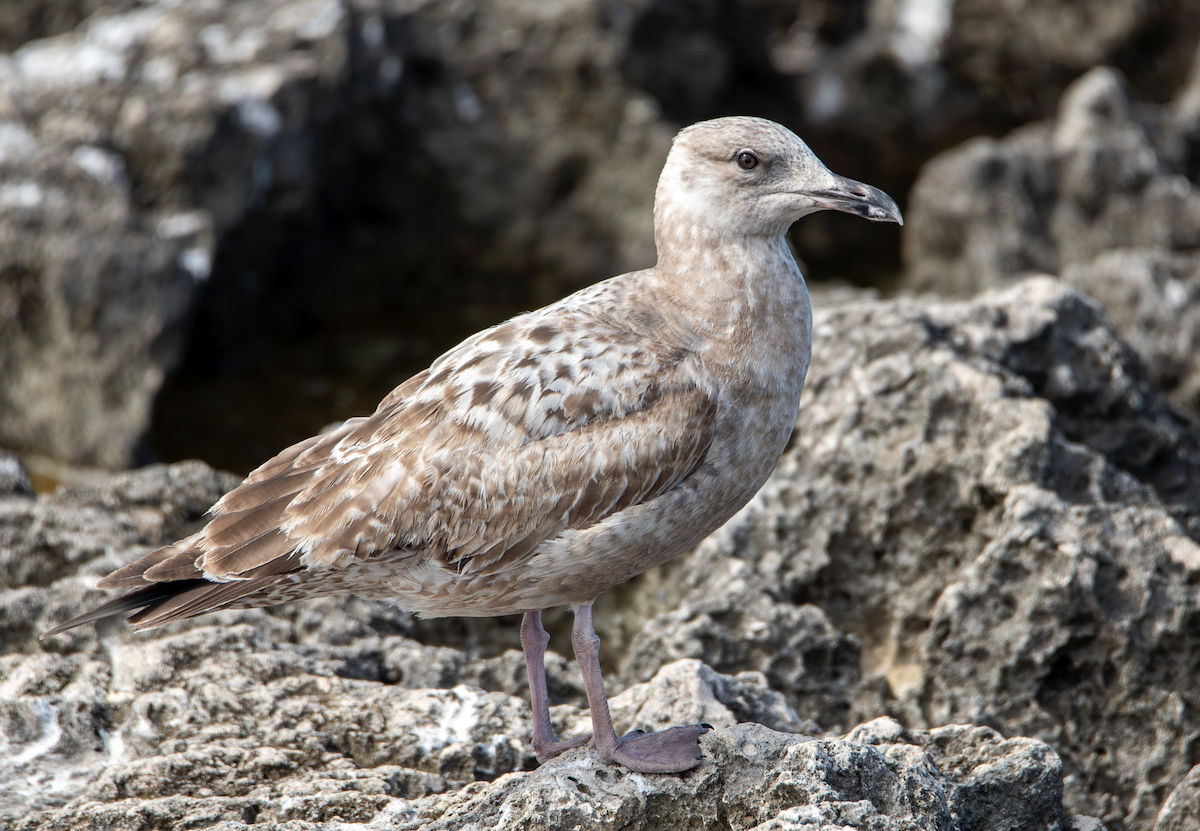
And now gull enthusiasts get a treat: the old, widespread Herring Gull has been split into four species — American Herring Gull, European Herring Gull, Vega Gull, and Mongolian Gull. We’ll be seeing the American Herring Gull around our Caribbean seas, but be sure to look out for the others!
Around the Caribbean, you’ll most often see the American Herring Gull, but keep your eyes open — winds and weather occasionally deliver surprising visitors from across the ocean.
Within the gull family Laridae, there’s more movement. Brown Noddies have been shifted out of the tern subfamily Sterninae and into their own distinct grouping, Anoinae, alongside White Terns . Physical traits, vocalizations, and even archaeological evidence show these birds stand apart from the classic tern lineage.
American Herring Gull spotted in the Cayman Islands. (Photo by Denny Swaby ML629237235)
In summary, this year’s updates bring some fascinating shifts:
Greater Antillean tanagers are now united into a single Caribbean-endemic family, Phaenicophilidae.
Gundlach’s Hawk is finds its new home in the genus Astur, refining our understanding of its evolutionary relationships.
Herring Gull is now four species, with one regular Caribbean visitor, American Herring Gull, with eyes on the lookout for transatlantic surprises.
While this supplement didn’t add new endemic species to the Caribbean, it did deepen our understanding of how unique — and evolutionarily distinctive — our birds truly are and how they fit within the larger ornithological world. And there’s still more to be discovered! Our Caribbean avifauna, including taxonomy, remains understudied. Only through more research and observations, can we gain a deeper knowledge of how remarkable our island birds really are, and how best to protect and conserve them.
Please consider making a contribution to our research and grants programs here. Your support makes critical Caribbean bird research and conservation possible.
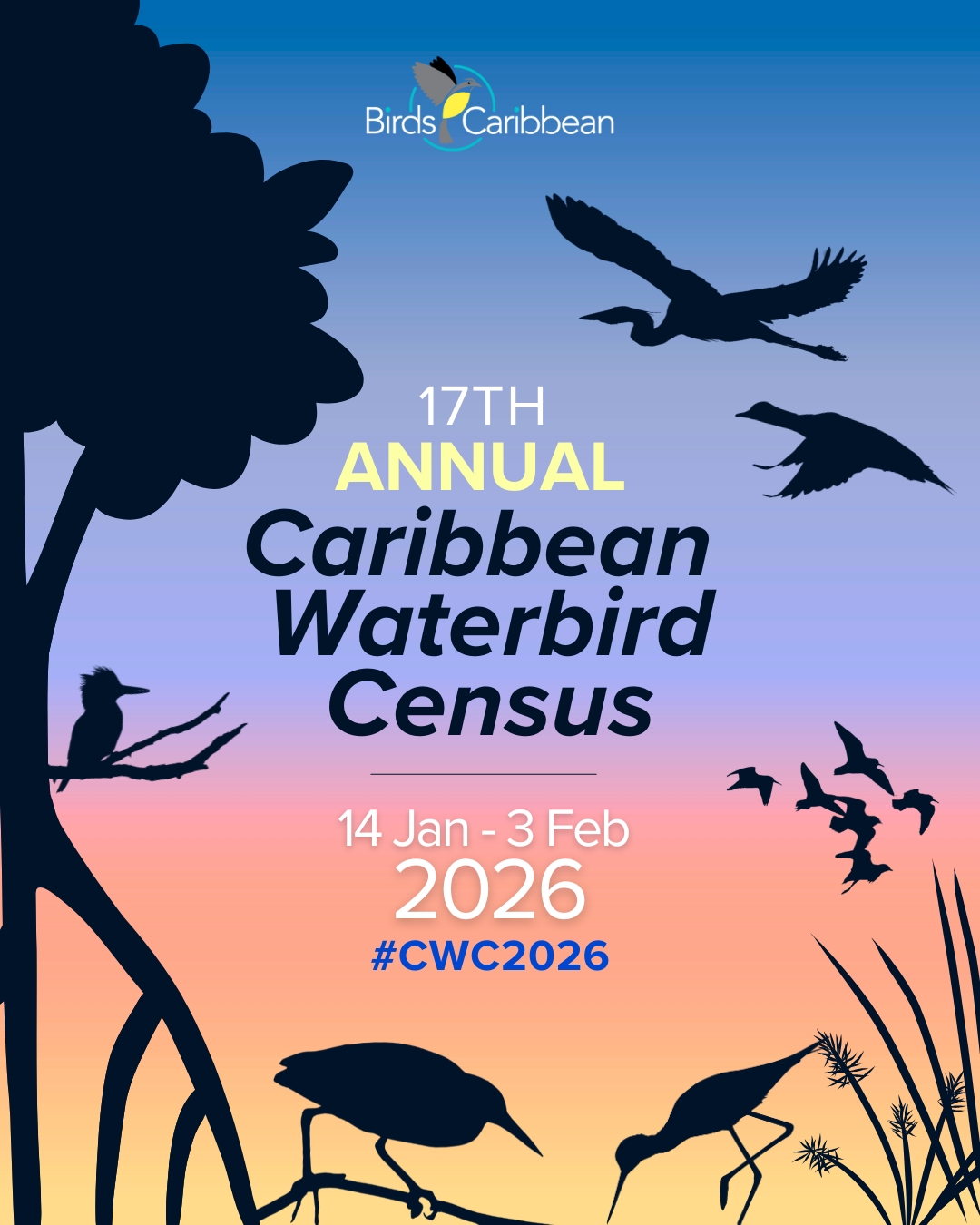
Get ready for the 17th annual Caribbean Waterbird Census (CWC) Region-Wide count! This year is extra special as we mark the 60thyear of the International Waterbird Census (IWC) — a global effort to collect waterbird data, of which the CWC is a part. From January 14th to February 3rd 2026, you can directly contribute to Caribbean Waterbird conservation.
Did you know that when you take part in our CWC regional count you are part of something much bigger? Since 1967, thousands of people around the world have headed to their local wetlands to take part in the International Waterbird Census (IWC). That’s 60 years of global citizen science efforts, all dedicated to tracking the health of waterbird populations and the wetlands they depend on! And our very own CWC has been part of this for the past 16 years! You can find out more about this special 60th anniversary of the IWC here.
Supporting over 185 species of waterbirds, Caribbean wetlands are great places to explore to discover amazing birds and habitats. You might see one of our Caribbean endemics like the West Indian Whistling Duck, or ones of the many globally threatened species that live there, including many migrants such as shorebirds like Lesser Yellowlegs and Short-billed Dowitchers. Our wetlands are threatened by coastal development, pollution and the impacts of climate change, so it’s critical that we protect these special places. The data you collect in this ongoing, annual, standardized survey is essential for helping us understand how to best protect these amazing habitats and protect these birds. CWC surveys are also critical in keeping up to date with the changes and threats to waterbirds and their wetland homes.
How to be part of the bigger picture
As we mark our 17th year, you can play an important role in this global effort to protect waterbirds and wetlands! Anyone can participate in the CWC –— just head out to your nearest wetland, and record the birds you see — don’t wait, just wade right into the wonderful world of waterbirds!
Birding at Hellshire Wetlands, Jamaica. (Photo by Damion Whyte)
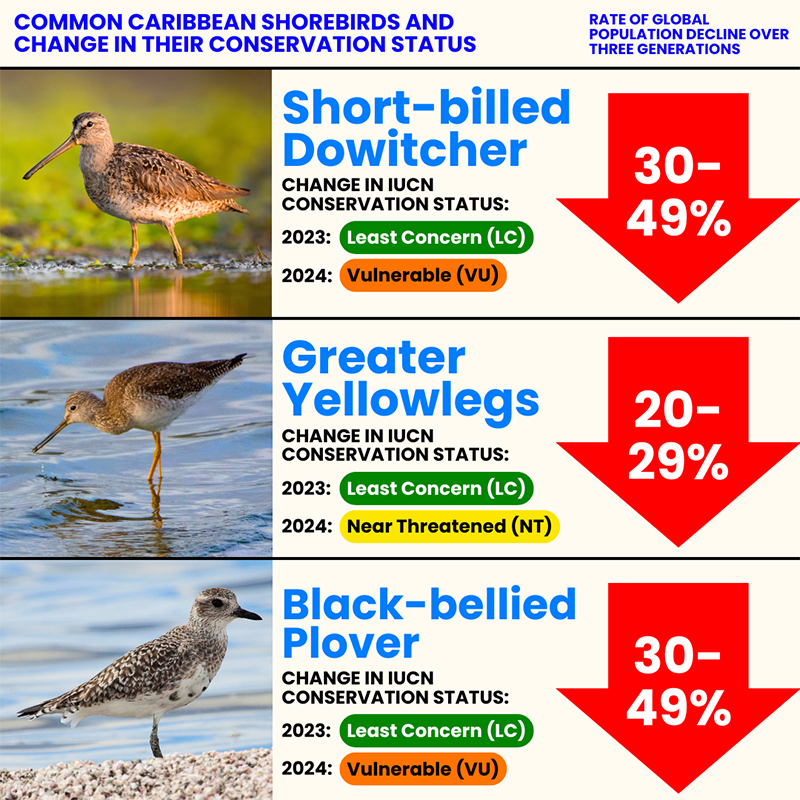
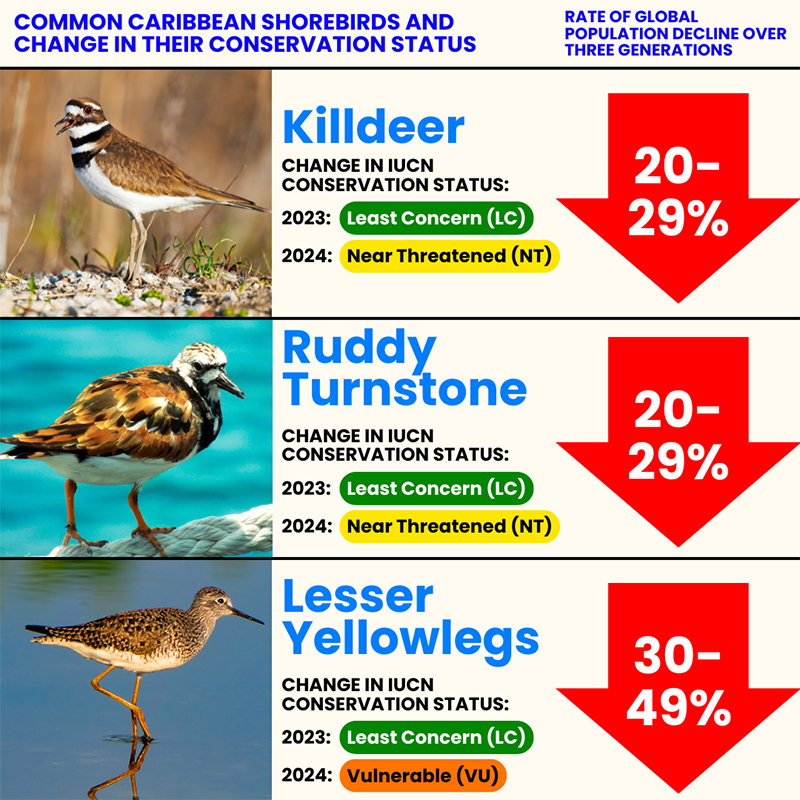
The Lesser Yellowlegs, a medium-sized shorebird widespread in the Caribbean, has suffered a population decline of 30 to 49%. Its IUCN threat level has been raised from Least Concern to Vulnerable. (Photo by Hemant Kishan)
The Cargill Salt Ponds site also supports other habitat types, like these mangroves. (Photo by Lisa Sorenson)
West Indian Whistling-Duck & Wetlands Conservation
For CWC, a wetland is any area where water is the primary factor controlling what lives there. These include any place where water is covering the land or is just below the surface. This wide definition includes coastal wetlands like mangroves, mud flats, lagoons and beaches, as well as inland wetlands like lakes, ponds, swamps, areas around rivers and streams and even some types of agriculture (e.g. rice fields). Of course, because this is the Caribbean Waterbird Census, you need to be in the Caribbean to take part! You can find more information about how to conduct surveys here.
Get with the project
Getting a CWC list on eBird. (photo by EAG)
All our CWC data is still stored on eBird, but earlier in 2025 CWC became a project in eBird. This means that you need to be part of the project on eBird to ensure that your counts contribute to our amazing database!
Here’s the good news—if you’ve ever submitted a checklist using a CWC protocol in the past—you’ve likely been automatically added to the project! Check out the CWC project pages here to confirm you’ve joined.
If you’re new to CWC or if for some reason you’ve not been joined, just visit the CWC Project Page and click “Learn how to join.” Review the info about the project, scroll to the end and then click “Join Project.” If you are not logged into eBird you will be prompted to “Login to Join Project.”
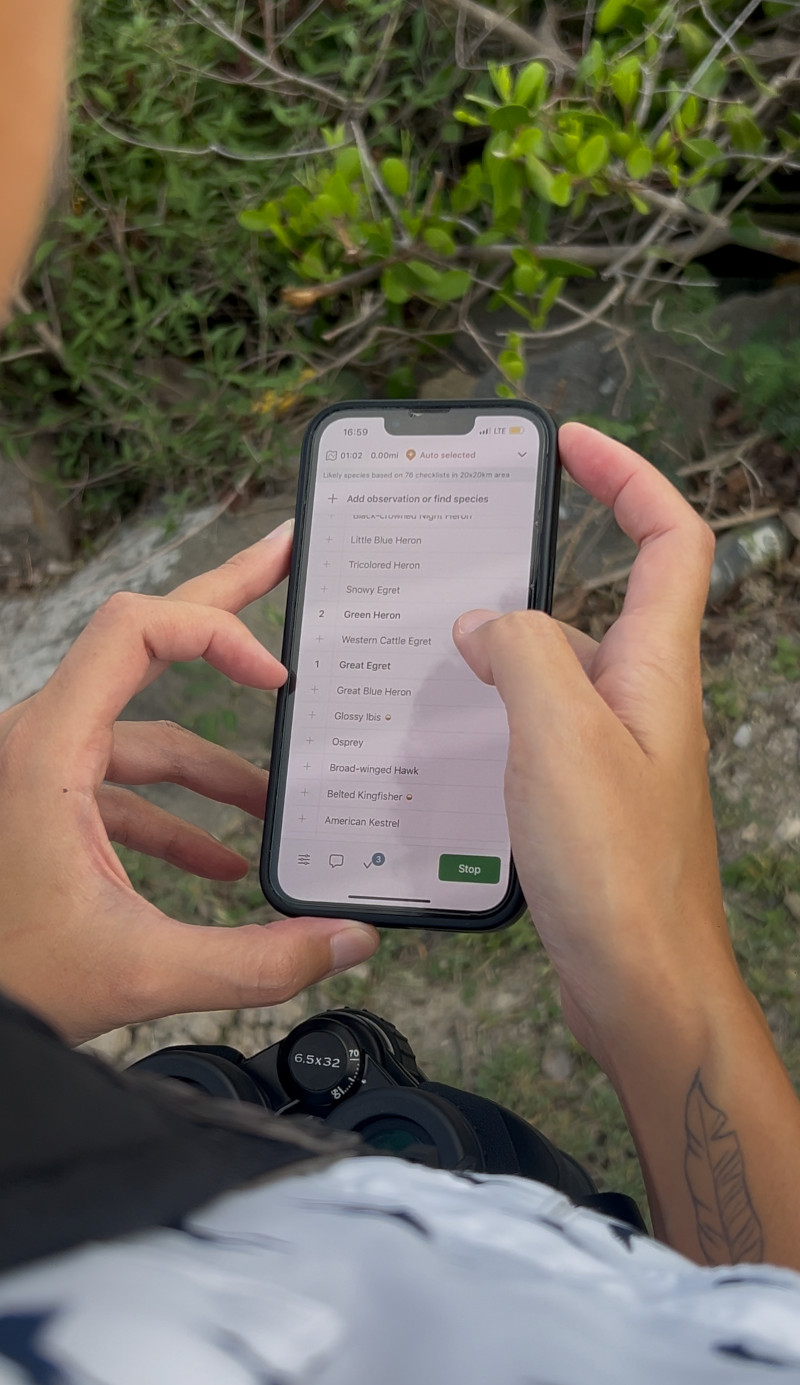
Once you’ve joined the CWC project, it’s easy to add your CWC lists to our database on the eBird app or on the website.
Here’s how:
CWC in the eBird Mobile App:
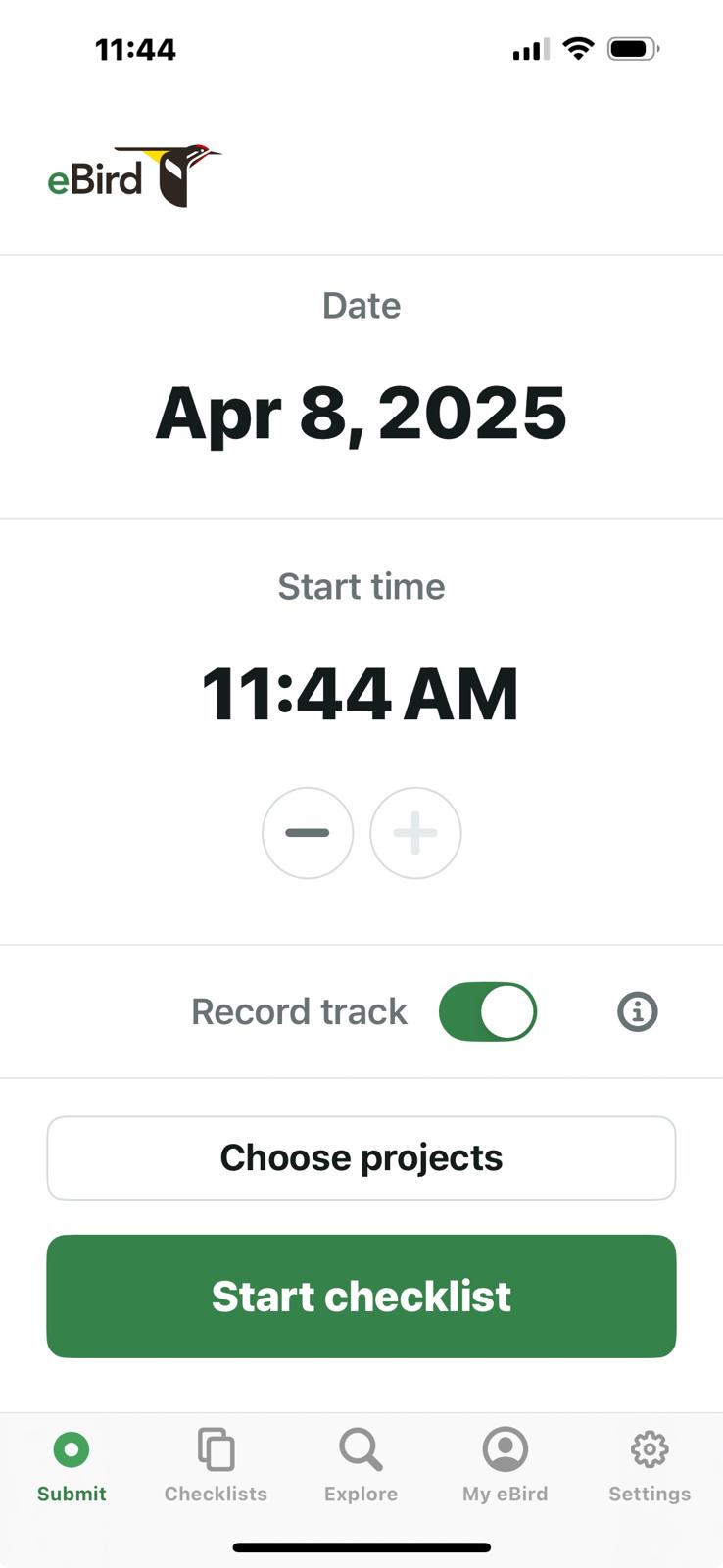
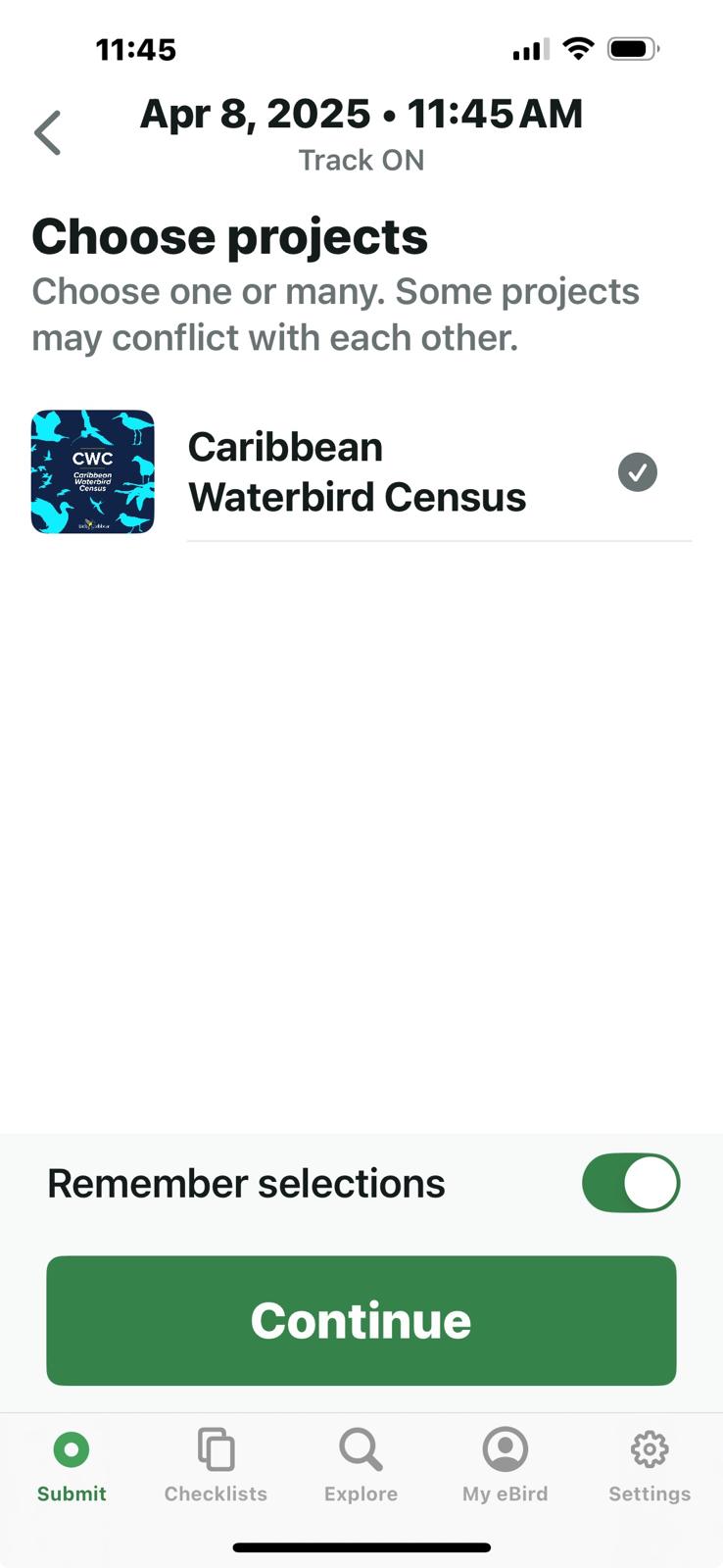
Tap “Choose projects” above the “Start checklist”’ button.
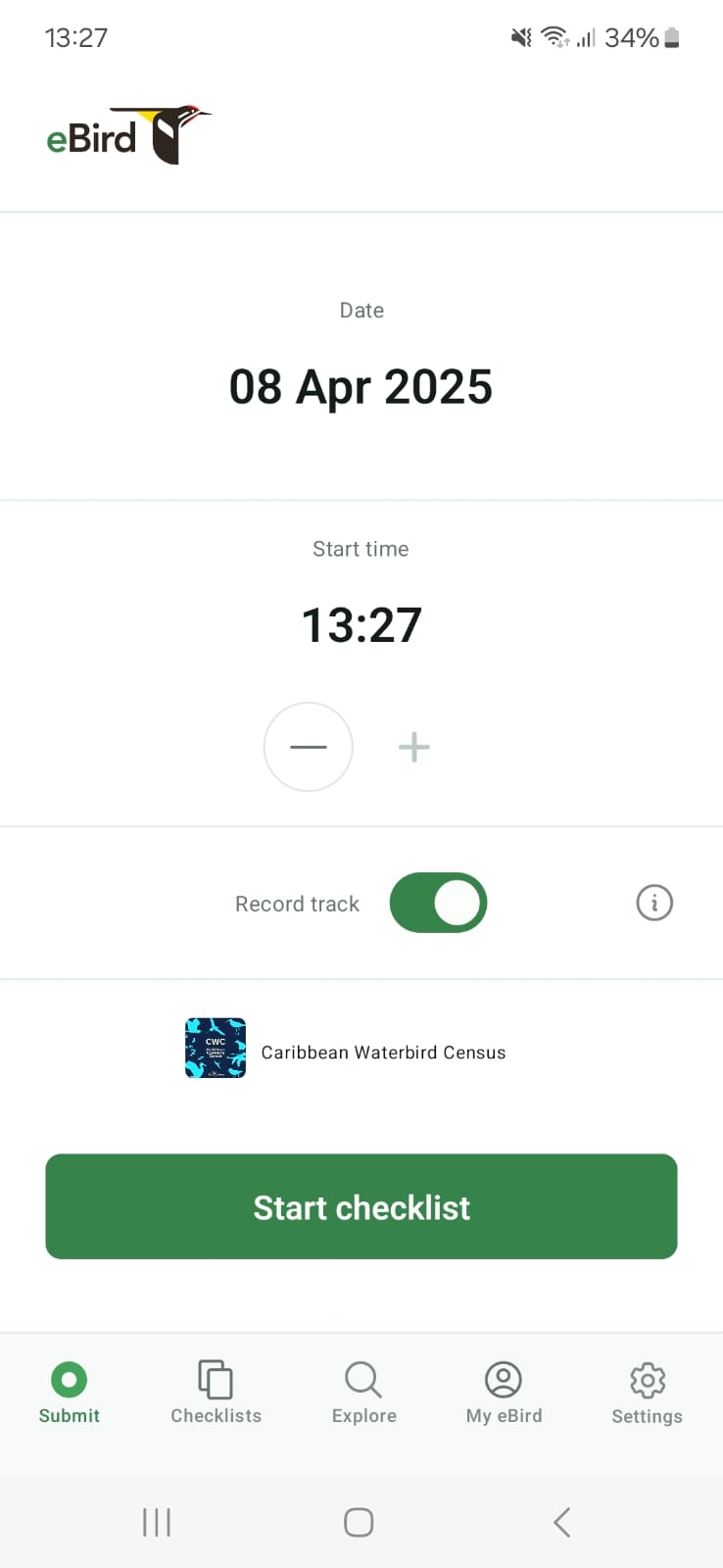
Select the CWC project, and, if you like, ask the app to remember this choice for future submissions. If you do this CWC will appear automatically above the “Start checklist” button next time you use App.
Tap “Continue” and do your count (it’s that simple!)
Next time you do a count at a Caribbean wetland, select “Caribbean Waterbird Census” above the “Start checklist” button.
CWC on the eBird Website:
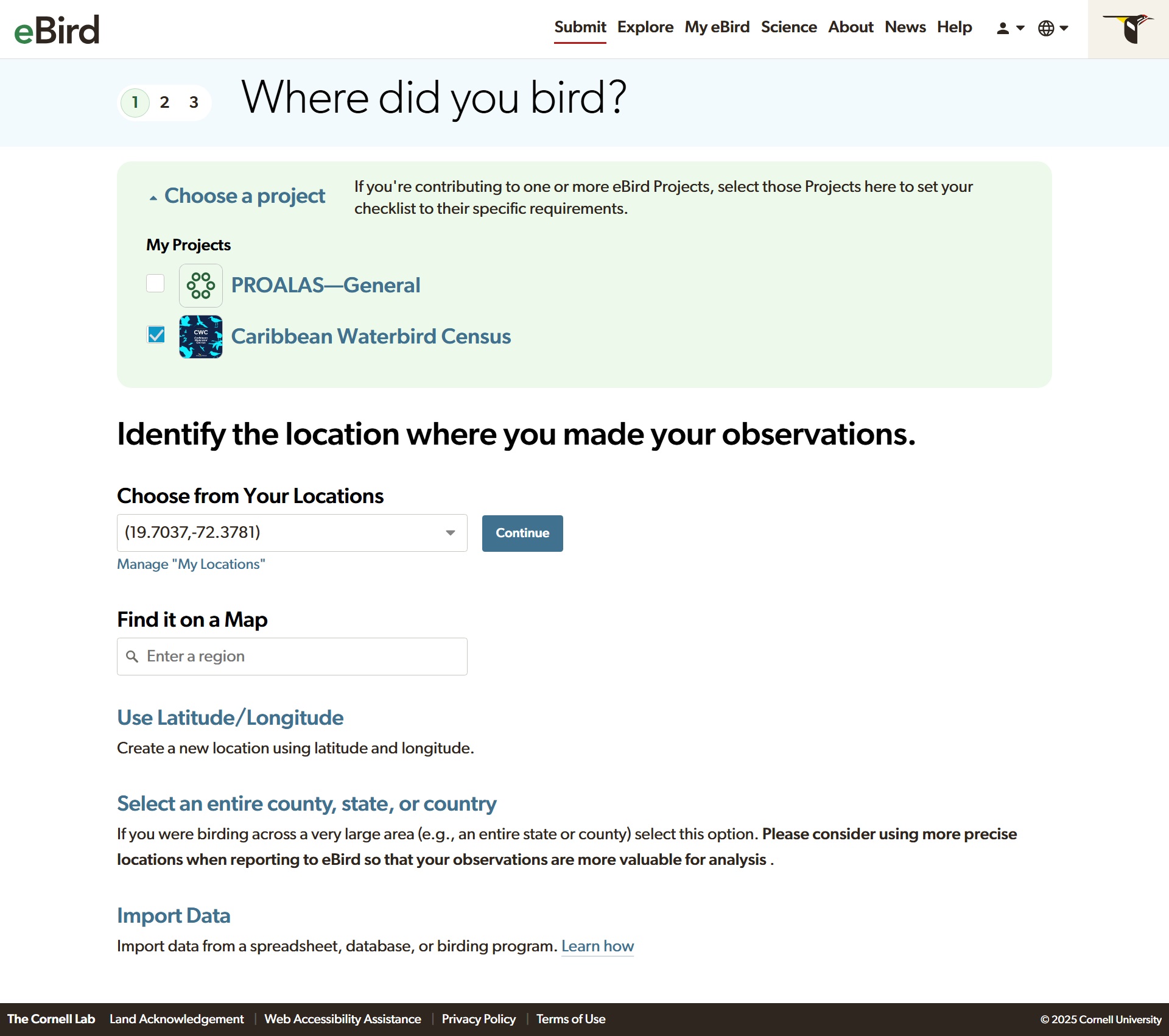
Go to the Submit page.
Use the “Choose a Project” dropdown to check the box next to “Caribbean Waterbird Census.”
Then follow the steps below to add your list details as normal.
Now that CWC is a project there are no longer specific ‘CWC protocols’ in eBird, you just need to select the “Traveling” or “Stationary” protocol before submitting.
Remember that although these are waterbird counts, you should be sure to count all the birds that you see and hear during your survey visits, not just the waterbirds. If you need help with eBird submissions, have questions about which protocol to choose, or with setting up an eBird account, please contact Alex Sansom: waterbird.manager@birdscaribbean.org
You can learn more about the CWC project on eBird here. And if you’re completely new to eBird, start by looking at this page that will guide you through opening an account and adding data.
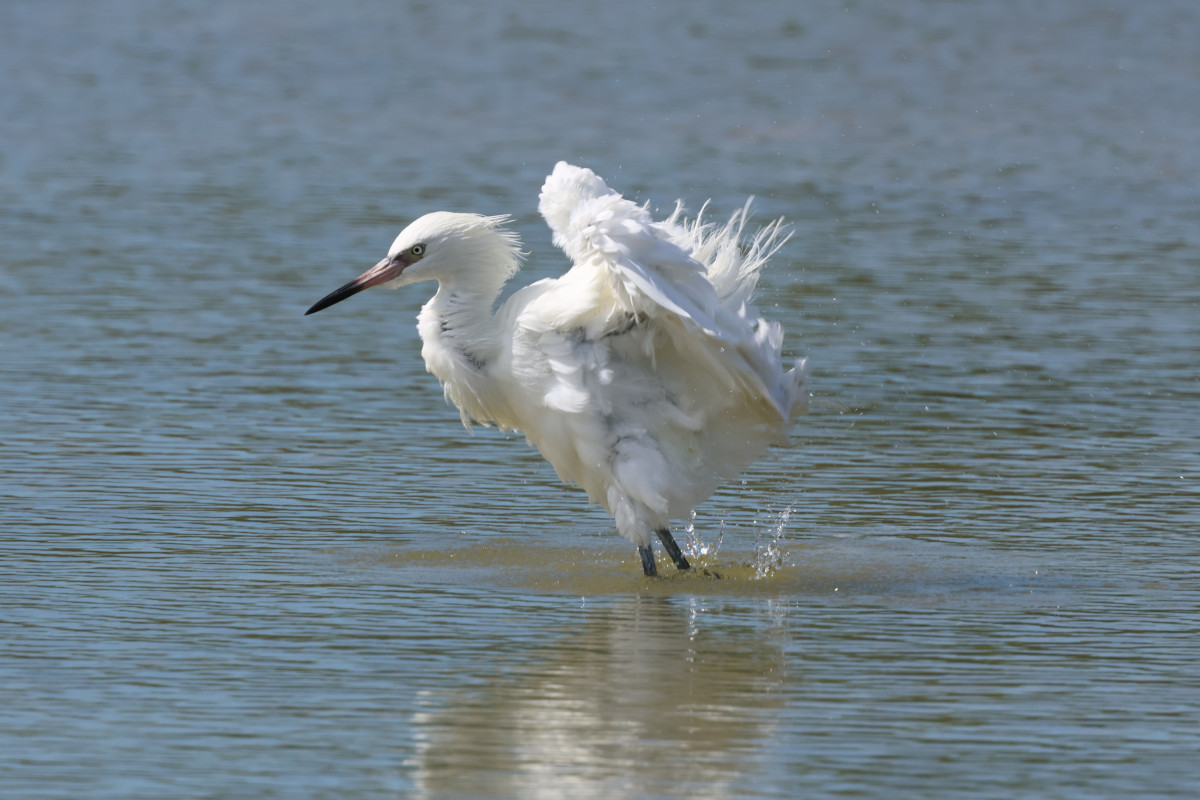
Reddish Egret at Las Salinas De Brito, Cuba (Photo Andrew Dobson)
Forget to choose the CWC project in eBird?
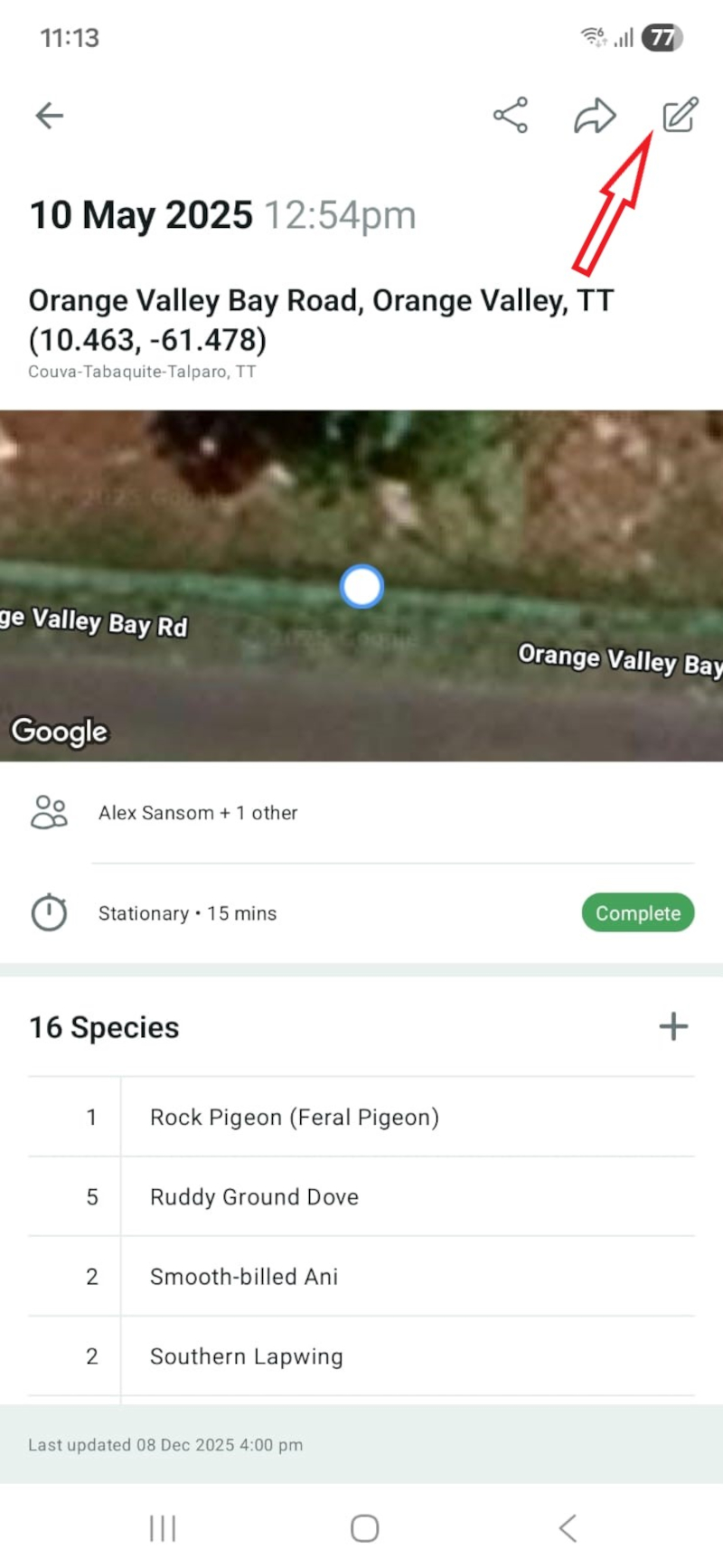
You went out in the field, you started your list in eBird and did your CWC survey and submitted the list…. THEN you realize that you forgot the “choose a project” step at the start! It happens! This means your list will not be ‘counted’ as part of the CWC- yet. But don’t worry it can be fixed, you just need add it to the project after you have submitted.
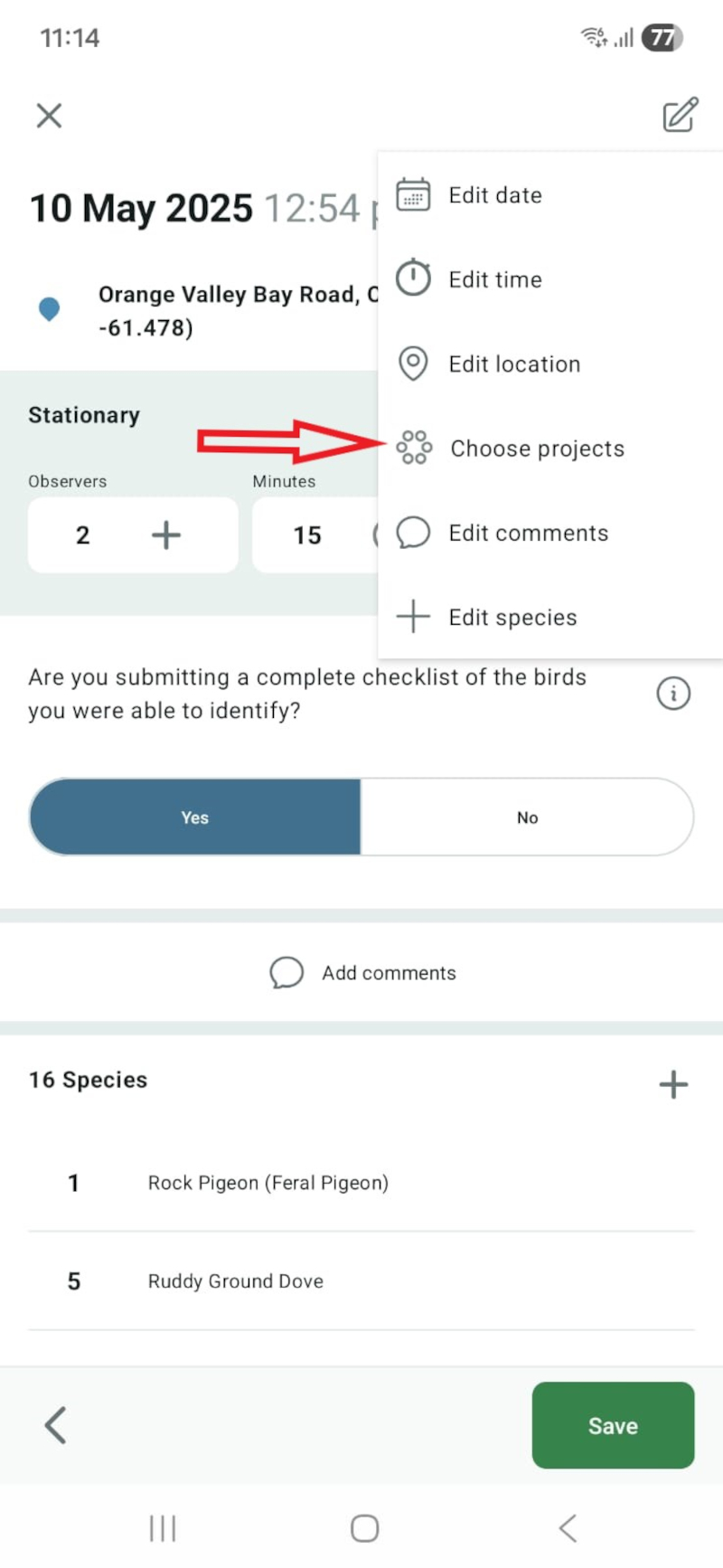
On the eBird app, go to “checklists”, then toggle to show your submitted lists. Next find the list that should have been in the CWC project and open it. Open the ‘edit checklist’ menu (click on the edit icon on the top right), then once in ‘edit’ mode, choose the ‘edit’ menu icon again (again in the top right). Here you will see a menu with the option to ‘choose projects’. Click on this and select the Caribbean Water Census from your projects (of course you need to have joined the project already to do this!). Then save your changes.
On the eBird website it’s slightly different. You can go to ‘My Checklists’, and choose the one you want to add to the CWC project. Once this list is open, you need to select the ‘Edit Location’ option. When you click on this you will see the ‘choose project’ option, at the top of the page under the ‘Where did you bird?’ heading. Just select the Caribbean Waterbird Census project and save the changes.
Surveying in San Juan estuary. (Photo by Emilio Font SOPI)
We’re here to help!
Never done a CWC survey before or need a refresher? Don’t worry! We’ve pulled together some amazing resources that will help you with your counts. To help you get started on your CWC survey journey or give you a reminder about how to take part check out our helpful YouTube webinar that takes you through the steps of how to participate in the CWC*!
*This is a great introduction to the CWC and how to plan your counts and carry out surveys, but the information on adding data to eBird has been updated since it was recorded. Please use the information provided above and here. Join the project, then remember to choose the project when making your eBird list to make sure your data gets included as CWC in eBird.
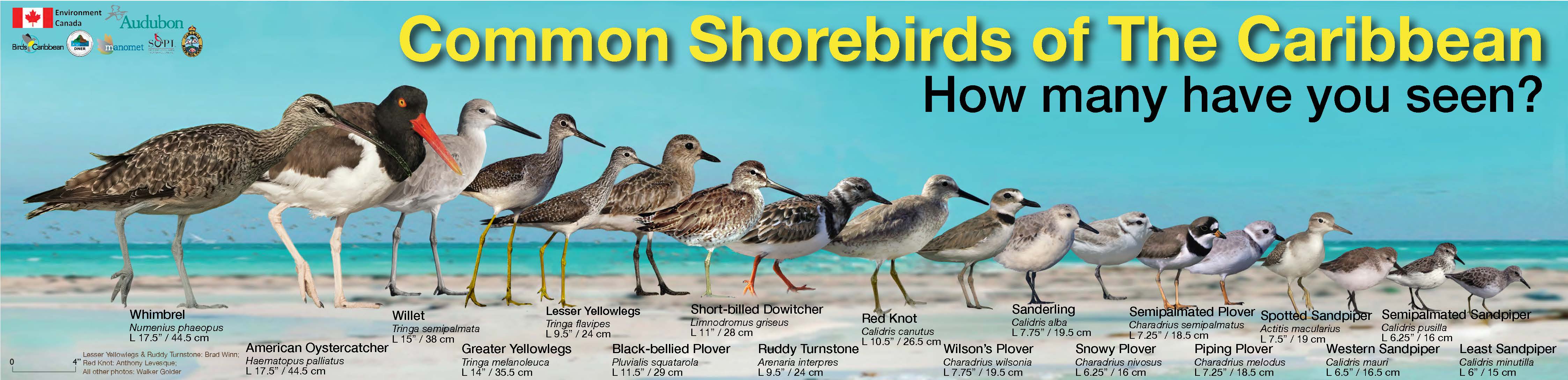
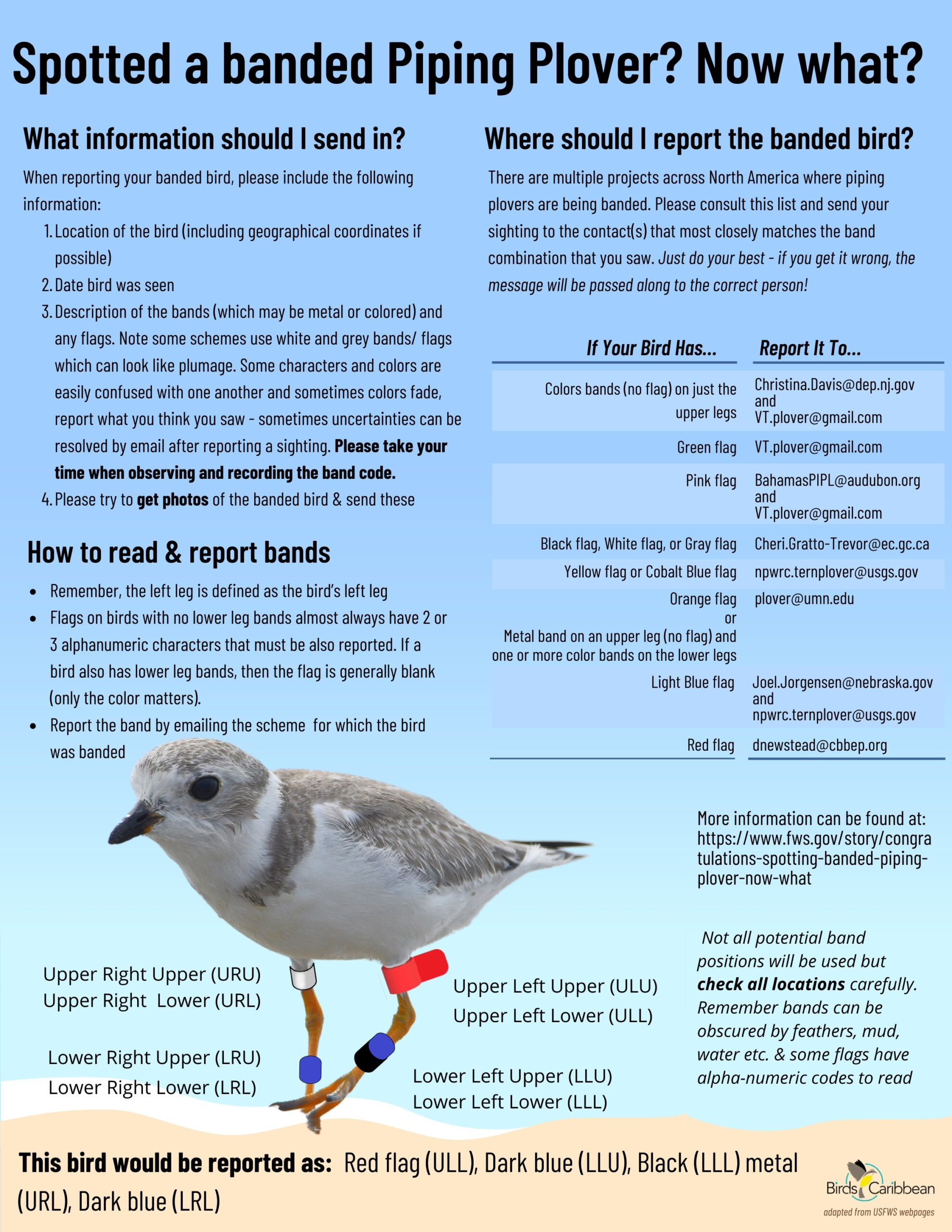
If you need a hand with your waterbird ID you’ve come to the right place—why not brush up on your ID skills using our helpful videos on YouTube! Part I covers herons, egrets, ducks, marsh birds, and seabirds. Part II tackles those tricky shorebirds! We also have even more ID, survey planning tips, and outreach resources that are available for you to use and download on this page. This includes information on what to do if you see a banded bird during your surveys as well as our handy ID Guide to Common Caribbean Shorebirds, which can print and take with you on your surveys.
Shanna explains bird ID at McKinnons Pond, Antigua, during the 2025 CWC Count. (Photo by Sherrel Charles)
Ajhermae White helps students of the Grade 5 class of Look Out Primary School with shorebird ID during their field trip at Marguerita Bay. (Photo by Stephen Mendes)
If you need more help with those troublesome shorebirds you can also check out our series of short videos. Each of these deals with ID-ing some of the shorebirds that are more difficult separate, even those tricky small sandpipers!
Have fun out there!
We hope you have a great time exploring your country’s wetlands and counting birds during the regional CWC count! Please remember to stay safe and carry out your counts responsibly. This means taking care not to disturb the birds or damage their habitats. Enjoy counting birds and see how many of your local wetlands you can visit during this three-week period! Finally, if you enjoy your CWC experience remember that CWC counts are not limited to the regional count. You can do a CWC survey at any time of year as long as you are in a Caribbean wetland and count all the birds you see!
Good luck! We look forward to hearing about your findings. If you need help with bird ID, or have photos and exciting observations to share, please post to our Waterbird Group Listserv (everyone is welcome to join) and/or on our BirdsCaribbean Facebook page. For sharing on social media, use hashtags: #CaribbeanWaterbirdCensus #CWC2026 #WaterbirdsCount and for this special IWC anniversary year #IWC60 AND please tag us: @BirdsCaribbean
The Caribbean Waterbird Census is an ongoing, long-term survey effort that provides important data that helps us keep track of the birds using Caribbean wetlands, understand the threats they face, and raise awareness. With 27,000+ CWC lists in our long-term database, we’re building an invaluable resource for bird conservation across the region. You can support the CWC here.
Promotional Social Media Graphics – Please feel free to download these graphics and use these to promote your Caribbean Waterbird Census surveys (just open the graphic you want to use right click and choose ‘save image as’) .
Global seabird populations are in serious decline, facing threats that span from habitat loss to climate change. These magnificent birds are essential indicators of ocean health and help maintain resilient coastal ecosystems like mangroves and corals. Their crisis is a crisis for our marine environment that strengthens Caribbean island economies through tourism and fisheries, and protects coastal communities from storms.
This urgency is what drove the Seabird Working Group (SWG) in May 2022 to launch the first-ever coordinated Caribbean Seabird Census (CSC).
Grenadines Guardians seabird survey. (Photo by Juliana Coffey)
The goal was simple: to improve knowledge of where seabirds nest in the region, and how many are in their breeding populations, providing them with the hard data needed for effective advocacy, protection, and management actions.
Now, a major milestone has been reached: researchers from across the region recently convened in Santo Domingo, Dominican Republic, from 23rd to 24th September, to analyze the rich dataset collected from 2023 to 2024.
What did they find? This report by the Seabird Working Group details how the CSC has progressed across the region and what the dataset reveals about the state of our Caribbean seabirds.
Setting the stage
The 2023–2024 Caribbean Seabird Census (CSC) marks a major step forward in conserving our seabird populations. Led by BirdsCaribbean and EPIC, this regional effort brought together more than 150 experts and volunteers from across more than 30 organizations representing 25 territories to gather the first comprehensive seabird data for the Caribbean in over a decade. These counts, done through boats, drones, and on-the-ground surveys, help understand how seabird populations are coping with challenges like invasive species, coastal development, and climate change. By mapping where seabirds still thrive and where they are disappearing, the CSC provides the science needed to guide urgent conservation action. Its findings will help shape recovery programs, and ensure that future generations will witness the vibrant seabird life of the Caribbean.
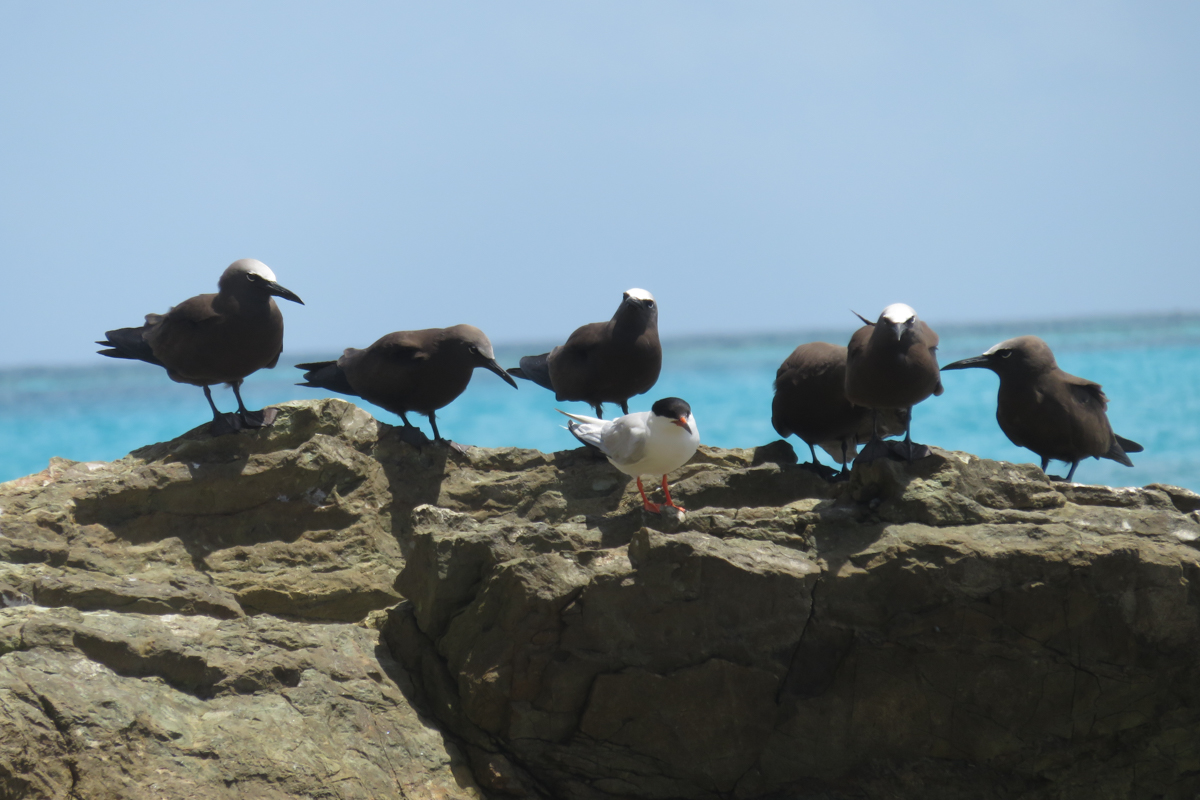
Brown Noddies with a Roseate Tern (photo by J. Coffey)
Following the success of the CSC, we shifted our focus in 2025 to sharing results and building regional collaboration. This continued effort led to a CSC workshop in Santo Domingo, Dominican Republic, where 25 participants from 14 countries in and bordering the Caribbean worked together to strengthen seabird conservation across the region, along with four instructors from the UK, US, and Ecuador.
Our objective was to take a deep dive into the data collected during the 2023–2024 CSC. Specifically, we aimed to:
Collate and review seabird census data at national and regional levels.
Discuss and agree on methods to standardize, process, and analyze data for conservation use.
Provide training in tools for data processing and analysis.
Explore ways to identify conservation priorities and apply census data to management.
Identify next steps for coordinated regional seabird efforts following the baseline census.
Day 1: Diving into the data
We were warmly welcomed by Dr. Yolanda León, Executive Director of Grupo Jaragua, our local host and holder of workshop funds granted by the Bio-Bridge Initiative, a project of the Convention on Biological Diversity.
Participants introduced themselves; we represented a wide range of experience—from those new to seabird monitoring to others with extensive expertise in data collection and analysis.
Yvan Satgé, researcher with Clemson University–South Carolina Cooperative Fish & Wildlife Research Unit (US) and long-time Co-Chair of the SWG, opened the sessions with an overview of Caribbean seabirds and the 2023–2024 CSC. Yvan highlighted how the CSC builds on previous regional efforts, described in Bradley & Norton (2009) and Lowrie, Lowrie & Collier (2012), and suggested the value of making regional censuses a recurring initiative. He emphasized the importance of data standardization for meaningful comparisons across sites, countries, and years—an approach modeled by the Caribbean Waterbird Census, coordinated by BirdsCaribbean.
Yvan giving an overview of the 2023-2024 CSC. (Photo by Jennifer Wheeler)
Dr Rhiannon Austin discussing key considerations in surveying seabird populations. (Photo by Jennifer Wheeler)
Next, Dr Rhiannon Austin, research associate at theUniversity of Liverpool, UK, another SWG Co-Chair, led sessions on Census Data Considerations. She reminded us that while the goal of a survey is to estimate population size accurately, challenges abound—no survey detects every bird, and factors such as method, behavior, habitat, and weather all play roles.
Then came our first hands-on exercises. Participants grouped into English- and Spanish-language tables, working on either their own data or example datasets from the Turks and Caicos Islands (where Rhiannon just wrapped up a two-year seabird monitoring project). We focused first on data cleaning in Excel—learning how small inconsistencies in date formats, coordinate precision, or file types can complicate regional compilations.
From there, we moved to GIS exercises using QGIS, exploring how to map, visualize, and compare data across years. While some found this a refresher and others a first experience, the peer-to-peer support made it fun and productive.
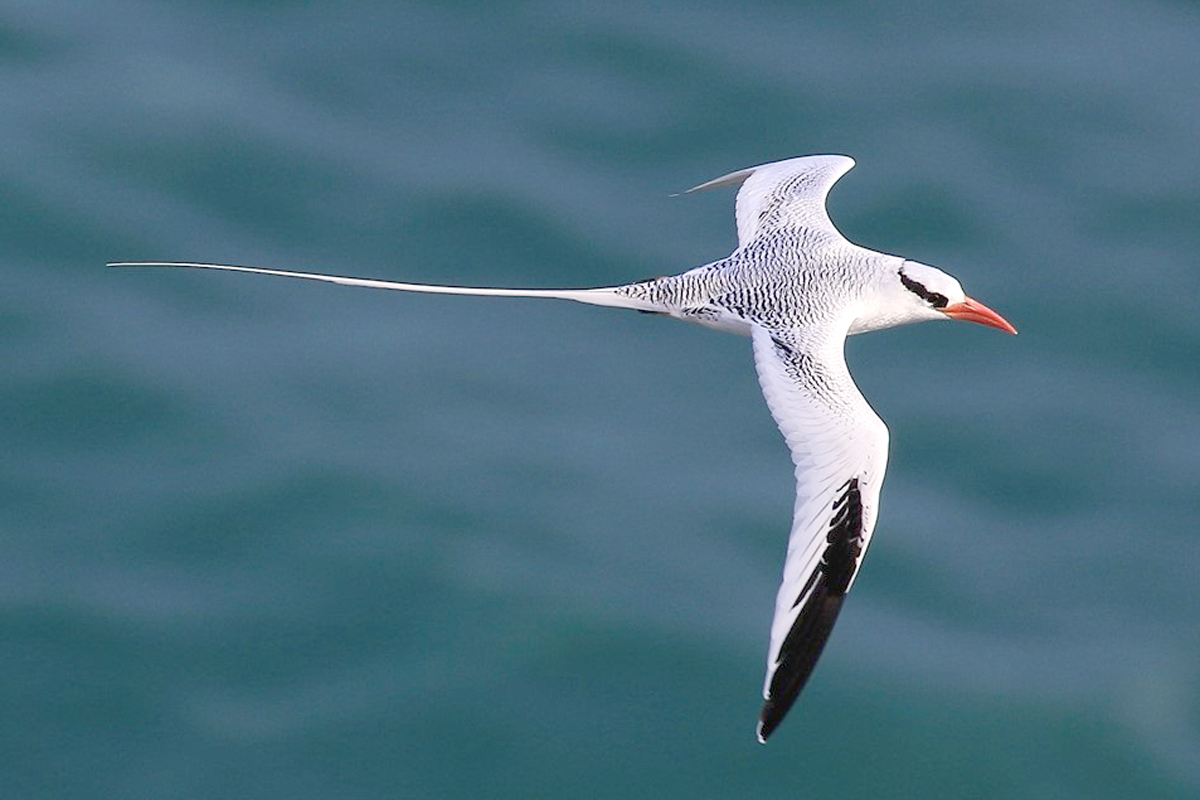
Red-billed Tropicbird. (Photo by Birding the Islands client, Keith Clarkson)
After dinner, we reconvened to enjoy videos from participants showcasing seabird conservation work across the region—proof that seabird monitoring in the Caribbean involves breathtaking landscapes, fascinating species, and some very dedicated (and tough!) fieldworkers.
Day 2: Assessing threats and setting priorities
The second day focused on interpreting data at the regional and global scale. Louise Soanes of the RSPB Centre for Conservation Science (UK) presented results from the 2023–2024 CSC, which covered 17 species, 18+ countries, 300+ sites, 30+ organizations, and 150+ observers. Louise compared these data with those from Bradley & Norton (2009), identifying monitoring gaps, challenges, and opportunities for future coordination.
Participants then tackled a practical exercise in threat assessment—evaluating major threats to key seabird colonies, rating their likelihood and severity, and noting current actions. This helped illustrate how site-level analysis can guide regional conservation priorities.
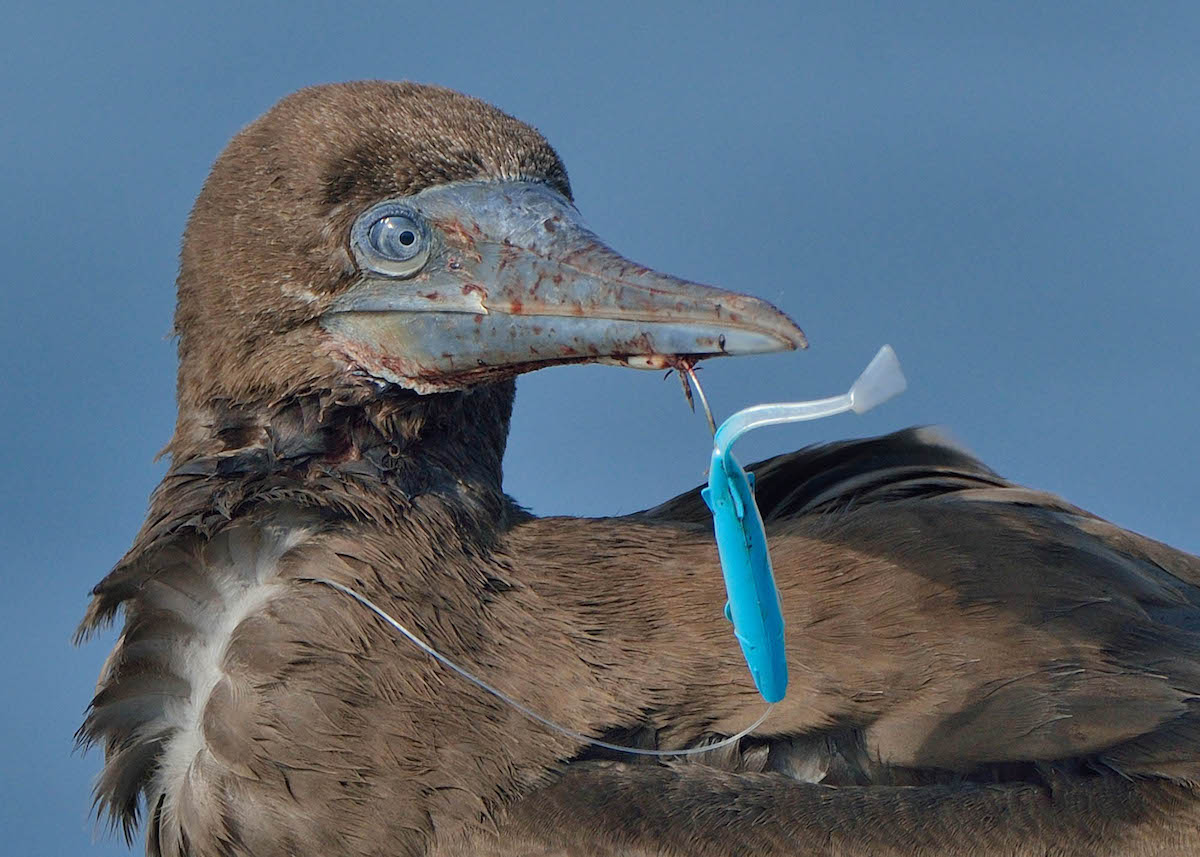
A young Brown Booby caught on a fishing lure. Many kinds of plastic are dangerous to Caribbean birds. (Photo by Michiel Oversteegen)
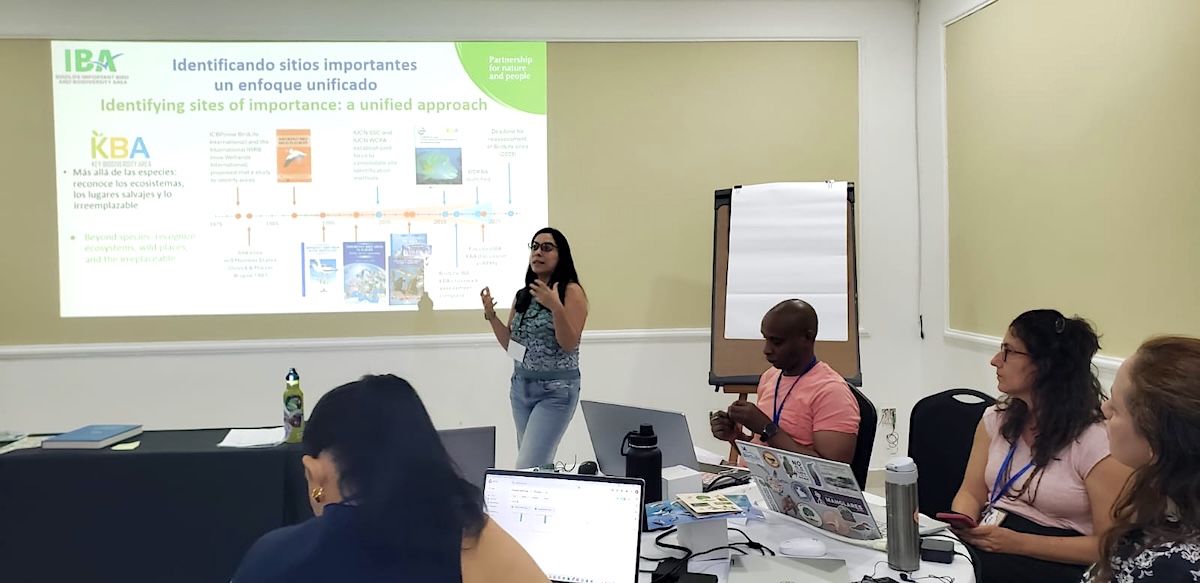
Next up was Gabriela (Gaby) Toscano from BirdLife International, who discussed Key Biodiversity Areas (KBAs) and how they relate to the earlier framework of Important Bird Areas (IBAs). She explained how BirdLife and partners have transitioned from bird-specific IBAs to all-taxa KBAs, harmonizing criteria to ensure globally consistent biodiversity site designations.
Gabriela Toscano speaks about KBAs in the Caribbean. (Photo by Jennifer Wheeler)
Today, the Caribbean region includes 429 KBAs in the World Database of KBAs—most designated before 2016 through the IBA “crosswalk” process. While 191 are globally confirmed, many remain “priority for update,” underscoring the need for renewed data collection like that generated by the CSC.
Hands-on exercises followed, where groups reviewed Caribbean seabird IBAs under the KBA framework. Participants assessed which species could trigger KBA designation, verified thresholds and population data, and discussed whether other taxa might qualify sites as KBAs.
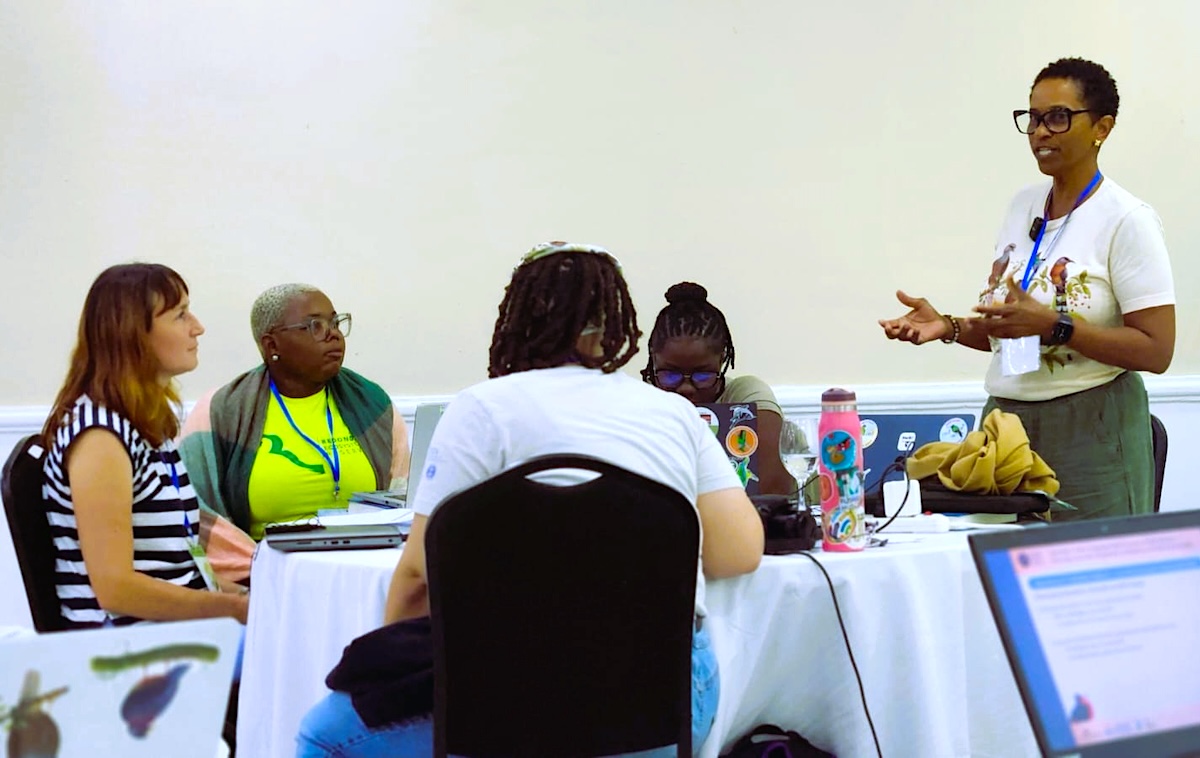
Lillian Russell adds to the discussion on KBAs in the Caribbean drawing on her experience in The Bahamas. (Photo by Jennifer Wheeler)
A key issue emerged: many Caribbean seabird species are pan-tropical (distribution spans tropical regions of both western and eastern hemispheres), and individual colonies rarely exceed the global threshold (1% of the species’ population). Yet, given the historic decline in regional populations, nearly every colony holds conservation importance. Participants discussed the possibility of developing Caribbean-specific regional criteria to ensure that even smaller colonies receive recognition and protection.
Conclusions and Next Steps
We closed the workshop with reflections on the 2023–2024 CSC and ideas for the road ahead. Participants emphasized the importance of sustained regional collaboration, continued data sharing, and integration with broader biodiversity initiatives.
Group photo of workshop participants and facilitators.
Everyone agreed: building a long-term regional seabird monitoring and conservation program is both necessary and achievable.
Jethro van’t Hul, Terrestrial Parks Manager, St. Eustatius National Parks Foundation (STENAPA), Sint Eustatius emphasized, “It’s refreshed motivation and redrawn attention to the importance of our seabird colony and the work we need to do to protect them. Definitely good things to come!”
Ernesto Hernández Pérez, Lead Specialist, Flora and Fauna Company of Villa Clara, Cuba added, “For me, it was very educational to share with specialists who do the same work, and very useful to standardize methodologies and apply mapping in a practical way to achieve results.”
The next key step is the publication of a co-authored report in the Journal of Caribbean Ornithology. The report will share results of the CSC in a formal but accessible way that can be used as a reference across the region and for years to come. Looking ahead, we also plan to expand participation in the CSC, refine monitoring methods, and launch a follow-up census in 2030.
Celebrate World Migratory Bird Day (WMBD) with us in 2025! This year’s theme is “Shared Spaces: Creating Bird-friendly Cities and Communities”. Have fun learning about a new migratory bird every day. We have coloring pages, interesting facts, activities, and more. Download for free and enjoy nature with your family at home.
Migratory Bird of the Day: Northern Yellow Warbler
A ray of sunshine visiting from the north—it’s the Northern Yellow Warbler! Formally known as the Yellow Warbler, this species—which once included a whopping 37 subspecies—was recently split into two: the Northern (migratory) and Mangrove (resident) Yellow Warblers. As of October 2025, ornithologists officially recognize them as distinct species. We’ll share more on this split soon, but as we celebrate migratory birds, let’s learn more about the northern traveler.
True to its name, the Northern Yellow Warbler is almost entirely yellow with beady black eyes and stout bill. Males shine in bright yellow plumage with a yellow-green back and reddish streaks on the breast. Females are also yellow overall, but paler, and immatures range from dull yellow to brownish to grayish. At just 12–13 cm long and around 10 grams in weight—about the weight of a chopstick—these tiny birds are a burst of color and energy in any landscape.
They breed across most of North America in shrubby thickets and woodlands, particularly along streams, swamps, and lakeshores. Their neat, cup-shaped nests are usually tucked into shrubs or low trees, carefully woven from plant fibers, grass, and down.
Few sounds capture the joy of spring quite like their sweet, musical song—“sweet-sweet-sweet, I’m-so-sweet!”—one of the easiest warbler songs to recognize. During the non-breeding season, you’ll be far more likely to hear them making persistent, repeated chip calls as they move through mangrove, scrub, wetland edges, forest and even the trees in your garden!
These remarkable migrants travel thousands of kilometers from their breeding grounds to wintering sites in Central and northern South America, flying nonstop across the Gulf of Mexico. They’re regular passage migrants through The Bahamas and Greater Antilles, with a few migratory birds also possibly passing through Lesser Antilles. In Puerto Rico and Cuba, these bright birds are woven into local folklore as cheerful omens of rain and renewal. During migration they can be seen beside resident Mangrove Yellow Warblers. Males of the resident species are distinctive, with heavier streaking on the breast and varying amounts of reddish-chestnut on the crown and head, but females are notoriously tricky to tell apart!
Feeding mainly on insects—caterpillars, mosquitos, beetles, flies, spiders, and more—Northern Yellow Warblers play a vital role in natural pest control. In coffee farms of Costa Rica, both Northern and Mangrove Yellow Warblers help coffee farmers by reducing infestations of coffee berry borers. In other areas, they help keep mosquito numbers down, much to the relief of the human population.
Like other migratory birds, they depend on healthy forests, wetlands, and mangroves for their survival. There are many ways you can help them! Why not plant and/ or protect patches of native trees and shrubs for shelter and foraging? You should also avoid pesticides—warblers rely on insects for food! Learn more about this species, including its range, photos, and calls here. Great news! If you’re in the Caribbean, thanks to BirdsCaribbean, you have free access to Birds of the World and you can find out even more in the full species account of this bird!
Thanks to Jethro van’t Hul for the text and Arnaldo Toledo for the lovely illustration!
Color in the Northern Yellow Warbler
Download the Migratory Birds of the Day Coloring Page! Use the picture above and the photos on this page as your guide, or look up pictures of the bird online or in a bird field guide if you have one. Share your colored-in page with us by posting it online and tagging us @BirdsCaribbean #WMBD2025Carib
Listen to the calls of the Northern Yellow Warbler
The call of the Northern Yellow Warbler is short, repeated ‘chip’
Enjoy these photos of Northern Yellow Warblers
Female Northern Yellow Warbler. (Photo by Linda Petersen)
Male Northern Yellow Warbler. (Photo by Jesse Gordon)
Activity of the Day
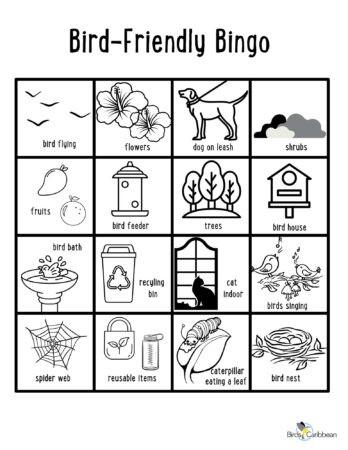
FOR KIDS: Get ready to head out on a bird-friendly adventure with our bird-friendly bingo game! Ask a trusted adult if you can take a walk in your backyard, or go with them on a walk around your neighbourhood. As you walk around look carefully for things that help keep birds safe in your community. You can then mark them off on the bingo card we provide in our game! Get out there and see what you can find!
FOR KIDS AND ADULTS: Enjoy this video of a Northern Yellow Warbler in the wild!
Want to brush up your shorebird ID skills or learn how to conduct Caribbean Waterbird Census (CWC) counts? Keep reading for details about this exciting opportunity!
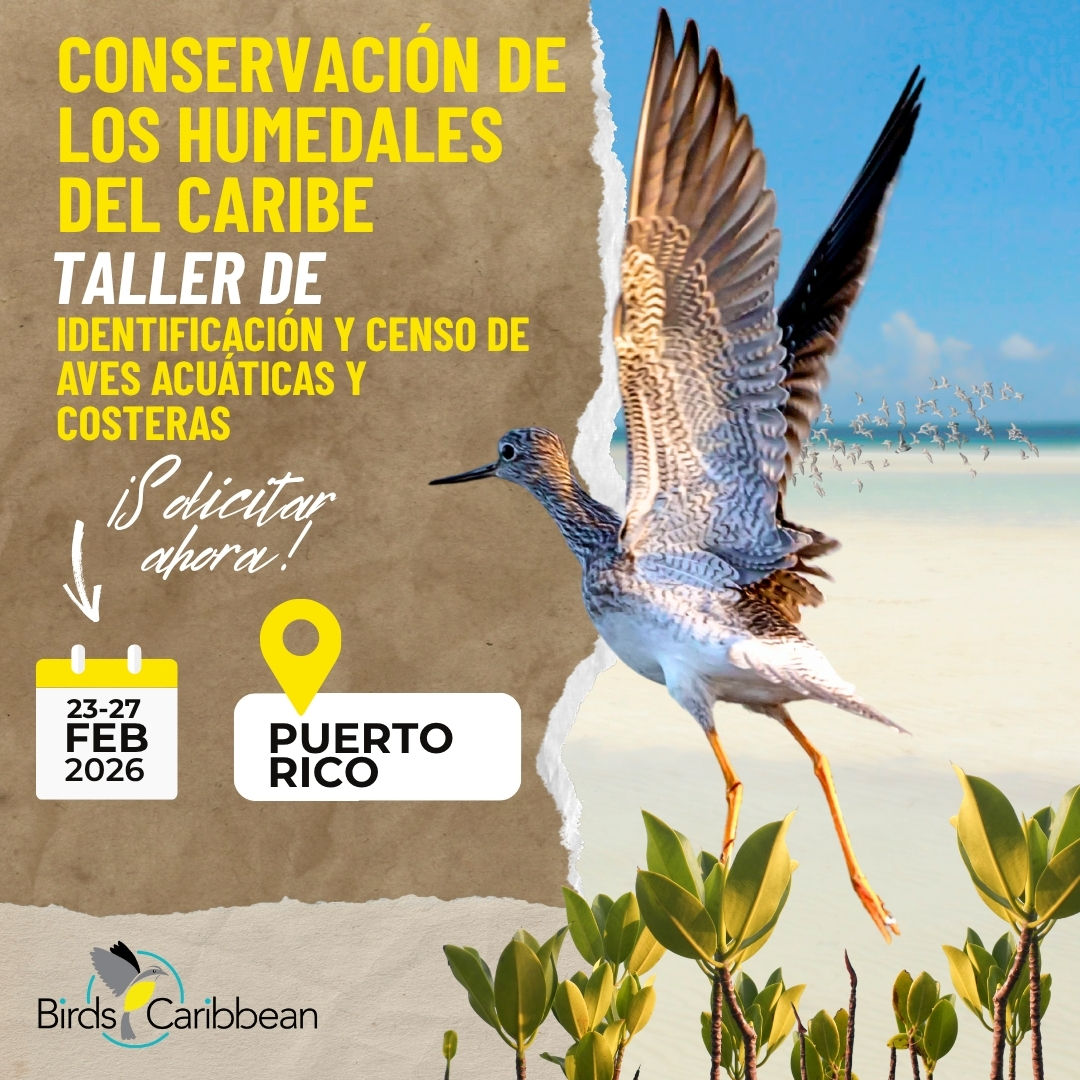
BirdsCaribbean is pleased to invite applications for a five-day training workshop focused on shorebird and waterbird identification and CWC survey methods. Participants will strengthen their ID skills, and learn counting and survey techniques through a blend of classroom and field-based activities. We’ll also explore key threats to shorebirds and wetlands and discuss conservation solutions.
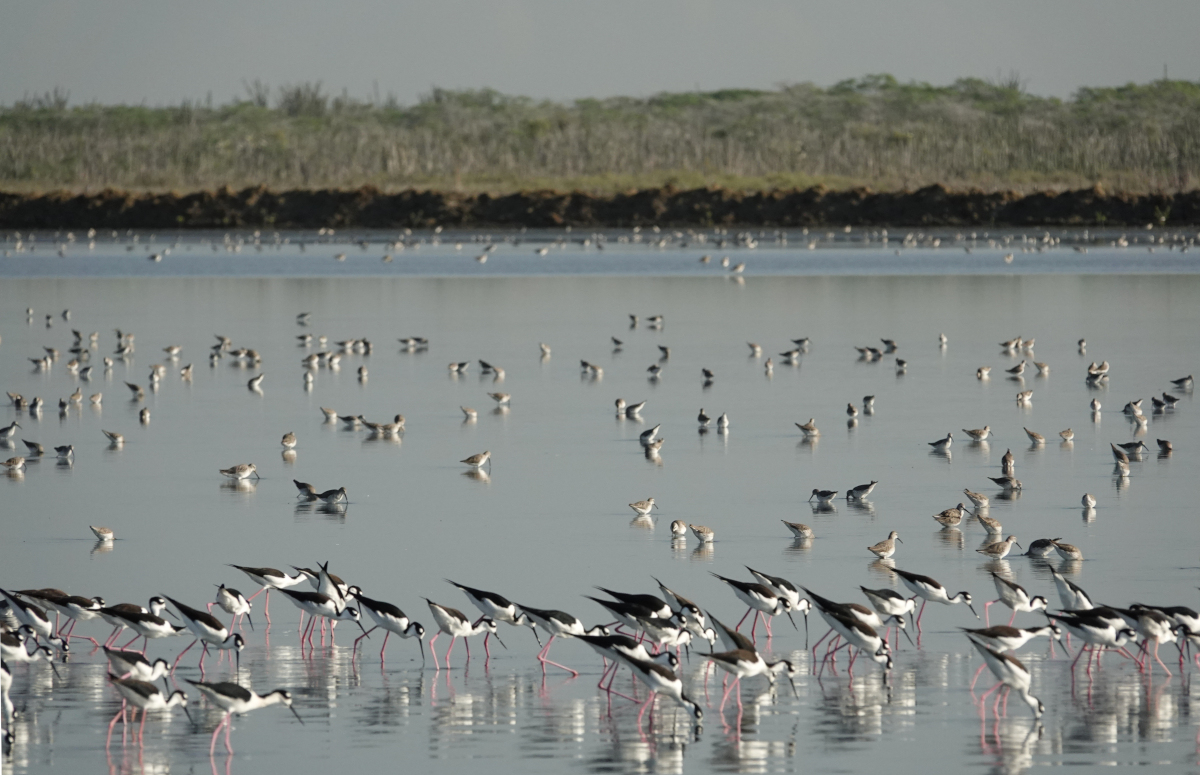
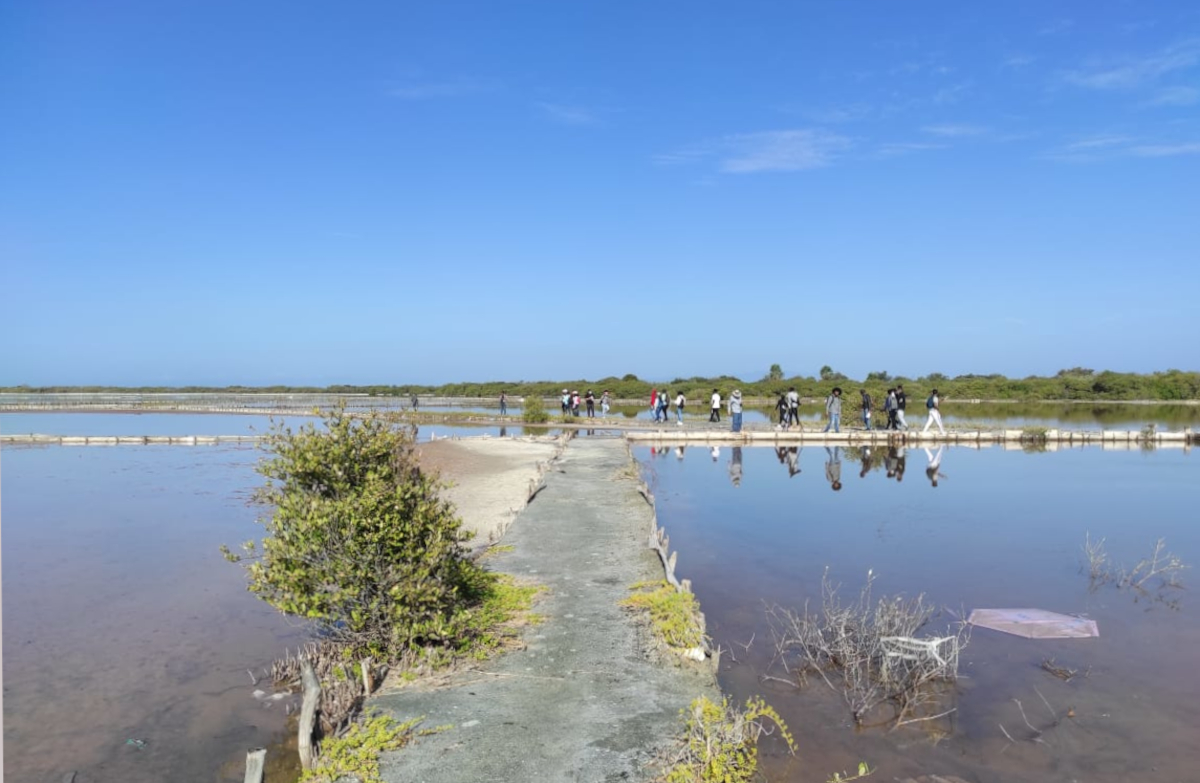
We’re delighted to host this workshop at Jobos Bay National Estuarine Research Reserve in Puerto Rico, thanks to a partnership with JBNERR. from 23-27 February, 2026 — mark your calendars! JBNERR is on the Southern coast of Puerto Rico. With mangroves, salt flats, and seasonal lagoons it’s a haven for thousands of migratory shorebirds, and hosts a wonderful diversity of other waterbirds. It’s the perfect place to learn more about CWC and waterbird ID!
Why count shorebirds and waterbirds?
Wetlands across the Caribbean are critical for numerous resident and migratory waterbirds — yet they face mounting threats, from coastal development and pollution to land-use change and climate change impacts. In addition, migratory shorebirds are experiencing alarming declines over the last decades, and need our help. Protecting birds starts with understanding where they go and what habitats they rely on.
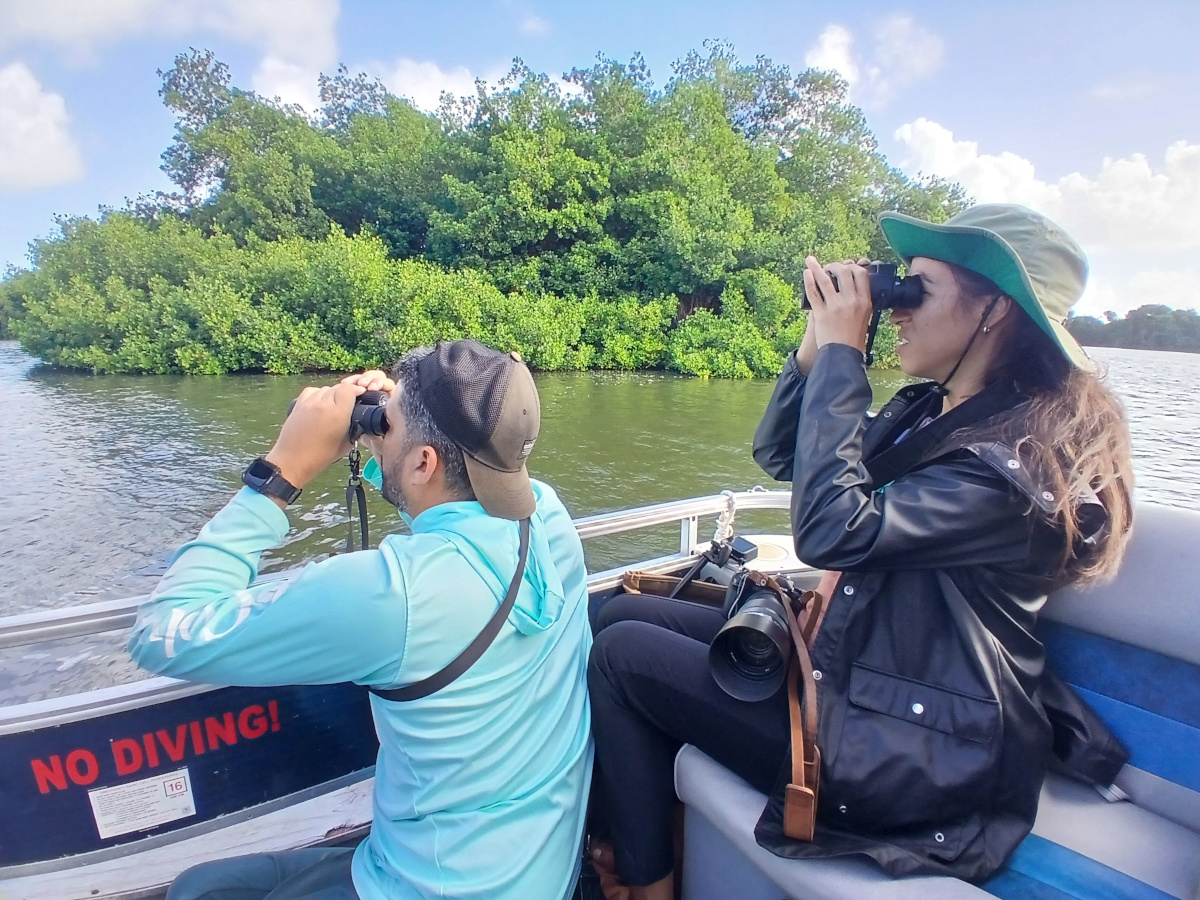
Out in Jobos bay doing CWC surveys by boat. (Photo by Carmen Maldonado)
Monti Cristi in the Dominican Republic is estimated to host 20,000+ migrating shorebirds per year—making it a regionally important site! (Photo by Maria Paulino)
Great Blue Heron, Blassina Puerto Rico. (Photo by Eliezer Nieves)
Systematic bird monitoring allows us to:
Identify key habitats and stopover sites
Understand migration patterns and threats
Prioritize areas for protection or restoration
Track the success of conservation and management actions
Critical data on shorebird migration, especially during fall migration, are still lacking in the Caribbean. Expanded monitoring across regional wetlands will help identify and safeguard priority sites—advancing Caribbean biodiversity goals and supporting global shorebird conservation efforts.
About the workshop
This will be the 6th CWC Training Workshop in the region — and the first in seven years! Like our 2019 event, it will cover essential topics in waterbird monitoring and conservation.
This bilingual (English and Spanish) workshop is designed for Caribbean wildlife professionals and volunteers interested in strengthening their waterbird and shorebird ID and survey skills. Prior experience is helpful, but not required. The workshop is open to anyone eager to learn more about waterbird monitoring techniques—especially those who wish to initiate or expand waterbird and wetland monitoring programs in their home countries. Preference will be given to individuals working in protected areas, wetland conservation, or bird monitoring with government agencies or NGOs in the Caribbean, as well as those committed to launching or growing a CWC monitoring program.
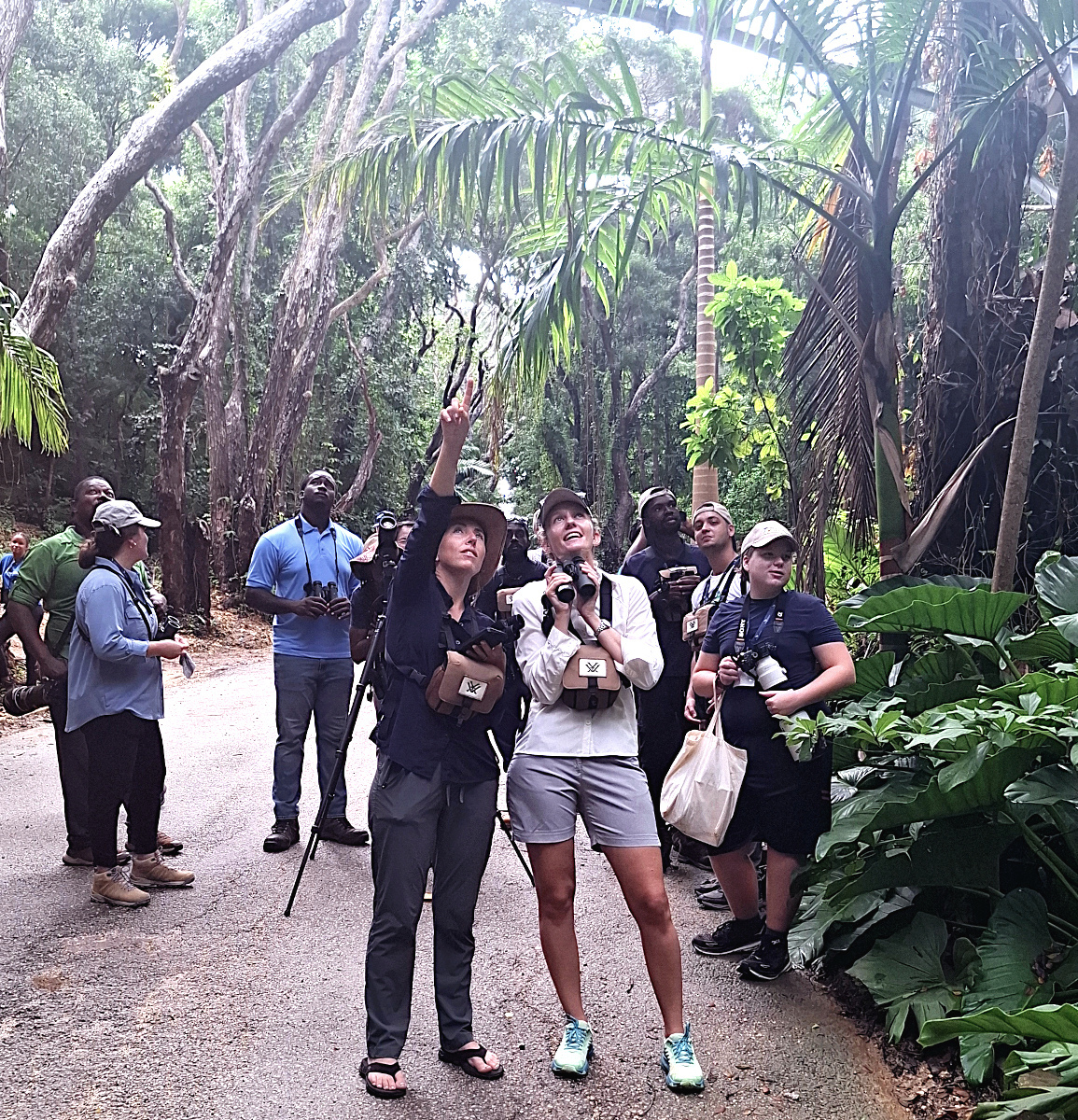
Field trip within Cabo Rojo National Wildlife Refuge. (Photo by Lisa Sorenson)
The goals of the workshop are to:
Increase awareness and appreciation of the Caribbean’ importance for shorebirds and waterbirds
Build confidence in identifying common Caribbean shorebirds
Share information waterbird ecology and the threats that they face
Provide participants with the knowledge, skills, and tools needed to conduct CWC surveys and contribute to regional monitoring
Inspire and facilitate involvement in conservation action, including raising public awareness, alleviating threats, and restoring habitats that have been damaged
Grow our regional network of CWC monitors and stewards of our shared waterbirds
The workshop will be a mixture of classroom and field trip sessions, meaning there will be daily opportunities to practice survey and identification skills.
Topics covered
Participants will gain comprehensive training in:
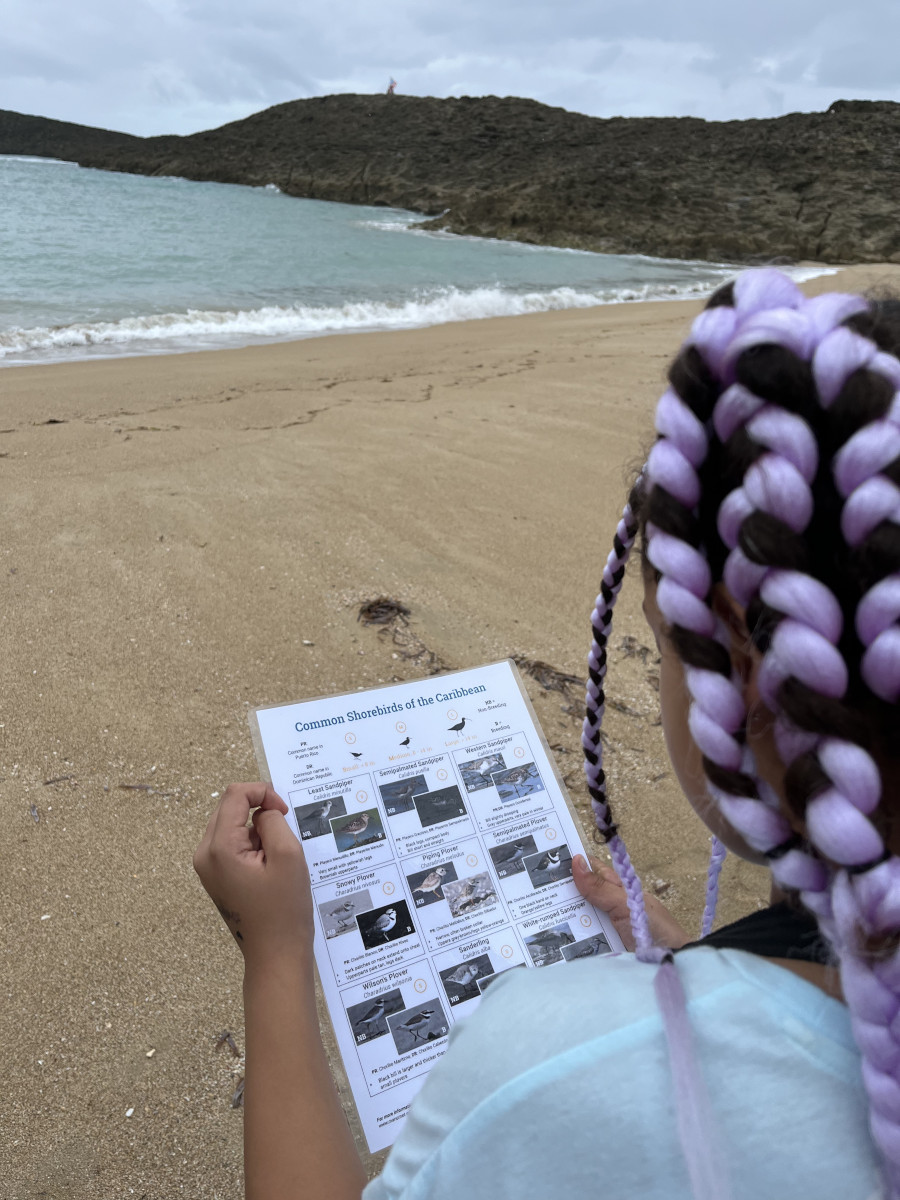
A volunteer uses a Shorebird ID card at a Caribbean Waterbird Census count. (Photo by Dayamiris Candelario OPAS)
Caribbean Waterbird Census (CWC) overview: How to design and implement a monitoring program
Field training in shorebird ID, counting, and wetland habitat monitoring using standardized CWC monitoring techniques
Threats to shorebirds and their wetland habitats (e.g., dumping, habitat destruction and degradation, water mismanagement, invasive species, disturbance, etc.) and education, conservation, and management strategies to mitigate these threats
Engaging citizen scientists and sustaining long-term monitoring
Data entry and use of eBird
Sharing results with decision-makers and the public
By the end of the workshop, you will have received comprehensive training in both CWC survey techniques and field identification of Caribbean shorebirds. You will be equipped to monitor wetland sites (including changes in condition and threats), recruit and train new volunteers, and raise awareness about waterbird conservation in your community.
Funding and Logistics
We aim to include approximately 25 participants in this workshop. BirdsCaribbean has funding for a limited number of need- and merit-based scholarships to cover travel and participation costs. Specific funds are available for nationals of Puerto Rico and the US Virgin Islands, and we strongly encourage applications from these islands.
Please note: Participants who are not U.S. citizens or permanent residents will need to obtain the appropriate U.S. visa or travel authorization in advance. We strongly encourage you to check your national visa requirements and apply early to ensure entry to Puerto Rico. Find out more here.
Participants who are able to contribute part or all of their expenses will help us include more participants. We encourage applications from all candidates who are well-suited to make use of this training, regardless of their financial ability.
Participants should plan to arrive Puerto Rico by February 22 and depart on February 28.
Applications
If you’re interested in participating in this workshop, please complete the application form by November 25, 2025.
If you have any questions, please send an email to: Alex Sansom (Waterbird.Manager@BirdsCaribbean.org)
We are grateful to the US Forest Service International Programs and Cape Cod Bird Club for providing funding support and to the staff at Jobos Bay National Estuarine Research Reserve for kindly hosting this workshop.
Oportunidad de Capacitación: Conservación de los Humedales del Caribe- Taller de Identificación y Censo de Aves Acuáticas y Costeras
¿Quiere refrescar sus habilidades de identificación de aves playeras o aprender a realizar recuentos del Censo de Aves Acuáticas del Caribe (CWC)? ¡Siga leyendo para obtener más detalles sobre esta emocionante oportunidad!
BirdsCaribbean se complace en invitar a presentar solicitudes para un taller de capacitación de cinco días centrado en la identificación de aves playeras y los métodos de estudio del CWC. Los participantes reforzarán sus habilidades de identificación y aprenderán técnicas de recuento y estudio mediante una combinación de actividades en el aula y en el campo. También exploraremos las principales amenazas para las aves playeras y los humedales y discutiremos soluciones de conservación.
Estamos encantados de organizar este taller en la Reserva Nacional de Investigación Estuarina de la Bahía de Jobos en Puerto Rico, gracias a la colaboración con JBNERR. Del 23 al 27 de febrero de 2026: ¡apúntelo en su calendario! JBNERR se encuentra en la costa sur de Puerto Rico. Con manglares, salinas y lagunas estacionales, es un refugio para miles de aves playeras migratorias y alberga una maravillosa diversidad de otras aves acuáticas. ¡Es el lugar perfecto para aprender más sobre CWC y la identificación de aves acuáticas!
¿Por qué contar las aves costeras y acuáticas?
Los humedales del Caribe son fundamentales para numerosas aves acuáticas residentes y migratorias, pero se enfrentan a amenazas cada vez mayores, desde el desarrollo costero y la contaminación hasta los cambios en el uso del suelo y los efectos del cambio climático. La protección de las aves comienza por comprender adónde van y de qué hábitats dependen.
Out in Jobos bay doing CWC surveys by boat. (Photo by Carmen Maldonado)
Monti Cristi in the Dominican Republic is estimated to host 20,000+ migrating shorebirds per year—making it a regionally important site! (Photo by Maria Paulino)
Great Blue Heron, Blassina Puerto Rico. (Photo by Eliezer Nieves)
El monitoreo sistemático de las aves nos permite:
Identificar hábitats clave y lugares de parada
Comprender los patrones migratorios y las amenazas
Priorizar las áreas para su protección o restauración
Hacer un seguimiento del éxito de las medidas de conservación y gestión
En el Caribe aún se carece de datos críticos sobre la migración de las aves costeras, especialmente durante la migración otoñal. La ampliación del monitoreo en los humedales regionales ayudará a identificar y salvaguardar los sitios prioritarios, lo que contribuirá a avanzar en los objetivos de biodiversidad del Caribe y respaldará los esfuerzos mundiales de conservación de las aves costeras.
Acerca del Taller
Este será el sexto taller de capacitación de la CWC en la región, ¡y el primero en siete años! Al igual que nuestro evento de 2019, cubrirá temas esenciales sobre el monitoreo y la conservación de las aves acuáticas.
Este taller bilingüe (inglés y español) está diseñado para profesionales y voluntarios del ámbito de la vida silvestre del Caribe interesados en mejorar sus habilidades para identificar y estudiar aves playeras. Se valora la experiencia previa, pero no es imprescindible. El taller está abierto a cualquier persona que desee aprender más sobre las técnicas de monitoreo de aves acuáticas, especialmente a aquellas que deseen iniciar o ampliar programas de monitoreo de aves acuáticas y humedales en sus países de origen. Se dará preferencia a las personas que trabajen en áreas protegidas, conservación de humedales o monitoreo de aves con agencias gubernamentales u ONG en el Caribe, así como a aquellas comprometidas con el establecimiento o el crecimiento de un programa de monitoreo de la CWC.
Los objetivos del taller son:
Aumentar la concienciación y la apreciación de la importancia del Caribe para las aves playeras y acuáticas.
Fomentar la confianza en la identificación de las aves playeras comunes del Caribe.
Compartir información sobre la ecología de las aves acuáticas y las amenazas a las que se enfrentan.
Proporcionar a los participantes los conocimientos, las habilidades y las herramientas necesarias para realizar estudios de aves acuáticas y contribuir al monitoreo regional.
Inspirar y facilitar la participación en acciones de conservación, incluyendo la sensibilización del público, la mitigación de amenazas y la restauración de hábitats que han sido dañados.
Ampliar nuestra red regional de monitoreos de la CWC y guardianes de nuestras aves acuáticas comunes.
El taller será una combinación de sesiones en el aula y excursiones, lo que significa que habrá oportunidades diarias para practicar las habilidades de estudio e identificación.
Temas de Discusión
Los participantes recibirán una capacitación completa en:
Descripción general del Censo de Aves Acuáticas del Caribe (CWC): cómo diseñar y poner en práctica un programa de monitoreo.
Capacitación de campo en identificación de aves costeras, recuento y monitoreo de hábitats de humedales utilizando técnicas de monitoreo estandarizadas del CWC.
Amenazas para las aves costeras y sus hábitats de humedales (por ejemplo, vertidos, destrucción y degradación del hábitat, mala gestión del agua, especies invasoras, perturbaciones, etc.) y estrategias de educación, conservación y gestión para mitigar estas amenazas.
Participación de científicos ciudadanos y mantenimiento de un monitoreo a largo plazo.
Introducción de datos y uso de eBird.
Compartir los resultados con los responsables de la toma de decisiones y el público.
Al finalizar el taller, habrá recibido una capacitación completa tanto en las técnicas de estudio de la CWC como en la identificación de campo de las aves playeras del Caribe. Estará preparado para supervisar los humedales (incluidos los cambios en su estado y las amenazas), reclutar y formar a nuevos voluntarios y sensibilizar a su comunidad sobre la conservación de las aves playeras.
Financiación y Logística
Nuestro objetivo es incluir aproximadamente 25 participantes en este taller. BirdsCaribbean dispone de fondos para un número limitado de becas basadas en las necesidades y los méritos, que cubren los gastos de viaje y participación. Hay fondos específicos disponibles para los ciudadanos de Puerto Rico e Islas Vírgenes de los Estados Unidos, por lo que animamos encarecidamente a los residentes de estas islas a que presenten su solicitud.
Nota: Los participantes que no sean ciudadanos estadounidenses ni residentes permanentes deberán obtener con antelación el visado estadounidense o la autorización de viaje correspondientes. Le recomendamos encarecidamente que verifique los requisitos de visado de su país y lo solicite con antelación para garantizar su entrada a Puerto Rico. Más información aquí.
Los participantes que puedan contribuir con parte o la totalidad de sus gastos nos ayudarán a incluir a más participantes. Animamos a todos los candidatos que reúnan los requisitos para aprovechar esta capacitación a que presenten su solicitud, independientemente de su capacidad económica.
Los participantes deben planificar su llegada a Puerto Rico para el 22 de febrero y su salida para el 28 de febrero.
Solicitudes
Si está interesado en participar en este taller, complete el formulario de solicitud antes del 25 de noviembre de 2025.
Si tiene alguna pregunta, envíe un correo electrónico a: Alex Sansom (Waterbird.Manager@BirdsCaribbean.org)
Agradecemos al US Forest Service International Programs y al Cape Cod Bird Club su apoyo financiero y al personal de la Jobos Bay National Estuarine Research Reserve por aceptar acoger este taller.
The 60th anniversary of the International Waterbird Census (IWC) is coming up! We’d love for the Caribbean to contribute to the celebration that Wetlands International is planning. They are collecting waterbird survey stories from all around the world to share, showing the amazing breadth and enthusiasm for waterbird monitoring and conservation. You can make sure the Caribbean is showcased. Read on to find out how!
The Caribbean Waterbird Census (CWC) is one of five regional International Waterbird Census –which means counts from the CWC regional count contribute to this amazing global database! It also means that YOU can be part of the IWC 60th anniversary celebrations.
Wetlands International is sharing these ‘post cards from the field’ on a story map. Currently the Caribbean is looking a little bit empty but by adding your story you can change that!
Your ‘story’ can be very short (just one paragraph). You can share about who you are and where your do your counts; or about a memorable day in the field or an exciting bird you’ve seen during your counts or anything else you’d like to tell people about the birds and wetlands you do CWC counts in! If you need some inspiration for the type of story that might work, take a look at https://iwc.wetlands.org/postcards where you can see other people’s contributions.
Will you send a postcard from the field? All you need to do is:
Grab your fave photo from any CWC count
Write some short text about your CWC counts
Share them using the Google form (below)
You can share your story in English, French or Spanish, just chose your preferred language and click on the link to the form:
Celebrate World Migratory Bird Day (WMBD) with us in 2025! This year’s theme is “Shared Spaces: Creating Bird-friendly Cities and Communities”. Have fun learning about a new migratory bird every day. We have coloring pages, interesting facts, activities, and more. Download for free and enjoy nature with your family at home.
Migratory Bird of the Day: American Golden-Plover
This shorebird is golden! In breeding plumage the American Golden-Plover, a medium-sized, bowling-pin shaped shorebird, is spangled with golden flecks across its wings and back. This beautiful plumage contrasts with a black face and underside, bordered with white on the head and neck. They are a striking sight!
Outside the breeding season they have a change of wardrobe, molting into a more demure plumage. Males and females are both speckled brown with a pale eyebrow and dark cap. They lose their black underparts which become buffy and speckled. In non-breeding plumage American Golden-Plovers can be easy to confuse with Black-bellied Plovers. American Golden-Plovers are smaller and slighter looking, with a finer bill. They also lack the black ‘wing-pits’ sported by the Black-bellied Plover, you can get more ID tips here.
American Golden-Plovers breed in the Arctic, laying their eggs in ‘scrapes’ (a shallow depression on the ground), on the tundra. When breeding is over and it is time for them to head south these shorebirds really are migration masters! They make an epic journey south, with many individuals making the long flight from the east coast of North America down to South America without stopping once! Adults head off in late July and August, but they leave their chicks behind to follow later. These young birds might stay in the north until October, after which they also head to South America.
In the Caribbean we mainly see American Golden-Plovers during fall migration. Birds not able to do a non-stop trip all the way to South America will land to rest and refuel in Caribbean wetlands. American Golden-Plovers like to flock together and you might also spot them hanging out with other ‘shorebird friends’ like the Pectoral Sandpiper. You can look for them in wet grassy areas, agricultural areas like rice fields as well as on mudflats, and shorelines. Here they will be feeding on a variety of insects and insect larvae, as well as worms and mollusks.
Unfortunately, American Golden-Plover populations are declining and they have lost more than 50% of their population in the past 50 years. One of the main threats to them during migration is loss of habitat. This includes changes caused by unfavorable agricultural practices including, intensification, drainage and pesticides, and the conversion of their habitats to other uses such as residential developments and conversion of grasslands to row-crops. This beautiful shorebird relies on wet grasslands with healthy insect populations so switching to organic fertilizers and reducing pesticide use can help them out. Learn more about this species, including its range, photos, and calls here. Great news! If you’re in the Caribbean, thanks to BirdsCaribbean, you have free access to Birds of the World and you can find out even more in the full species account of this bird!
Thanks to Alex Sansom for the text and Arnaldo Toledo for the lovely illustration!
Color in the American Golden-Plover
Download the Migratory Birds of the Day Coloring Page! Use the picture above and the photos on this page as your guide, or look up pictures of the bird online or in a bird field guide if you have one. Share your colored-in page with us by posting it online and tagging us @BirdsCaribbean #WMBD2025Carib
Listen to the calls of the American Golden-Plover
The call of the American Golden-Plover is a plaintive “pleedoo”
Enjoy these photos of American Golden-Plovers
American Golden-Plover in non-breeding plumage. (Photo by Hemant Keshan)American Golden-Plover in flight. (Photo by James MacKenzie, Macaulay Library- ML481014871)
Flock of American Golden-Plovers molting out of their breeding plumage. (Photo by Jack Starret, Macaulay Library-ML623806656)
Activity of the Day
FOR KIDS: American Golden-Plovers have seriously long migrations. Flying 1000s of miles nonstop over the ocean until they reach their final destinations. Because they have so far to go, golden-plovers fly at high speeds. Studies tracking the birds found they averaged over 30 mph—that’s as fast as a car driving on a main road. Sometimes they even reached more than 80 mph, during their long flights over the ocean!
In this activity you’re your own paper bird so it can be ready for its own long journey!
With the help of an adult, get ready to help your bird get its wings by gathering the following materials:
printed flapping bird template
scissors
glue
string
crayons, colored pencils or markers
You can download all the information, instructions and worksheet here.
FOR KIDS AND ADULTS: Enjoy this video of a American Golden-Plover in the wild!
We’re thrilled to share that BirdsCaribbean’s 25th International Conference—our Silver Anniversary!—will be held in Trinidad & Tobago, July 23–27, 2026.
Prepare for a powerful gathering of the brightest minds in Caribbean ornithology. At BirdsCaribbean conferences, we don’t just talk about a future where birds and people thrive — we forge it together. Join us to explore cutting-edge conservation strategies, groundbreaking research, transformative education, and concrete actions that will protect the region’s extraordinary birdlife for generations to come.
What’s in store:
Powerful keynotes from regional and global conservation leaders
Hands-on workshops to level up skills in monitoring, education, tech, and management
Latest research & case studies on avian ecology, habitat protection, monitoring, ecotourism, education, policy, and community engagement programs
Invaluable networking to power your career and spark collaborations
Immersive cultural experiences across the twin-island nation
Unforgettable field trips to world-class birding sites, such as Asa Wright Nature Centre, Caroni Swamp, Nariva Swamp, the Main Ridge Forest Reserve (Tobago), and many more!
Plus the fan favorites: our famously not-so-silent Silent Auction, the BirdsCaribbean Raffle (hello, brand-new spotting scope!), the Photo Contest (hello, new binoculars!), and our new crowd hit: the epic Caribbean Bird Song Showdown—all set against the lush, bird-filled landscapes of Trinidad and Tobago.
This is your official heads-up to hold the dates. More details will be shared in the coming weeks on the venue, costs, registration, field trips, workshops, call for symposia and workshops, abstract submissions, and travel scholarships.
Sponsorship & Support:
We’re thrilled to have the Government of Trinidad and Tobago and HADCO Experiences—our Pawi-level sponsor and official Conference Co-Host—already on board. Their leadership and commitment to regenerative tourism and sustainable Caribbean development are helping make this landmark event possible. HADCO’s partnership reflects our shared vision for a Caribbean where conservation and sustainable tourism thrive together—benefiting both people and wildlife.
To ensure the conference’s success, we need your support too. Your contribution can help us bring frontline conservationists, students, and educators from across the Caribbean to share knowledge, build skills, and strengthen our regional network for bird and habitat conservation.
Interested in sponsoring a delegate or becoming a conference sponsor? Please contact:
You can appreciate birds. You can love birds. You can be a birder. You don’t need to hike steep hills, keep a life list, own expensive binoculars, or even have sight to connect with the wonderful world of birds. But this is only true if we ensure that everyone of all abilities is included in the definition of what it means to be a birder. We must challenge the assumption that people with disabilities or chronic illnesses are not interested in, or able to, experience the joys of birdwatching. They are, and they care deeply about their birdwatching communities, birds, and their habitats.
Virginia Rose, disability rights advocate and founder of the non-profit Birdability, who has been a wheelchair user for over forty years knows how challenging it can be to enjoy nature as a disabled person. But her use of a mobility aid did not diminish her curiosity about the world around her. As she inspiringly shared, “the only thing that I felt really changed was that I had to manage getting around in a wheelchair.”
Founder and President of Birdability, Virginia Rose. (Photo credit: birdability.org)
It is this desire to explore and connect with the world that has fueled her dedication to increasing access to nature for people of all abilities — and to helping them find community. Inspired by movements like Latino Conservation Week and Let’s Go Birding Together, Virginia founded Birdability in 2020. Birdability’s vision is simple yet profound: birding is for everyone, regardless of ability.
Our partners in Antigua and Barbuda, the Dominican Republic, Puerto Rico, Cuba, St. Vincent and the Grenadines and Margarita Island are exploring ways to make their birding events more welcoming and inclusive. And we would love to see more of these events taking place throughout the region, whether it’s allowing visually impaired participants to “see” birds by handling carved wooden birds, as done by Sociedad Ornitólogica Puertorriqueña, or learn to ID birds using bird songs, as done by Simón Guerrero.
A member of the Antigua and Barbuda Association of Persons with Disabilities birdwatching with staff from the Environmental Awareness Group. (Photo by Sherrel Charles)
In the coming weeks, we will be speaking with Caribbean bird educators who have successfully hosted inclusive events. Through their stories and advice, we will share what’s needed to plan and host such events — creating a practical roadmap for a more accessible birding community.
Stay tuned for their insights and a practical guide to planning your own accessible birding event by signing up to our mailing list.
Birdability Week (20th-26th October 2025) offers the opportunity for birding groups, non-governmental organizations, and groups of family and friends to host an accessible bird outing. With some thoughtful planning this event can be enjoyable for everybody. The 2025 theme is “You Belong Here.”
Birdability focuses on people with mobility challenges, blindness or low vision, chronic illness, intellectual or developmental disabilities, mental illness, and those who are neurodivergent, deaf or hard of hearing, or have other health concerns. So if you are looking for information and resources to help your organization be more mindful and inclusive of these birders please check Birdability’s website!
Watch the Birds or Follow the Birdsong — Birding is for ALL
Help Put Accessible Birding Locations in the Caribbean on the Map!
There is also a Birdability Site Map which allows you to share your accessible location, and to search for potential accessible sites near you. The majority of the locations are in North America and a few have been identified in Central America and South America. If you know of accessible birding locations on your island we encourage you to complete on-site, in-person Birdability Site Reviews and add them to the Birdability Map.
Birdability Site Map showing locations of nature reserves and parks with varying degrees of accessibility. (Photo credit: birdability.org)
Attend a Virtual Event and Connect with Differently Abled Birders
There are a number of virtual events already scheduled — from panel discussions about accessibility in conservation to nature journaling and field safety for Birdability Week 2025.
Together we can build a more welcoming community and ensure that the joy of birding is a shared experience for everyone, everywhere. The key is to remember that the birding community is strongest when it includes all of its members, and that a love for birds knows no bounds.
Colorful and friendly, the Cuban Tody is one of Cuba’s most beloved endemic birds. (photo by Aslam Ibrahim)
Join BirdsCaribbean, the Caribbean Birding Trail, and expert Cuban bird guides, Ernesto Reyes Mourino and Tania Piñeiro, on the adventure of a lifetime! Choose from our January, February, or March 2026 trips to explore Cuba’s spectacular landscapes, vibrant culture, and extraordinary birdlife. The tour is perfect for individuals, couples, and groups of friends looking for a truly unique experience! Several spaces still available for our January trip – sign up today!
New for 2026 – Birding, Culture, and Jazz Festival Tour in January!
With over 400 bird species recorded, including 29 unique endemics and 21 globally threatened species, Cuba is a birder’s paradise. Its expansive landscapes and prime Caribbean location make it a critical stopover and wintering site for over 180 Neotropical migratory species, creating rare opportunities to observe both endemic and migratory birds.
Our carefully crafted itinerary takes you to Cuba’s premier birding locations, where you’ll encounter the island’s diverse avifauna. Along the way, you’ll connect with Cuban ornithologists, guides, and community members; stay in welcoming casas particulares (Bed & Breakfast establishments); and dine in cozy paladars (private restaurants), giving you an authentic taste of Cuba’s rich culture, delicious food, and warm hospitality. Discover Cuba through its birds, landscapes, and people—join us for an unforgettable experience in 2026!
Explore, Enjoy, and Empower: Why you’ll Want to Book this Trip ASAP!
Your trip, led by outstanding and experienced certified Cuban guides Ernesto Reyes & Tania Piñeiro, and group leaders Lisa Sorenson (Executive Director, BirdsCaribbean, January trip), Holly Garrod (Bird Banding Network Coordinator, BirdsCaribbean, February trip), and Jeff Gerbracht (Checklist Working Group Co-Chair, BirdsCaribbean, March trip), combines expert guidance with local insights. Your adventure includes hassle-free Cuban visa arrangements, dedicated driver and first-class bus transportation, bilingual guides, accommodations, meals and non-alcoholic drinks (with tips at restaurants taken care of), and admission fees for all itinerary locations, ensuring a seamless experience.
Traveling with us not only lets you experience the beauty of Caribbean birds, it also directly supports their conservation. A portion of your trip proceeds goes towards our bird conservation programs and partners in Cuba and the Caribbean. Enjoy unforgettable sightings of some of the world’s most iconic birds, all while contributing to their welfare and supporting the dedicated people who study and protect them.
From Cuba’s majestic mogotes to lush tropical forests to vibrant swamps and wetlands, we explore a wide variety of spectacular habitats. For a glimpse of the incredible bird species you may encounter, take a look at our eBird trip reports.
Still not convinced? Check out the rave reviews at the bottom of this page and see what fellow birders are saying about their unforgettable experiences! See also photos from past trips in the gallery below.
Three exceptional tours to choose from in 2026: a 10-day Birding & Jazz Tour in January, a 9-day Birding Tour in February, and an 11-day Birding Tour in March
See detailed itineraries for our 2026 trips below!
Celebrate World Migratory Bird Day (WMBD) with us in 2025! This year’s theme is “Shared Spaces: Creating Bird-friendly Cities and Communities”. Have fun learning about a new migratory bird every day. We have coloring pages, interesting facts, activities, and more. Download for free and enjoy nature with your family at home.
Migratory Bird of the Day: Hudsonian Godwit
With long elegant legs and a long uptilted bill the Hudsonian Godwit certainly stands out from the crowd. This large shorebird is rusty red in the breeding season, but molts to a pale gray-brown with a white belly for the rest of the year. On migration you might still spot traces of rusty coloration. The bill is bi-colored, with pink at the base and black at the tip. In flight you will spot a white rump and wing-stripe together with dark underwings. This can help you separate them from other, rarer, godwits which might be seen in the Caribbean. Marbled Godwits have cinnamon washed underwings, while Black-tailed Godwits share the white wing stripe and white rump, but have a black tail and do not have a dark underwing.
Hudsonian Godwits breed in the arctic, in areas where boreal forest transitions into wet tundra meadows and bogs. The exact breeding range of this shorebird is not well understood and there are likely to be breeding areas that we don’t yet know about! We do know however that after breeding, Hudsonian Godwits make an incredible migration of nearly 10,000 miles from the arctic, all the way down to their wintering habitat near the southernmost tip of South America. Some birds have even been recorded in the Falkland Islands! This journey involves non-stop flights of thousands of miles, some of it over open ocean.
Hudsonian Godwits are not common visitors to the Caribbean, but they do sometimes take a break here to rest and refuel on their epic migration. You might spot a solo godwit, though sometimes they’ll hang out in small groups. You can find them by ponds or large rainwater pools on flooded agricultural areas (including rice farms) or wet pastures. They also rely on coastal areas including brackish swamps, estuaries, lagoons, and beaches. Hudsonian Godwits mainly eat soil dwelling invertebrates, probing for them in the mud with their long, but surprisingly flexible bills. Their flexible bill-tips allow godwits to bend their bill tip to grasp their prey in thick mud.
Hudsonian Godwits are listed as Vulnerable by the IUCN and their population is thought to be decreasing. This bird already has a relatively small global population, with a fragmented breeding range and a very restricted wintering area. In the Caribbean we can help by supporting wetland habitat protection and restoration efforts and joining wetland clean-ups wetlands; making sure there are places for godwits and other shorebirds to get the resources needed to successfully complete their long journeys. Learn more about this species, including its range, photos, and calls here. Great news! If you’re in the Caribbean, thanks to BirdsCaribbean, you have free access to Birds of the World and you can find out even more in the full species account of this bird!
Thanks to Alex Sansom for the text and Arnaldo Toledo for the lovely illustration!
Color in the Hudsonian Godwit
Download the Migratory Birds of the Day Coloring Page! Use the picture above and the photos on this page as your guide, or look up pictures of the bird online or in a bird field guide if you have one. Share your colored-in page with us by posting it online and tagging us @BirdsCaribbean #WMBD2025Carib
Listen to the calls of the Hudsonian Godwit
In wintering areas the Hudsonian Godwits are typically silent, but you might hear a flock makes soft “wheet, wheet” calls.
Enjoy these photos of Hudsonian Godwits
Hudsonian Godwit. (Photo by Kyle Tansley, Macaulay Library-ML278029941)
Hudsonian Godwit in flight, showing the white rump and wing stripe, and the dark underwing. (Photo by Luke Seitzt, Macaulay Library-ML66903611)
Hudsonian Godwit molting out of breeding plumage. (Photo by Peter Brannon)
Activity of the Day
FOR KIDS: Hudsonian Godwits are incredible travelers! Every year, they fly thousands of miles from the Arctic all the way to South America for the winter. That’s a super long journey! Along the way, they stop at important places called wetlands, like ponds, mudflats, beaches and even flooded farmland. These spots are like a perfect rest stop, full of yummy food like insects, worms, and small crustaceans that help them refuel for the rest of their trip.
With help from an adult, gather the following materials:
A paper plate
Small pebbles
Small sticks
moss
Plastic animals- optional
White cardstock or bristol board
Paints
Markers
Glue
Glue gun (optional)
Once you’ve gathered your materials, it’s time to make a wetland habitat no Hudsonian Godwit can resist! You can download all the information, instructions and worksheet here.
FOR KIDS AND ADULTS: Enjoy this video of a Hudsonian Godwit the wild!
Ready, set—BIRD! It’s time to flock together for the season’s biggest day of birding!
Get ready for a spectacular October Big Day (OBD)! This annual event, falling on Saturday, October 11, 2025, coincides with World Migratory Bird Day(WMBD) and is a thrilling celebration of our feathered friends and the vibrant birding community.
At BirdsCaribbean, we eagerly anticipate October Big Day. This massive citizen science event is a wonderful opportunity for us to unite with fellow bird lovers to share in the joy of birdwatching and the beauty of Caribbean wetlands, forests, botanical gardens, and neighborhoods. This is our chance to celebrate Caribbean birds, support science, and strengthen our conservation efforts.
A group of Lesser Scaups at East End Pond. (Photo by Jacqueline A Cestero)
October 11 is truly the moment to puff out our chests and rack up those eBird checklists!
And there’s more! Global Bird Weekend runs from October 10 to 12, offering even more opportunities to engage and possibly set new world records. Last year, we saw record-breaking participation during Global Bird Weekend — more than 750,000 people from 202 countries submitted 99,317 checklists with eBird — and we’re aiming to surpass that achievement this year.
Let’s make birdwatching history together!
OBD guide for first timers
Welcome and we’re so happy you’re considering spending Saturday 11th October with the birds! Who knows, maybe this will be where your birdwatching lore begins? OBD is a citizen science initiative spearheaded by the Cornell Lab of Ornithology. Scientists team up with members of the public, called citizen scientists, to collect data on birds from midnight to midnight in their local time zone on October 11; or to bird anytime during the weekend of October 10-12 for the Global Bird Weekend.
Data sounds intimidating, doesn’t it? Luckily, it ab-so-lute-ly isn’t. Data here means the checklists of birds you see and hear. Spot a blackbird hopping along your fence? That’s data! Hear a bananaquit tsit tsit tsit-ing in your mango tree? You got it — that’s data too!
Bananaquits are found throughout the Caribbean. They have a sharp, curved bill, black head and upperparts with a white eyestripe, gray throat, and yellow underparts. (Photo by Dominic Sherony)
But your data must be submitted via the eBird app or website to count.If you do not already have a free eBird account,, it’s easy to sign up — and here’s a quick guide on how to use eBird. The handy mobile app allows you to seamlessly keep and submit lists, in-the-moment, all while you’re out birding — perhaps exploring nearby hotspots. It will even track how far you have walked while watching birds.
Remember to submit your eBird checklists before October 14, 2024 to be included in the initial results announcement!
Checklists for conservation
Every checklist submitted gives scientists at the Cornell Lab of Ornithology and beyond real-time, worldwide insights into bird populations, migration patterns, and important habitats that might be at risk. Without the collective effort of birdwatchers like you, gathering such a vast and diverse dataset would be impractical, making your participation essential to understanding and protecting birds in the Caribbean and across the globe.
Entering data into eBird. (Photo by Holly Garrod)
The information you collect and share helps paint a clearer picture of how bird populations are faring in the face of devastating existential threats, like habitat loss and climate change. By identifying where birds are thriving or declining, conservationists can make informed decisions about where to focus their efforts, implement protective measures, and advocate for policies that safeguard these species. Ultimately, your observations translate to the protection and survival of birds — but they also form part of your legacy, part of the mark that you chose to make on the world. A legacy of care ensures that future generations can continue to enjoy the beauty and diversity of our beloved birds.
Some additional tips from the OBD veterans:
Check your checklists: By submitting complete checklists of the birds you see and hear you give scientists a comprehensive understanding of the bird community in your area. Counting birds is easy until you encounter a large flock…of mixed species of birds! Keep calm and check out eBird’s advice on how to count big flock of birds, multiple flocks, or big groups of mixed species here. You also want to keep multiple checklists throughout the day. The shorter the duration and distance of your checklist, the more valuable your data becomes. Long checklists that cover large areas make it hard to pinpoint exactly where and when birds were present.
Make connections: Birdwatching can be a peaceful solo activity, like a serene stroll through the forest punctuated by bird sightings. But it’s also a fantastic social experience, providing a great way to meet like-minded friends! And there’s so much to learn from fellow birders — they can help with spotting and identifying birds (especially those tricky warblers), and will even help you navigate the eBird app and submit your very first eBird checklist!
Connect with your local environmental or birding club — there’s a good chance someone is organizing a birding event for October Big Day on your island, and they’d be thrilled to have you join in!
Surfrider Foundation Puerto Rico’s small but dedicated birding group at Playa Table Rock for CEBF and GBD 2024. (Photo by Surfrider Foundation Puerto Rico)
Don’t wing it: Make a to-pack list and use a backpack. Remember to pack your field guide, stylish and functional BC buff, medicine, water, and food too! If you’re birding in an unfamiliar place, make a trip plan. Be sure to consider where you might park your car, the amount of time you plan to spend birdwatching, how far you want to walk, and tell your friends and family about your plans and where you will be.
Embrace being a beginner birder: If you’re a newbie don’t let anxiety keep you from discovering the wonderful world of birds. Early mornings are perfect for spotting warblers, while raptors soar as the day heats up. Seagulls and shorebirds are ever-present, and you might catch tanagers and bullfinches at their most active during the late afternoon.
Show off your bird sightings and let us in on the birding blast!
Don’t forget to share your birding stories and photos with us on social media. Follow us on Facebook and Instagram @birdscaribbean and tag us in your posts. If social media isn’t your thing, join our discussion group with over 950 members to share your October Big Day experiences.
If you’re getting excited about soaring into the world of birds, we’d love to remind you that a BirdsCaribbean membership has so many benefits: you will receive discounts on our products, workshops, and conferences; meet and network with fellow birders, scientists, educators and conservationists across the region; and keep in touch with birding trends and news through our monthly newsletters (free sign-up here). Join us today to help protect Caribbean birds and their habitats.
Let’s make October Big Day 2025 unforgettable. Have a blast, remember to stay hydrated, and tag @BirdsCaribbean in all your birding adventures!
Nestled in the eastern Caribbean, St. Vincent and the Grenadines is more than a multi-island travel destination offering stunning coastlines. The lush peaks and valleys of mainland St. Vincent are home to rare wildlife, including two species of profound importance: the vibrant St. Vincent Amazon, localled called ‘Vincy Parrot,’ and the elusive Whistling Warbler. These birds, found nowhere else on Earth, are fundamental to the island’s natural heritage and national identity.
St. Vincent Amazon. (Photo by Faraaz Abdool ML572563461)
However, their habitats face significant threats. The catastrophic eruption of La Soufrière volcano in 2021, after 40 years of low activity, followed by the devastating impact of Hurricane Beryl in 2024, underscored the urgent need for focused conservation efforts. These events brought attention to the uniqueness of the island’s biodiversity and led to a renewed commitment to safeguarding its threatened species.
Dense and steep mountains in Silver Spoon, a well-known Whistling Warbler habitat. (Photo by Kaitlyn Okrusch)
Following the 2021 eruption, a conservation emergency group led by BirdsCaribbean quickly raised funds to assist the St. Vincent and the Grenadines Forestry Department (SVGFD). On-the-ground efforts included providing supplemental food to parrots, searching for injured parrots and administering first-aid, and repairing park infrastructure like observation decks and signs. The SVGFD also conducted a census of the St. Vincent Amazon at watch points across the parrot’s range.
Whistling Warbler spotted on La Soufriere Windward Trail. (Photo by Jonathan Slifkin ML621602299)
Over the last several years, projects funded by CEPF and UNDP were launched to research the ecology of the St. Vincent Amazon and Whistling Warbler, build local landbird monitoring capacity, and prepare Conservation Action Plans.
The primary goal of this workshop was to unite species experts, natural resource managers, environmental advocates, and other stakeholders to create strategic Conservation Action Plans for the Whistling Warbler and the St. Vincent Amazon. A wide coalition of partners, including BirdsCaribbean, Re:wild, the SVGFD, Science Initiative for Environmental Conservation and Education (SCIENCE), St. Vincent and the Grenadines Environment Fund (SVGEF), Ministry of Tourism, Civil Aviation, Sustainable Development and Culture, National Parks, Rivers and Beaches Authority, Amazona Nest, Sustainable Grenadines Inc., Wild Dominique, and researchers from Florida International University and Antioch University, convened in St. Vincent.
This collaborative effort is a pivotal milestone, leveraging existing partnerships and scientific insights to forge a unified strategy for the conservation of these birds. As Cuthbert Knights, Permanent Secretary of the Ministry of Agriculture, Forestry, Fisheries, Rural Transformation, Industry, and Labour stated in his opening remarks, “This workshop is a demonstration of our shared purpose to protect the St. Vincent Amazon and Whistling Warbler. These birds are more than national treasures, they are living symbols of our natural heritage…there is an urgent need to understand and better protect the island’s rich biodiversity. ”
So what exactly is a Conservation Action Plan?
Each Conservation Action Plan is a unique roadmap tailored to conserve a species or habitat within specific ecological and social contexts. It provides a structured approach, outlining specific, measurable goals and objectives along with the actions, timelines, and resources required to achieve them. The plan guides all stakeholders, helping them work together to safeguard the future of the species or habitat.
Before we begin…
To set the stage for discussions during the workshop, BirdsCaribbean and partners from Florida International University, Cornell Lab of Ornithology and Antioch University hosted two webinars to equip registered participants with the latest research and findings on the Whistling Warbler and St. Vincent Amazon.
Post-Eruption Assessment and Habitat Associations of the Whistling Warbler: Insights for Conservation Action (Dr. Lisa Sorenson and Dr. Mike Akresh)
Spatial and Temporal Distribution of the St. Vincent Amazon (Amazona guildingii) Using Passive Acoustic Monitoring (Dr. Cristina Gomes and Dr. Vijay Ramesh):
]
Three Days of Focused Conservation
The three-day workshop, held at the Anglican Pastoral Centre in Kingstown, explored the multitude of interconnected reasons to conserve both species, identified key challenges to their protection, and developed practical solutions to overcome these hurdles.
While most people agree that protecting threatened species secures healthy ecosystems and a better future for everyone, the reasons for conserving the St. Vincent Amazon are deeply personal.
Justin Springer welcomes participants to the workshop. (Photo by Lisa Sorenson)
Day 1 of the workshop: Collaboration is in session!
When workshop facilitator and Re:wild’s Caribbean Program Officer, Justin Springer, asked the group why we should conserve the parrot, the response was immediate and unanimous: the parrot is an essential element of their national identity, heritage, and culture. The discussion also expanded to the parrot’s role as a plant mutualist, acting as a seed disperser, and its importance for avitourism. Participants agreed the parrot holds an inherent value independent of its use to humans, celebrated simply for its beauty.
SVG Forestry Officer Samuel Harry writes down his reason for conserving the St. Vincent Amazon. (Photo by Lisa Sorenson)
The ecological, cultural, and economic importance of the St. Vincent Amazon highlighted by participants. (Photo by Lisa Sorenson)
Adding a moral dimension, U.S. Fish and Wildlife Service (USFWS) Wildlife BiologistDr. Thomas White offered a powerful call to action, sharing: “Humans are the main drivers of extinction. We have the ability to recognize the damage we have done and it is morally incumbent upon us to right that wrong.”
While the reasons for conserving the St. Vincent Amazon were rooted in identity and heritage, the discussion around the Whistling Warbler focused a bit more on its ecological role. Participants highlighted the need to protect the species because of its importance in controlling insect pest populations. They also noted the uniqueness of he warbler, being endemic to the island, and that it deserved to be similarly celebrated and conserved. The group also noted the lack of ecological information about the Whistling Warbler, with Forestry Officer III Leon Matthews noting, “We don’t know a lot about the Whistling Warbler.”
Forestry Officer Felicia Baptiste adds her reason for conserving the Whistling Warbler.
The ecological, cultural, and economic importance of the Whistling Warbler highlighted by participants. (Photo by Lisa Sorenson)
Peril in Paradise
The workshop then shifted its focus to the challenges faced in protecting the St. Vincent Amazon and Whistling Warbler.
To tackle these complex challenges, Justin introduced a structured approach. He asked everyone to write down the various threats they had identified on individual sheets of paper. These were then used to construct a “problem tree” on a wall, with the core issue “extinction of the Whistling Warbler/ St. Vincent Amazon” at the crown of the tree and the various challenges forming the branches. This visual method offered several key benefits. It allowed the group to see the interconnectedness of the challenges, prioritize issues that need urgent attention, identify root causes of the problems, and build understanding and consensus among the diverse group.
Justin explains what is a Problem Tree before asking participants to list threats to the survival of the St. Vincent Amazon. (Photo by Lisa Sorenson)
Justin uses the Asian Elephant extinction crisis to explain how a problem tree is created and then analyzed. (Photo by Lisa Sorenson)
The threats to the St. Vincent Amazon are numerous and complex. They include weak legislation and enforcement—first-time offenders caught possessing, harming, or killing a parrot often face minimal fines of only $2,000–$5,000 ECD, though penalties of up to $10,000 ECD are allowed by law. Other challenges include human–wildlife conflict, as parrots sometimes feed on crops such as passion fruit, an important export for small farmers. Poaching of eggs and chicks also persists, with birds occasionally trafficked overseas. Limited customs capacity and training make it difficult to detect and prevent illegal exports.
Adding to these concerns is a long history of controversy surrounding the Association for the Conservation of Threatened Parrots (ACTP), a private organization based in Germany. Over the past decade, investigative reports have raised serious questions about transparency, accountability, and financial motives behind international parrot transfers carried out in the name of conservation. Recent exposés by German journalists on ACTP’s expanded trade in rare and endangered wildlife highlight how protected species (including the St Vincent Amazon) are exploited for profit, renewing calls for stronger oversight, transparent permitting, and a genuine focus on in-country conservation to keep this iconic parrot safe in its natural habitat. Read more here.
The St Vincent Amazon Problem Tree created by workshop participants. (Photo by Lisa Sorenson)
Habitat encroachment through agriculture and housing developments also emerged as a major threat, compounded by the escalating impacts of climate change. In a reflection on his 40-year career, recently retired Director of Forestry Fitzgerald Providence noted that while the threats have remained consistent, the intensity and frequency of storms and droughts impacting the island have increased, leaving little time for recovery between events. Interestingly, the group also agreed that many locals lacked knowledge about the parrot: where it lives, what it eats, the threats it faces, and actions that can be taken to protect it, suggesting that the parrot, whilst being the national bird, may be a symbol of the nation rather than a symbol for the nation.
With the threats to the St. Vincent Amazon laid out, the workshop turned its attention to the equally pressing challenges facing the Whistling Warbler.
The group identified several key issues, including deforestation from both legal and illegal agriculture. They also extensively discussed the lack of dedicated zoning for farming and housing, which contributes to loss of primary forest and healthy habitats for both species. Invasive species like rats and mongoose were noted as a potential threat, likely preying on the warbler’s eggs and chicks. A major concern raised by Dr. Joanne Justo-Gaymes (wildlife veterinarian and SCIENCE education officer) and Fitzgerald Providence was the rapid spread of elephant grass, which is already outcompeting native plants in the warbler’s montane habitats in places like Montreal.
The Whistling Warbler Problem Tree created by workshop participants.
Illegal entry and trail cutting by farmers and community members makes the problem worse, as it gives invasive species easier access to warbler nests. According to Bradford Latham of the Forest Law and Compliance Unit, a key reason for this is that local communities are unaware that entering protected areas without permission from the St. Vincent and the Grenadines Forestry Department (SVGFD) is illegal. Furthermore, even with a permit, people are not allowed to cut vegetation, clear new trails, or remove any plants or wildlife.
Climate change was cited as a serious threat, with both droughts and hurricanes impacting the warbler’s habitats. A crucial challenge underlying all of these issues is a lack of information about the species. As one Forestry Officer in the Forest Mapping Inventory Unit, Samuel Harry, succinctly explained, “We can’t protect what we don’t understand.”
Crafting solutions for St. Vincent’s birds
With the problems clearly defined and visually organized, the group tackled the development of solutions. Using their local knowledge and diverse expertise, participants worked together to propose practical and effective remedies for each challenge. Their ideas were then added to the “problem tree” to transform it into a “solution tree.” This exercise helped turn their collective concerns into strategies to safeguard St. Vincent’s endemic birds.
Justin explains how to develop a solutions tree using the conservation of Asian elephants as an example. (Photo by Lisa Sorenson)
Drawing on their on-the-ground experience, participants then refined their suite of practical solutions, overlapping in some areas, for both the St. Vincent Amazon and Whistling Warbler. These included reforesting areas with native plants that provide food and shelter for wildlife. This includes thinning plantations of non-native Blue Mahoe and Mahogany, which were planted primarily for soil management. Participants also underscored the need for more research to better understand the parrot’s population size and seasonal movements, as well as the nature of crop damage to support farmers in mitigating any loss.
St. Vincent Amazon Solutions Tree created by participants.
Similarly for the warbler, it was highly recommended that more research be carried out on its habitat use, distribution, and nesting behaviour. Local environmentalist Marlon Mills stressed the importance of accurate data for proper resource management, emphasizing, “We need to take care of our own. If we don’t, we won’t be able to depend on them in the future. But first—we need to understand the needs of the species.“
Whistling Warbler Solutions Tree created by participants.
Other key strategies focused on improving land use planning to better protect the birds’ habitats, and fostering greater collaboration among various sectors, such as tourism and law enforcement.
The power of public education
While local NGO SCIENCE and the SVGFD have already done substantial work in educating the public about the St. Vincent Amazon and Whistling Warbler, the group agreed that this message now needs to be built into the national science curriculum. In support of this solution, Dr. Joanne Gusto-Gaymes delivered a powerful presentation on the impactful public education and outreach programs currently run by SCIENCE. The organization’s science camps, which were originally created for primary school students, were so popular that they had to expand their age limit to include secondary school students as well.
Dr Joanne Gusto-Gaymes speaks about SCIENCE’S education and outreach initiatives.
The success of these programs is evident: teachers now volunteer as activity leaders at the science camps to better connect with the national science curriculum, and a former student is even pursuing a degree in Conservation Biology at the university level. Through immersive field trips with visiting researchers and public wildlife exhibitions, SCIENCE instills in its students the core belief that “in order to preserve our heritage, we need to do the research to learn more about our species.” This dedication to hands-on learning and scientific inquiry should be a key component of the island’s long-term conservation strategy.
Students at Sandy Bay Primary School with a St Vincent Parrot plushie during CEBF celebrations. (Photo by Science SVG)
A Collaborative Effort
Following the identification of problems and solutions, the group moved on to setting clear goals for the action plans. Participants were asked to draft their own 10-year goals for both the St. Vincent Amazon and the Whistling Warbler. The facilitators then synthesized these ideas into a single, cohesive goal and several objectives for each bird. This draft was presented to the entire group, for their comments and revisions to ensure the final goals and objectives reflected the group’s shared vision.
Participants defining actionable steps to help them achieve their objectives.
After the goals and objectives were finalized, the group divided into break-out groups to outline specific actions to achieve the objectives, rating each action’s priority from low to high. This approach ensured that each objective had a clear pathway to being achieved.
Research and Monitoring group.
Legislation group.
The information gathered from the workshop is currently being compiled into a comprehensive draft Conservation Action Plan for each bird. These drafts will be shared with all stakeholders for an iterative editing process. Both the St. Vincent Amazon Conservation Action Plan and Whistling Warbler Conservation Action Plan are to be completed by fall 2025.
Habitat Restoration and Protection group.
Education and Outreach Group.
A Splash of Color and Creativity
The workshop also had a fun side that sparked creativity and connection among participants. They eagerly dove into a coloring competition, bringing to life St. Vincent’s spectacular endemic birds—the St. Vincent Amazon, the St. Vincent Wren, and the Whistling Warbler, beautifully drawn by Cuban artist, Arnaldo Toledo. This hands-on activity kept minds sharp and creativity flowing, helping everyone to stay engaged and contribute meaningfully. Of course, the atmosphere was also fueled by delicious coffee breaks and lunches, where lively conversations spilled over, allowing people to build relationships, and lay the groundwork for future partnerships.
St. Vincent Amazon colored artwork and line drawing are by Cuban ornithologist and scientific illustrator Arnaldo Toledo.
FIU Graduate student Kaylin shows off her colored in St. Vincent Amazon art. (Photo by Lisa Sorenson)
Forestry Officer flex their creative muscles during the workshop.
FIU Graduate student Alyssa shows off her colored in St. Vincent Wren art. (Photo by Lisa Sorenson)
Kisha McFarlene, Project and Community Officer for SusGren, with her colored in St. Vincent Amazon art. (Photo by Lisa Sorenson)
Local environmental advocate Marlon Mills shows off her colored in St. Vincent Amazon art. (Photo by Lisa Sorenson)
In-person meetings are an excellent chance to share resources, and this workshop was no exception. We seized the opportunity to distribute more custom stickers created for use by NGOs and government partners during their outreach events carrying the message to “Protect & Love our Endemic Birds” and helping to inspire the next generation of conservationists. We also provided Fact Sheets for both the parrot and warbler, as well as notecards about St Vincent’s three endemics.
Conservation chat over coffee.
Delicious food catered and served by Snagg Cuisine.
Garry Auguiste (Wild Dominique) and Jodelia Simmons (SVGFD Forestry Officer) also received monitoring equipment and field guides. They will use these to continue monitoring of the parrot and warbler populations on the island.
A Heartfelt Thank You
We extend our deepest gratitude to the Critical Ecosystems Partnership Fund (CEPF), the United Nations Development Programme (UNDP), and BirdsCaribbean members and donors for their generous support which made this workshop possible. Special thanks to Re:wild, particularly Justin Springer, for support with workshop planning and facilitation, and to our project partners, including the St. Vincent and the Grenadines Forestry Department, SCIENCE, SVG Environmental Fund, Florida International University, Antioch University, and the Cornell Lab of Ornithology.
We also want to express our sincere appreciation to all the participants for their invaluable contributions and enthusiastic engagement. A special thank you goes to the staff at the Anglican Pastoral Centre for their exceptional support in fulfilling all our venue requests and for their quick assistance with any issues that arose. We are also grateful to the caterers, Snagg Cuisine, for providing delicious meals that fueled our discussions. Finally, a huge thank you to Arnaldo Toledo for providing the beautiful artwork.
Building on the momentum and collaborative spirit of the workshop, the future of bird conservation on the island looks brighter than ever. We are proud to be a part of this journey and BirdsCaribbean looks forward to the successful completion and application of these conservation plans!
For all the latest news on this and other BirdsCaribbean programs, be sure to join our mailing list. We’ll deliver just the right amount of exciting Caribbean bird conservation news straight to your inbox. No spam. We promise. Click here to sign up!
WMBD 2025 english poster. (Artwork by Annamaria Savarino Drago)
What if instead of driving away birds, our cities could actually save them? This World Migratory Bird Day WMBD, join us as we answer that question by creating communities where birds and people can thrive together.
Our beloved migrants are winging their way south to the Caribbean, Central and South America. They have left their breeding grounds in North America before the weather there gets too chilly, and their favourite delicacies like insects become scarce. Some migrants, like elegant shorebirds touch down on our warm sandy shores; while debonair ducks (have you seen a Ring-necked Duck?!) seek ponds, swamps, and even agricultural fields; and others like warblers and tanagers make a beeline to bug-rich forests and gardens.
Wherever their weary wings lead them, we can ensure they find nutritious food and safe shelter. The WMBD 2025 theme “Shared Spaces: Creating Bird-Friendly Cities and Communities” calls on cities and communities to flock together to accelerate life sustaining action for nature’s frequent fliers.
WMBD is celebrated every second Saturday in October (October 11th) in the Caribbean. Similarly, our neighbors in Central and South America join in the celebration as they too welcome back plump warblers, wading shorebirds, agile raptors, and other migrants. The event unites people across the Americas in a shared commitment to securing a bright and sustainable future for these marvelous migrants.
A beautiful Male Ring-neck Duck in striking black and white breeding plumage. In winter he will gray-brown sides, you can look for the distinctive peaked head.(Photo by Becky Matsubara)
Whimbrel.(Photo by Rick Evets)
Male Wilson’s Warbler. (Photo by Rick Evets)
This October, we’re urging Caribbean islanders to roll up their sleeves and join the global initiative to create healthier habitats for birds. Remember — if the habitat is healthy for birds, then it’s definitely going to be healthy for people! So let’s get to work and have a lot of fun while we’re at it!
The WMBD 2025 theme in other languages:
Espacios Compartidos: Creando ciudades y comunidades amigables con las aves
WMBD 2025 Spanish poster. (Artwork by Annamaria Savarina Drago)
Espaces partagés : bâtir des villes et des communautés amies des oiseaux
WMBD 2025 French poster. (Artwork by Annamaria Savarina Drago)
Shared spaces, shared benefits
Creating bird-friendly communities is vital for helping bird populations — and this is especially important on Caribbean islands where towns and cities are often directly adjacent to or even interspersed amongst forests, wetlands, and coastal ecosystems. Urban development on an island inherently leads to habitat loss and fragmentation, directly impacting birds’ abilities to find adequate food, and places to raise their families and safely hide from predators.
This urban sprawl is a significant driver of some of the major threats facing birds, with climate change creating another series of deadly threats. Rising sea levels, catastrophic hurricanes, and changes in temperature and rainfall patterns directly endanger coastal wetlands and other natural habitats that birds rely on.
Common Gallinule at Hope Botanical Gardens. (Photo by BirdLife Jamaica)
Group of students birdwatching at one of the man-made lagoons in the National Botanical Gardens. (photo by GAE)
The Grenada Flycatcher is a landbird that is endemic to both St Vincent and Grenada. These two were spotted at the Botanical Gardens of St Vincent and the Grenadines. (Mike Akresh)
This is why every patch of green space, whether it’s a park, a backyard, or a tree-lined street, becomes a critical part of the larger ecological network on each island.
These shared green spaces are a win-win: they protect birds while also providing cool, peaceful refuges for people, offering places to relax and improve mental health. Bird-friendly communities that incorporate green infrastructure like mangrove restoration and urban forests can provide a buffer against climate impacts like flooding and rising temperatures. By investing in these environments, we build a comfortable and sustainable future for all.
Lay out the welcome mat for birds
7 simple actions you can take to make your community more bird-friendly. (Infographic created by Environment for the Americas).
Creating bird-friendly spaces starts with you! It doesn’t have to be exhausting or expensive — there are ways that even the small actions in your day-to-day life can support birdlife — like choosing a cup of joe brewed from bird-friendly beans! But given that worldwide, 49% of all bird species are in declinewith migratory bird populations, particularly, showing a continuous decrease — you may find yourself determined to do even more to protect birds. Check the infographic below, created by Environment for the Americas (EFTA) for additional actions you can take.
You are cordially invited to join us to celebrate birds, explore nature, and make your community bird-friendly
Our amazing community of Caribbean educators and WMBD coordinators are busy preparing exciting events, including birdwatching trips, habitat clean-ups, all-day festivals, art competitions, presentations in schools, webinars, and so much more. At these events anyone can expect to learn about migratory birds, their incredible journeys, amazing adaptations, and challenges they face. Attendees also get to be hands-on in activities that help to reduce threats to migratory birds like tree planting, habitat cleanup, and installation of bird feeders and/or bird baths around community buildings. Check out this World Migratory Bird Day Events Map to see what’s taking place near you!
WMBD presentation to St Nicholas Primary school students. (Photo by Sherrel Charles/EAG)
Bird stickers for everyone! (Photo by Sherrel Charles/EAG)
The team after a fun two hour birdwatching tour at Sandy Point National Wildlife Refuge, St. Croix.
Students birdwatching with Maria Paulino. (Photo by Grupo Acción Ecológica)
Gail Woon handing out fun bird-themed WMBD materials to students. (Photo by EARTHCARE Bahamas)
EFTA provides posters, stickers, fact sheets, and art and craft materials and more to coordinators hosting WMBD events across Latin American and the Caribbean.
Sabira’s students stops to take a photo with the colorful WMBD 2023 brochures. (photo by Sabira Ali)
We invite all who are interested in participating in or hosting WMBD activities to contact Laura Baboolal, the WMBD Caribbean coordinator at lbaboolal@environmentamericas.org.
If you are planning a WMBD event or two (and we hope you are!), you will find free digital resources in English, Spanish, and Portuguese on the World Migratory Bird Day Trello board.
BirdsCaribbean will also be featuring WMBD bird species that occur in the Caribbean on our Migratory Bird of the Day webpages (Birds Connect Our World). Our drawings this fall are featuring the art of Arnaldo Toledo — Cuban ornithologist, photographer, and scientific illustrator extraordinaire!
As in past years, we will provide free downloadable resources, including coloring pages, natural history information, puzzles, photos, videos and activity sheets — we invite you to check them out!
Meet Your 2025 Migratory Bird Ambassadors!
Every year, EFTA selects species as WMBD ambassadors. The eight focal species can be seen in the Americas Flyways and also in flyways in Europe, Africa, and Asia.
American Robin Turdus migratorius (Photo by Daniel Irons ML87243741)
Peregrine Falcon Falco peregrinus* (Photo by Beth Hamel)
Red Knot Calidris canutus* (Photo by Dina Perry ML393980111)
American Redstart Setophaga ruticilla* (Photo by Hank Halsey)
Giant Hummingbird Patagona gigas (Photo by Alexander Montero ML537902961)
Graylag Goose Anser anser (Photo by Manuel Segura Herrero ML546664031)
Common Crane Grus grus (Photo by Sharif Uddin ML628746958)
Yellow-breasted Bunting Emberiza aureola (Photo by Rui-Yang Ho ML562173221)
The species marked with an asterisk, occur in the Caribbean. Our region is critical for these traveling birds as they move to, from, across, and through our islands.
When bird migration and art take flight!
Annamaria Savarino Drago, the featured artist for World Migratory Bird Day 2025, brings a unique blend of scientific expertise and artistic talent to the role. After studying Biology and working with birds since 2014, including conducting research on the Serrano Sparrow, she spent five years in bird conservation at CONABIO, Mexico’s National Commission for the Knowledge and Use of Biodiversity.
World Migratory Bird Day 2025 Artist Annamaria Savarina Drago.
She has been drawing for over 20 years in many different mediums, and over the last decade, she has focused on using her nature illustrations for science outreach. An avid birder and teacher, Annamaria expressed her honor in combining her passions for nature and art for this important conservation initiative “I am very honored to participate as the DMAM [Día Mundial de las Aves Migratorias or World Migratory Bird Day] artist of the year. I love birds, nature and art, so I am very pleased to be able to collaborate with such important initiatives for the conservation of birds as EFTA does. Thank you!”
Annamaria’s artwork will be used throughout the Caribbean in this year’s WMBD events!
Interested in being considered for the artist for WMBD 2025? Contact Environment of the Americas at info@environmentamericas.org
Celebrate World Migratory Bird Day (WMBD) with us in 2025! This year’s theme is “Shared Spaces: Creating Bird-friendly Cities and Communities”. Have fun learning about a new migratory bird every day. We have coloring pages, interesting facts, activities, and more. Download for free and enjoy nature with your family at home.
Migratory Bird of the Day: American Kestrel
North America’s smallest falcon is also one of the most widespread raptors in the Western Hemisphere—found from Alaska and Canada all the way south to Tierra del Fuego, Argentina. Roughly the size of a Mourning Dove, this tiny falcon is strikingly colorful. Males have warm rusty backs and tails contrasting with slate-blue wings, while females are reddish-brown above with dark barring. Both sexes have pale underparts with brownish spotting, distinctive black vertical slashes on the sides of their faces—a “mustache” and a “sideburn”— and two black spots or “false eyes” on the back of the head, thought to deter potential attackers from the rear! Males sport a single black tail band, while females show multiple bars.
Small but mighty, kestrels feed mainly on insects (grasshoppers, cicadas, beetles, dragonflies, butterflies) and arachnids (spiders, scorpions), along with small rodents (mice, rats, voles, shrews, bats). These opportunistic hunters also eat lizards, reptiles, and even small songbirds. Their preferred hunting style is “sit-and-wait”— perching on wires or posts to watch for unsuspecting prey to pounce on. They’re also skilled at hover-hunting—hanging in mid-air as they scan below for savory grasshoppers, a favorite snack.
There are three unique subspecies in the Caribbean that look slightly different from each other: one found only on Hispaniola, an Eastern Caribbean race (Puerto Rico, Virgin Islands, and Lesser Antilles to Grenada), and a Cuban race (Bahamas, Cuba, and Jamaica). These resident island forms are joined on some islands by migrants of the northern subspecies escaping the cold winter.
American Kestrels rely on cavities for nesting—using old woodpecker holes, natural tree hollows, rock crevices, and human structures, including nest boxes. If nest sites are scarce, kestrels will fight off or evict other animals like birds and squirrels to secure their spot. The male finds potential nesting sites and presents them to the female, who makes the final selection. She typically lays four or five eggs, which are cream to yellowish or light reddish-brown, and beautifully mottled with violet-magenta, gray, or brown.
Though widespread, American Kestrel populations are declining in parts of their range. Habitat loss from land clearing, removal of dead trees, and pesticide use threaten both their nesting sites and food supply. “Clean” farming practices, i.e., eliminating hedgerows and brush, also reduce their prey and nesting sites.
To help conserve American Kestrels and their insect prey, protect their natural habitats, preserve old trees, install nest boxes, and support sustainable farming practices that preserve hedgerows and natural spaces. Every action counts in ensuring a brighter future for these charismatic falcons and the ecosystems they rely on! Learn more about this species, including its range, photos, and calls here. Great news! If you’re in the Caribbean, thanks to BirdsCaribbean, you have free access to Birds of the World and you can find out even more in the full species account of this bird!
Thanks to Holly Garrod and Aliya Hosein for the text and Arnaldo Toledo for the lovely illustration!
Color in the American Kestrel
Download the Migratory Birds of the Day Coloring Page! Use the picture above and the photos on this page as your guide, or look up pictures of the bird online or in a bird field guide if you have one. Share your colored-in page with us by posting it online and tagging us @BirdsCaribbean #WMBD2025Carib
Listen to the calls of the American Kestrel
The American Kestrel makes a series of high-pitched “killi-killi-killi” calls.
Enjoy these photos of American Kestrels
American Kestrel with prey in Cuba, whilst these raptors feed primarily on insects they also eat rodents, small birds and sometimes lizards and frogs. (Photo by Richard Grey, Macaulay Library-ML622485602)
American Kestrel in flight in the Dominican Republic. American Kestrel can often be seen hovering, facing into the wind, flapping and adjusting their long tails to stay in place. (Photo by Holger Teichmann, Macaulay Library-ML209799141)
American Kestrel of the Hispaniola race, seen in the Dominican Republic. The resident Kestrels on some Caribbean islands are joined by migrants from North America, who come to spend the winter in a warmer climate. (Photo by Juan Sangiovanni, Macaulay Library-ML623355248)
Activity of the Day
FOR KIDS: Many of the migratory birds we see in the Caribbean are flying south from the northern U.S. and Canada to wintering grounds either here on our islands or further South into South America. Sometimes they will cover thousands of miles on these trips, often stopping along the way. But have you ever wondered how scientists track birds’ movements across the globe?
In today’s activity you will learn more about how birds are tracked and find out about how radio telemetry can be used to understand bird movements. Radio telemetry is one type of technology that helps scientists find out where birds and other animals are located, using radio signals. It works by using three main pieces of equipment 1. A radio tag (which goes onto the bird to sends out a signal) 2. An antenna, which is either fixed in place at a station or carried by a scientist. This will detect the signal sent by the tagged animal 3. A receiver to log the data. You can download all the information, instructions and worksheet here.
FOR KIDS AND ADULTS: Enjoy this video of an American Kestrel feeding in the wild!
Celebrate World Migratory Bird Day (WMBD) with us in 2025! This year’s theme is “Shared Spaces: Creating Bird-friendly Cities and Communities”. Have fun learning about a new migratory bird every day. We have coloring pages, interesting facts, activities, and more. Download for free and enjoy nature with your family at home.
Migratory Bird of the Day: Solitary Sandpiper
While many sandpipers like to flock together, meet the one that literally stays away from the crowd—the Solitary Sandpiper! As its name suggests this bird is a bit of a loner. Medium-sized and gray-brown above with white underparts, it shows fine white speckling on the wings and a bold white eye-ring. In flight, look for dark underwings, a dark rump, and lots of white on the tail.
During the non-breeding season, it’s easy to mix this bird up with the similar Spotted Sandpiper. The Solitary Sandpiper lacks the Spotted’s “white shoulder,” and though it bobs up and down occasionally, it doesn’t dip and ‘teeter’ quite so much. You can find more ID tips for these two species here.
Like many migratory shorebirds found in the Caribbean, Solitary Sandpipers nest across northern North America. But unlike nearly all other sandpipers that nest on the ground, the Solitary Sandpiper does something unusual—it nests in trees! These resourceful birds will ‘upcycle’ old songbird nests in forested wetlands, likely to keep their eggs safe from predators. After breeding, they migrate south to spend the winter in Central and South America and throughout the Caribbean.
Because of their ‘lone wolf’ lifestyle, Solitary Sandpipers can be easy to overlook. But they’re not fussy about habitats—you might spot them at streams, lakes, pond edges, mangroves, roadside ditches, and even puddles in flooded agricultural areas. Wherever they are, they’ll be probing for crunchy insects and other mud-loving invertebrates.
The good news? Solitary Sandpipers are not currently threatened. Their solitary habits and wide habitat tolerance have made them less vulnerable than other shorebirds to threats like hunting and development. Still, they depend on clean wetlands and healthy insect populations, so opting for organic fertilizers, reducing pesticide use, and protecting waterways remain vital for their future.
Thanks to Alex Sansom for the text and Arnaldo Toledo for the lovely illustration!
Color in the Solitary Sandpiper
Download the Migratory Birds of the Day Coloring Page! Use the picture above and the photos on this page as your guide, or look up pictures of the bird online or in a bird field guide if you have one. Share your colored-in page with us by posting it online and tagging us @BirdsCaribbean #WMBD2025Carib
Listen to the calls of the Solitary Sandpiper
The Solitary Sandpiper makes a high-pitched two-note “tsee-weet!” call.
Enjoy these photos of Solitary Sandpipers
Solitary Sandpiper in flight. Look out for the dark, underwings, a great way to seperate this species from Spotted Sandpipers that have pale underwings. (Photo by Lev Frid, Macaulay Library-ML608359979)Solitary Sandpipers can be found in a variety of habitats, from streams, to lakes, ponds, mangroves, and ditches, to flooded fields. (Photo by Hemant Kishan)Look out for the white ‘spectacles’ on this bird. (Photo by Gary Robinette)
Activity of the Day
FOR KIDS : in non-breeding plumage Solitary Sandpipers are a medium sized gray-brown sandpiper with pale underparts. Spotted Sandpipers are also a medium sized gray-brown sandpiper with pale underparts. Both also have mid-length bills!
So we have two sandpipers look alike, but they’re not EXACTLY the same! There are some handy way you can tell them apart. Learn all about the differences between these birds in our ‘Bird vs Bird’ ID activity!
Can you tell the difference between the two birds in the photos? If not check out the tips and then try again! Scroll down the page and see if you got it right!
FOR KIDS AND ADULTS: Enjoy this video of a Solitary Sandpiper in the wild!
Learn how to tell the difference between Solitary and Spotted Sandpipers!
Celebrate World Migratory Bird Day (WMBD) with us in 2025! This year’s theme is “Shared Spaces: Creating Bird-friendly Cities and Communities”. Have fun learning about a new migratory bird every day. We have coloring pages, interesting facts, activities, and more. Download for free and enjoy nature with your family at home.
Migratory Bird of the Day: Wilson’s Snipe
What’s that small brown shorebird lurking in the grass? Chances are, it’s a Wilson’s Snipe! These plump, long-billed migrants love to skulk in wet grassy habitats. They are true masters of disguise with their cryptic brown and buff coloration. If you’re lucky enough to spot one in the open, you’ll see they have very long bills and highly patterned plumage with four long buffy-white streaks down the back (“snipe stripes”) and a striped head. Often, though, you won’t know one is there until it bursts from under your feet with a rasping ‘scaap’ call and a distinctive zigzagging escape flight.
Wilson’s Snipe breed across northern North America where they favor wet, marshy settings, and areas close to rivers and ponds. After breeding, some remain in the northwest, but many fly south, to the southern U.S., Central America, Venezuela, and the Caribbean. During the non-breeding season, they love those same soggy habitats, turning up in muddy wetlands, marshes, rice fields, wet agricultural areas, and near rivers and ponds. Here they probe in the mud for a delicious meal of insect larvae, snails, crustaceans, and worms.
Wilson’s Snipe are most active at dawn and dusk, often spending the day tucked away snoozing. If you catch them during spring migration or on their breeding grounds, you might witness their famous display flight, performed as a threat display and to advertise the territory. Known as “winnowing,” it involves the snipe circling high in the air, then diving down. During the dive you’ll hear an eerie, whirring ‘hu-hu-hu’ sound. This ”winnowing” isn’t a call, it’s made by air rushing over the outspread tail feathers!
On the ground, breeding Wilson’s Snipe can be just as dramatic. To protect its nest, a parent may feign injury—fluttering, flopping, or dragging itself as though wounded—luring predators away from its eggs or chicks.
Though their populations are currently stable, Wilson’s Snipe rely on wetlands, which are threatened by drainage for agriculture and development. Let’s protect our wetlands and make sure there are lots of places for these birds to hide, rest, and feed. Simple actions like minimizing single use plastics, recycling and fixing leaky taps reduce pressures on these fragile ecosystems and keep them safe for snipe and countless other species. Learn more about this species, including its range, photos, and calls here. Great news! If you’re in the Caribbean, thanks to BirdsCaribbean, you have free access to Birds of the World and you can find out even more in the full species account of this bird!
Thanks to Alex Sansom for the text and Arnaldo Toledo for the lovely illustration!
Color in the Wilson’s Snipe
Download the Migratory Birds of the Day Coloring Page! Use the picture above and the photos on this page as your guide, or look up pictures of the bird online or in a bird field guide if you have one. Share your colored-in page with us by posting it online and tagging us @BirdsCaribbean #WMBD2025Carib
Listen to the sounds of the Wilson’s Snipe
The Wilson’s Snipe will make a rasping call when flushed. During display flights on the breeding grounds, they produce a rapid series of ‘hu-hu-hu’ noises using outer tail feathers. These Winnowing Flights are used to threaten other birds, but may also function in attracting a mate.
Enjoy these photos of Wilson’s Snipe
Wilsons Snipe, out in the open. (Photo by Josiah Santiago, Macaulay Library-ML625634968)
Wilson’s Snipe in flight. (Photo by Rick-Evets)
Wilson’s Snipe, hiding in the grass; note the “snipe stripes” running down the back. (Photo by Dorian Anderson, Macaulay Library-ML620143387)
Activity of the Day
FOR KIDS AND ADULTS: Draw and colour the Wilson’s Snipe!
Gather your paper and coloring pencils and draw along with Josmar Esteban Marquez. He will guide you step-by-step to make your own beautiful drawing of this migratory shorebird.
Stretching from the Virgin Islands south through the Lesser Antilles, the 17 island groups of the Eastern Caribbean are a hotbed for biodiversity, boasting an astonishing array of plants and animals found nowhere else on Earth. Whether you delight in dragonflies, bask in the beauty of birds, or even harbour a fascination for land crabs, the Eastern Caribbean offers endless discoveries for every kind of nature lover. Yet despite its extraordinary richness, there hasn’t been an individual field guide that brought together the region’s birds, mammals, amphibians, reptiles, land crabs, dragonflies, and butterflies in one accessible volume —until now!
We are delighted to welcome Wildlife of the Eastern Caribbean—the first photographic field identification guide for the region. Conceptualized by husband-and-wife team Gill and Steve Holliday, after a 2000 visit to the region that sparked their curiosity, the guide grew from their search for exactly such a resource. When they couldn’t find one, they set out to create it themselves.
The result? A landmark book showcasing more than 420 species via 850+ stunning photographs. It highlights regional endemics, “don’t miss” wildlife for each island group, suggested sites to get the most out of your visit, and even practical notes on site accessibility. This indispensable guide is certain to become a must-have for travelers, naturalists, nature lovers, and residents alike.
In this interview, Gill and Steve share how their love affair with the Eastern Caribbean began, recount their most challenging photo expeditions, and reveal what it took to bring this monumental project to life.
Gill searching for mangrove crabs, Tortola. (Photo by Steve Holliday)
Gill and Steve on the Mount Scenery Trail, Saba.
Guided walk, Scrub Island, Anguilla. (Photo by Steve Holliday)
About the Field Guide
What inspired you to create this field guide? We first visited the Eastern Caribbean in 2000 and wanted to know more about the fantastic range of wildlife we came across. There were excellent field guides to birds of the West Indies, but books on bats, amphibians, reptiles, butterflies and dragonflies were either out of print, limited in scope, or not available in a handy guide. We knew the type of identification guide we wanted, which ideally would cover the groups of land animals you could most expect to see on the islands. We waited many years for someone to write it, but when no-one did, we decided to have a go ourselves! We were then fortunate to find support from Princeton University Press whose Wildlife Explorer Series was the perfect format for the guide.
What makes the Eastern Caribbean a unique and important biodiversity hotspot? The islands are volcanic in origin and formed over millions of years along lines of past and current volcanic activity. Today they span 500 miles from the Virgin Islands through the Lesser Antilles to Grenada and while some islands joined to form island banks during periods of fluctuating sea levels, most have remained isolated. Any plants and animals that crossed the ocean and reached the islands, have had time to evolve in relative isolation. This has led to high levels of endemism, especially among amphibians and reptiles. Of 578 species referred to in the guide, 30% are endemic to the Eastern Caribbean, most only found on a single island or island bank.
How long did it take to complete this guide? We’ve used notes and photos from our visits to the region spanning 25 years, but the main research, writing, editing and image sourcing was completed on and off over the past five years or so. Even then, it has only been possible thanks to the contributions from so many people; experts in their field, staff in local forestry departments, national parks and conservation organisations, local guides and enthusiasts, and especially photographers. The sections on dragonflies and butterflies took longer to compile as they needed much more research in the field.
What was one of the most surprising things you learned about birds in the Eastern Caribbean while creating this field guide? Distribution both on-island and between islands. While many species of bird can be found across the eastern Caribbean, every island is subtly different; each one having its own endemic species, sub-species or what we’ve called ‘speciality species’. Here’s a few examples: the Snowy Plover is more common on the Virgin Islands and northern Lesser Antilles where it is a real specialty; the Purple-throated Carib is a Lesser Antillean endemic and widespread in rainforests but absent in the dry forests of lower-lying islands. It was also surprising to find how rare and restricted some species are: the entire world population of the critically endangered Grenada Dove is found in just a few fragments of forest on Grenada.
Besides birds, what was a fascinating discovery you made about another group of animals (e.g., reptiles, amphibians, insects, marine life) in the Eastern Caribbean during your research for the guide? There are some amazing land crabs! We just fell in love with them and found them fascinating to watch. From the tiny, but so aggressive fiddler crabs around mangrove-edged lagoons, to the outrageous petrol-blue of the male Blue Land Crab. The latter is the largest of the land crabs; its burrows and untidy piles of excavated mud can litter the floor of mangrove swamps. We also fondly remember watching the endemic Yellow Land Crab (only found from Guadeloupe to St Vincent) along a stream high in a rainforest on St Vincent when a Common Black Hawk flew into a perch above us; the hawk is a main predator of this crab on the island!
Observing Fiddler Crabs, Martinique. (Photo by Steve Holliday)
About the Process
Creating a field guide is a monumental undertaking. How did you keep up the motivation to complete this field guide? Did you have specific routines or personal inspiration to help keep you on track? You’re right—it was a monumental undertaking, and we quickly realised why it had never been done before! We lived by the spreadsheet and the page plan to keep us on track and then it was down to putting the hours in: we tried to work most mornings. We focused on one section at a time, reading and rewriting until we were satisfied with every word. For inspiration we really enjoyed the challenge of keeping the species text succinct and accessible without compromising on key identification features.
How did you gather photos for the guide? We have our own extensive library of images, but some species are notoriously difficult to even see, never mind photograph! Our aim, which we largely achieved, was for as many photos as possible to have been taken in the region; each had to be of sufficient quality for publication and demonstrate key identification features. We are forever grateful to the numerous people who provided their images for us, including BirdsCaribbean members Mark Yokoyama, Anthony Levesque and Frantz Delcroix.
What was the most unexpected challenge you encountered? And how did you overcome this challenge? Data—especially for dragonflies and butterflies! There’s been a lot of work across most of the groups covered in the guide, but dragonfly and butterfly data are limited on some islands. With dragonflies we are particularly indebted to Dennis Paulson and Francois Meurgey who were so helpful with ID. We spent a lot of time in the field to fill distribution gaps for both dragonflies and butterflies, and we had to develop field identification criteria for some species. It was also challenging to keep up to date with changes to common names and taxonomic updates. For example, as the book was with the copy editor and designer, several new endemic bird species were recognized (four wrens and two thrashers), which had to be added to what was supposedly the final text and design!
Were there any particularly challenging photo expeditions? Any photographic expedition into a rainforest presents challenges, as any photographer will know; poor and shaded light, humidity, difficult trails, and biting insects! And forest birds are notoriously elusive and hard to see when high in the canopy. For these reasons, it’s just incredibly difficult to get good photos of some forest species. For example, we have been unable to find a usable upperwing image of the Dominican Leafwing butterfly, a species found only on Dominica, Martinique, and St Lucia.
What was the most rewarding experience while writing this field guide? We got to know some amazing people, both in person and online; some are renowned experts in their field, some enthusiastic amateurs, but all shared a passion for the wildlife of the Eastern Caribbean. We can’t thank everyone enough for their support.
About the Authors
What do you love most about the Eastern Caribbean? The friendliness and generosity of people on all the islands, alongside spectacular landscapes, amazing wildlife, beautiful seas, and the sense of adventure which we still get every time we set off to explore a forest trail or a small offshore island.
What’s one non-essential gear item you always bring with you when you’re out in the field? Thermal coffee mugs!!! When we’re out before sunrise, fresh coffee keeps us going!
Steve getting to grips with shorebirds on Martinique (Photo by Gill Holliday)
On the trail in Montserrat. (Photo by Gill Holliday)
Gill photographing Red-billed Tropicbirds, Statia. (Photo by Steve Holliday)
What do you hope readers will gain from using this guide? We really hope this guide will encourage people to take more interest in the region’s wildlife and enjoy the challenge of identifying and being able to put names to what they are seeing. The guide covers 420+ species, so there’s plenty to go at! We also hope that people gain some understanding of the conservation challenges of the region, including the devastating impact of invasive species such as Small Indian Mongoose and Cane Toad. Over 100 of the species in the guide are on the IUCN Red List of globally threatened species; looking after the amazing habitats that they depend upon and ensuring space for nature is essential for these species to survive for future generations to enjoy.
Sample pages from ‘Wildlife of the Eastern Caribbean’:
Front cover of the Wildlife of the Eastern Caribbean field guide.
What’s next for you? Are there any plans for future editions, companion guides, or other projects related to Eastern Caribbean wildlife? We will of course continue to visit the region and keep up to date with what’s happening that affects species in the region such as the recently produced AviList, a new unified global checklist with up-to-date taxonomy. It has been an incredible experience researching and writing this guide and we’ve learned so much about the whole process of book design and production. Hopefully we can put this experience to good use, so we’ll have to wait and see what’s next for us!
With so many islands to explore, each with their own special sights and surprises, Wildlife of the Eastern Caribbean is the perfect traveling companion for new adventures, or for seeing your local patch with fresh eyes. You can get your own copy of this fantastic guide here.
Steve Holliday has had a long career in wildlife conservation and Gill Holliday has provided images for several wildlife publications. They have been supporting conservation projects for more than 20 years and are lead authors/photographers of bird and wildlife guides for Anguilla and Montserrat.
Birding at Cherry Tree Hill, Barbados. (Photo by Alex Sansom)
Imagine helping scientists make amazing discoveries, all from the comfort of your own home or backyard. That’s the power of citizen science! You don’t need a white lab coat to contribute to real research, just a curious mind and a willingness to observe the world around you. We’ve got all the details in this blog to help you take simple yet concrete actions to protect our planet.
Ever wanted to make a real difference in your community—no, make that in the world? With citizen science you actually can! Citizen science is all about scientists teaming up with everyday people who are curious, concerned, and motivated to tackle real-world problems. These people are called citizen scientists. Science needs more eyes, ears, and perspectives than any single scientist possesses to protect threatened species, safeguard natural resources, and prevent the spread of diseases. Think about it—thousands of citizen scientists, each doing a small amount of work, focused on a single goal, can collect more data in a shorter period and for less money than can any researcher or research group. Additionally, citizen scientists can collect data from places like backyards or schoolyards that may be difficult for researchers to access.
Many names with the same aim
“Community science,” “participatory science,” “crowdsourced science,” “volunteer monitoring,” and “public participation in scientific research” are common aliases for citizen science. But whatever it’s called in your neck of the woods, all citizen science projects share these four key characteristics:
Anyone can participate no matter occupation, age, background, gender, or location. Seriously, if you’re curious and willing to help, you’re in!
Everyone uses the same method. This ensures the data collected is top-notch.
Your data makes a difference. It can help scientists make amazing breakthroughs.
It’s a two-way street. Scientists and volunteers openly share data and results so everyone, including the public, can see what’s happening.
Surfrider Foundation Puerto Rico’s small but dedicated birding group at Playa Table Rock for the Caribbean Endemic Bird Festival (CEBF) and Global Big Day (GBD) 2024. (Photo by Surfrider Foundation Puerto Rico)
Citizen scientists commonly collect data. But they can also be involved in other phases of the scientific process like defining the research question, analysis, reporting, and sharing results. The work itself is also incredibly varied. Citizen scientists may be asked to watch and record birds, take photos of local streams and rivers, test water samples for pollutants, or survey marine debris on local beaches. Some projects are even as fun as playing online games to help advance health research. Whatever your interest, we’re certain there’s a project out there for you to make a difference!
The value of citizen science to YOU
Now, you’re probably wondering, “What’s in it for me?” Well, loads.
It’s a fantastic way to connect with a global community who shares your passions. Whether you’re tracking local wildlife with neighbors or collaborating on a global research project online, you’ll be part of a supportive community of volunteers and scientists. This shared purpose and teamwork can turn a solo activity into a meaningful and less daunting experience. Within this community, you’re encouraged to ask questions, share your unique viewpoint, and by doing so enrich a body of knowledge with your input.
BirdLife Jamaica members and guests take a bird walk at Source Farm. (Photo by Source Farm)
Becoming a citizen scientist also offers opportunities for hands-on learning. You’ll gain practical skills in data collection, observation, and critical thinking. You might learn how to identify different bird species, use scientific instruments to test water quality, or build your scientific literacy.
Painted Buntings, a gorgeous migrant to the Caribbean, feast at a backyard feeder in Grand Bahama, The Bahamas. (Photo by Erika Gates)
For example, you join a citizen science project like the Great Backyard Bird Count and notice a bird you’ve never seen before in your backyard. You snap a picture and share with your local birding group or through an online search or field guide to learn how to identify it. This bird now has a name! You’ve come this far, can’t stop now. You then learn what it eats, where it builds its nest, and that your backyard is providing it with food and shelter. Just like that, your backyard goes from being a small green patch to an important part of a local ecosystem—and now you’re actively participating in understanding and protecting it.
You’ve also unlocked the art of noticing your world deeply—increasing your sense of presence, and helping you be more connected to the everyday wonder that surrounds you.
Ultimately, citizen science is all about you. It’s a chance to put your curiosity to work on your own terms. You can choose a project that aligns with your interests, and set your own schedule—contributing as much or as little as you like, from your house, backyard, neighbourhood park, or nature reserve. This self-directed approach empowers you to be a part of something bigger while feeling a sense of ownership and pride in the work you do.
What a difference your data makes!
Entering data into eBird. (Photo by Holly Garrod)
It may sound implausible that simple actions like recording the birds you see or taking photos of rivers and streams can lead to big changes. But your data is a real-game changer in how we think about and conserve our natural resources.
When conservation efforts are steered by sound data, the results can be truly magnificent for birds, habitats and people!
Thanks to the collective power of citizen scientists—heading out, recording the birds they saw, then submitting those sightings to eBird—researchers were able to complete the first-ever Caribbean-wide assessment of shorebird use in the region, via the Caribbean Waterbird Census, now in its sixteenth year.
For ten years, volunteers continuously contributed more than 211,000 shorebird observations through more than 78,000 eBird checklists. This immense pool of data allowed the researchers to identify critical conservation hotspots that were previously unknown. This breakthrough is a huge deal, finally giving the Caribbean the recognition it deserves as a crucial region for North American shorebirds, so important given alarming declines in shorebirds in our region. The study highlighted that Humedal Sur de Pinar del Río in Cuba and Monte Cristi in the Dominican Republic should be priority areas for shorebird conservation. As these sites each support over 20,000 shorebirds annually like Short-billed Dowitchers, Black-bellied Plovers, Wilson’s Plovers, and Black-necked Stilts they are also candidates to be designated as WHSRN (Western Hemisphere Shorebird Reserve Network) sites of regional importance.
Over 20,000 shorebirds rely on the wetlands at Monte Cristi in the Dominican Republic during migration every year – making this a regionally important site and a critical lifeline for shorebirds. (Photo by GAE)
This study also pinpointed at least 15 additional sites that are crucial for shorebird populations and may now qualify for international designations. This massive effort by thousands of volunteers has provided the evidence needed to protect these habitats and ensure a safer future for migratory shorebirds. You can read the full article here!
With countless opportunities available, it’s easy to find and join a citizen science project. But before you begin your new adventure in science, here are some tips to get you started on the right foot.
Your first step should be to find a project that genuinely interests you. Do you love to hike? There are projects for tracking wildlife. Are you interested in birds? You can help monitor populations. Do you want to help your local community? You can help monitor water quality or noise pollution. It’s important to choose a project that aligns with your interests. This will make the experience more fun and rewarding.
Participants at bird walk led by Miguel A Landestoy and Grupo Jaragua team at Las Salinas, DR. (Photo by Grupo Jaragua)
Once you’ve zoned in on the type of project you’d like to join, ‘google it!’ A quick search will connect you with platforms that host thousands of projects. If you’re a bird lover, eBird is our absolute favorite. eBird offers projects, courses and news to help you get started and stay up-to-date with everything citizen science. We’ve also got some great longstanding citizen science projects in the Caribbean too, more on this below.
After selecting a citizen science project you’ll typically have to download a free app or visit a website, sign up, and follow the simple instructions to collect and submit your data.
If you’re completely new to the citizen science scene, here are some additional tips:
Start small and local. The good news is that you don’t have to be an expert or commit a lot of time. Many projects can be done in as little as 15 minutes, and every single observation helps. (There’s no bad news!) Also, follow the instructions. Each project has a specific set of instructions to ensure the data is high-quality. Reading and carefully following the instructions will make your contribution even more valuable. And of course, when in doubt, ask questions! The community is here to support everyone, from beginners to experts.
Looking for shorebirds for a CWC Count at Old Harbour mudflats, Jamaica. (Photo by BirdLife Jamaica)
Shanna explains bird ID at McKinnons Pond, Antigua, during the 2025 CWC Count. (Photo by Sherrel Charles)
Finally, and most importantly—have fun! You are helping to make ripples of impact while having an adventure of a lifetime so give yourself the space and time to enjoy the process of discovery, learning, and contributing.
Bonus tip: Citizen science is all about community. Invite a friend to be your fellow explorer!
A few members of Statia’s Golden Warblers in St. Eustatius, Global Big Day 2025. (Photo by Jethro van’t Hul)
Members of BirdersSKN birdwatching on Global Big Day.
Brendan Burns and Skyler Bol of Gavilán Guardians in Puerto Rico, Global Big Day 2025. (Photo by Brendan Burns)
Mirielle and Kathleen surveying birds at Anasco, Puerto Rico, 2025 Global Big Day. (Photo by Marisol Villanueva Mendez)
Ready to start your Citizen Science adventure with BirdsCaribbean?
If you’re ready to start your citizen science adventure, here are some great projects to join throughout the year:
Global Shorebird Count (September 2025): If you love plump adorable animals, then we think you’re going to love this project! Learn more about the Global Shorebird Count here and get the resources (for FREE) to help with your count here.
Shorebirds like the Short-billed Dowitcher and Stilt Sandpiper are long distance migrants that spend part of their year in the Caribbean. (Photo by Mark Yokoyama)
October Big Day (October 2025): A global event where you can join thousands of birders to find and report as many bird species as possible in a single day. And get this, you can watch birds right from the comfort of your backyard or balcony! However, if your feet are itching to cover more ground, birders also head to botanical gardens, wetlands, and nature reserves. Learn more here.
Caribbean Waterbird Census (January- February 2026): For over 16 years, BirdsCaribbean has been monitoring waterbird populations thanks to the efforts of a region-wide network of amazing birders and bird lovers! While the official count happens in January, you can submit waterbird observations throughout the year to this important program. Click here to learn more about this incredible citizen scientist project and access free resources like webinars, bird ID guides and more.
Counting shorebirds on Turks and Caicos. (Photo by Simon Busuttil)
Global Big Day (May 2026): Join birders from around the world to find and count birds on a single day in May. Be sure to check out this year’s recap of the event and get ready to participate, wave your country flag high, win fabulous prizes, show off your best shots and raise funds to protect Caribbean birds and build local conservation capacity, next year!
You’ve got the tools. You’ve got the drive. Now go make history! Your observations are the building blocks of a better world. The projects are waiting for you, and so are we. The only thing missing is you!
Ansaki uses a handheld antenna to track parrots fitted with radio transmitters.
It has been four years since La Soufrière Volcano roared to life on the island of St. Vincent, after being dormant for decades. Explosions and heavy ash falls blanketed wildlife habitats, further threatening endemic species like the Vulnerable St. Vincent Amazon (Amazona guildingii) and Endangered Whistling Warbler (Catharopeza bishopi). Since this disaster, BirdsCaribbean and partners have been working with the St. Vincent Forestry Department to strengthen conservation capacity through monitoring and research on forest birds and their habitats, as well as outreach and education.
In May 2025, a vital training opportunity arose.
Five forestry officers traveled to Rio Grande, Puerto Rico. There they received technical training in the conservation and management of native Caribbean parrots. This exchange was with the U.S. Fish and Wildlife Service’s Puerto Rican Parrot Recovery Program and, supported by a grant from the United Nations Development Program (UNDP). Over five days spent at the captive rearing and release facility in El Yunque National Forest, the trainees learned how to operate captive breeding facilities, techniques involving the care, monitoring and release of captive and wild parrots, banding and attaching radio transmitters and, critical “parrot first-aid.”
The foresters intend to put to use the valuable lessons learned in current and future efforts to protect the St. Vincent Amazon, their National Bird. Please enjoy this lively account in the words of Leon Matthews (Forestry Officer 3), Ansaki Roberts (Technical Aide) and Felicia Baptiste (Forestry Officer 1), which they describe as “wonderful, nerve-racking, and informative.” They were accompanied by Technical Aides Quasim Roban and Fabian Young, who also added their comments. Enthusiasm was high!
Puerto Rican Amazon. (Photo by Dubi-Shapiro ML490544571)
St. Vincent Amazon. (Photo by Faraaz Abdool ML572563461)
Our Fun and Interesting Experiences on the Island of Enchantment
St Vincent and the Grenadines is home to the St. Vincent Amazon. Our National Bird’s habitat is the interior of the lush mountainous forest in the Jennings-Congo Valley, South Rivers, Vermont, Hermitage and Richmond. Apart from natural disasters like catastrophic hurricanes and volcanic eruptions, this endemic bird’s long-term survival has faced serious threats, including illegal trafficking and conflicts with farmers.
Coming to Puerto Rico
Ansaki: Anyone can dream all they want to visit America—however Caribbean nationals can’t enter without a nonimmigrant visa. A team of five were selected to take part in a training in Puerto Rico, but guess what? None of us had a visa! So on 9th April we traveled, with high hopes, to the U.S. Embassy in Barbados for an interview on the 10th. Thankfully we were all granted visas which meant we could continue with our plans to travel to Puerto Rico.
Leon: The Embassy was a bit intimidating with all the security, but our mission was complete.
Felicia: Our travel date was soon after—27th April. We packed our carry-ons and headed to Argyle International Airport, eager to get to the aviary at the El Yunque National Forest. The boys decided to walk around the airport to kill time and look for food. Ansaki, being the smart one, brought her own food. We sat there and waited for our turn to board the plane, and oh! Were we in for a long wait…
Ansaki: I got to the airport around 10 a.m., and was awaiting the arrival of my other colleagues—just to hear the flight was delayed. We finally boarded our flight at 4:15 p.m. instead of 1:15 p.m. During the flight delay, we appreciated the constant support of the excellent team via Whats App. “Welcome to the world of international air travel!” joked U.S. Fish and Wildlife Service (USFWS) Wildlife Biologist Dr. Thomas White (Tom), our host and Head of the Puerto Rican Parrot Recovery Program in Rio Grande, Puerto Rico.
Finally, we’re in Puerto Rico!
Felicia: We were finally on our way. Now you would think, “We are just going to one of our Caribbean islands, it shouldn’t take too long.” But we were wrong. The two flights took a total of nine hours! The first leg of the journey to JFK International Airport in New York City was five hours, and the second leg to San Juan was another four hours. By the time we arrived in New York, we were officially tired and hungry (time didn’t allow us to grab food at JFK)—and we weren’t even at our destination yet!
Navigating new shores
Ansaki: We arrived in Puerto Rico on 28th April at 3:02 a.m., and were kindly escorted by BirdsCaribbean Operations Officer, Alexia Morales, and her partner, Mario, (our saviours) safely to our Airbnb in Rio Grande. We quickly settled in and rested for a while.
Leon: As the senior officer, I had to take on the driving responsibility. It was an experience! Driving a left-hand drive vehicle for the first time, paired with the task of driving on the right side of the road was scary as I had to adapt immediately. Nerves got the better of me—but I had to do it for the team. I was so happy to get to the Airbnb. My fingers cramped from holding onto the steering wheel so tight like my life depended on it—and yes, it did!
Ansaki: Our team met up with Tom and his beautiful wife Arelis at “El Patio de Lola” for dinner later that evening. Then we headed to the supermarket to buy groceries, because we hadn’t had a good home-cooked meal since the day before. With its size and huge variety, Famcoop Supermarket became our favorite choice for shopping almost every evening.
Cheers to an exciting week ahead! The team with Tom and Arelis at El Patio de Lola.
Felicia:Tom and Arelis were our guides to the supermarket. They led us to the parking lot and then waved “goodbye.” We were happy we found food to cook to our hearts’ content. We shopped, comparing prices back home (it’s a bit cheaper in PR), wandered around the supermarket, and proceeded to the parking lot. It was then we realized we had a small problem—we didn’t really know our way back to the Airbnb! Leon said, “We’ll figure it out—we will count the traffic lights.”
And so we started back home, counting traffic lights, until at the first traffic Ansaki shouted, “Turn left!”
The others insisted, “ No, keep straight, we’re not there yet.”
Fortunately Quasim remembered and guided, “Look out for the big restaurant sign at the next traffic light.”
Leon said, “Ansaki, stop talking, you’re giving wrong directions!”
In spite of everything we got back to the Airbnb safely, with the confidence that we could find our way to and from the supermarket when needed.
A home cooked meal in a foreign country.
The team shopping in their favorite PR supermarket.
Inside the aviary
Ansaki: The next day we packed our lunch and headed out with our ‘trusty’ driver Leon, who drove us to the USFWS compound in El Yunque. The drive took us through the forest. The main highway in St. Vincent is located along the coast of the island, so having a drivable road through a forest was interesting.
Leon: It was time for me to shine again and the nerves kicked in. I had to drive in a strange country, through three-lane highway traffic, heading to somewhere I didn’t know, and all I could think about was Tom’s statement, “It’s so easy to find, even a blind man from St. Vincent can find it.” He was correct! It took us just over 30 minutes to get to the USFWS compound.
Ansaki: We arrived at the El Yunque Parrot Recovery Aviary, where we were greeted and introduced to the Aviary staff. We received a brief history of the Puerto Rico Parrot Recovery Program from Tom. I accompanied Iris to take the baby chick to the foster parent cage. After, Felicia and I assisted Arelis with feeding the parrots. We also looked at live videos of parrot nests. In the evening, we visited the El Yunque National Forest Visitor Center and learned about forest management practices and their application to parrot conservation.
The team received a warm welcome from the USFWS Forestry Officer Laura at El Yunque National Forest Visitor Center. (Photo by Tom White)
3D model of El Yunque National Forest.
Dr Tom White inside the parrot aviary.
USFWS Forestry Officer Laura takes the team on a tour of the nursery.
Testing of egg to know when it is fertile
Ansaki:During our time in the incubator room Iris showed us how to check for fertile eggs. “Lights out,” said Iris. In the darkened room she turned on a flashlight and gently placed it under the large end of an egg taken from the incubator; we were able to see the live embryo within the egg shell. Eggs that are not fertile look glossy. An incubator is used to help with the hatching process, especially for parrots that are inexperienced. I didn’t know it was that easy to confirm when an egg is fertile.
Felicia: On day two we learned how to prepare food for the parrots. The bowls, knives, and cutting board were washed in warm water and sterilized. Fruits and vegetables were cut into small pieces, mixed with bird feed, nuts, calcium, and vitamins (given to parrots with chicks).
Leon and Felicia cut up veggies and fruits for the Puerto Rican and Hispaniolan Amazons. (Photo by Ansaki Roberts)
Meal prep for the parrots was truly a team effort!
Another exciting task lay ahead of us that day:
Practicing how to attach radio transmitters on the parrot
With assistance from Iris, Tom demonstrated how to attach the first radio transmitter on the parrot. He then guided each member of the team on how to do it. Firstly a parrot was selected to practice on with a dummy transmitter. Two people worked together as a team, with one holding the parrot in the correct way, while the other prepared to place a dummy radio transmitter on the parrot.
Many Amazona species favor dense tropical forest canopies. Radio telemetry allows researchers to obtain location and movement data of these birds that would otherwise be extremely difficult to obtain. This technique helps researchers track parrot movement and behaviour throughout the habitat over time which is valuable for the species management and conservation.
Ansaki cuts off the excess wire after she and Leon attached the radio transmitter to a Puerto Rican Parrot.
Iris helps Fabian attach a radio transmitter to a Puerto Rican Parrot.
Quasim and Felicia practice attaching a radio transmitter to a Puerto Rican Parrot.
The dummy transmitter is placed around the neck of the parrot, then secured, and tightening off is completed using an instrument to clamp both ends together. One finger space is left between the parrot neck and the radio transmitter, before cutting off the excess wire of the radio transmitter.
On day three, we practiced using telemetry equipment to locate the parrots in the wild that have been equipped with radio transmitters. We hiked along a narrow trail to identify wild parrot nests.
Ansaki learns how to use the handheld antenna to locate parrots in the forest, as Tom looks on.
Afterwards, we headed to the “parrot hospital” where Dr. Tony, the veterinarian, imparted a wealth of knowledge on how to care for sick parrots before the vet can arrive. The consistency of the meal prepared and the instrument used to feed the sick parrot was an eye-opener for me.
Felicia was intrigued with every aspect of the experience in the hospital.
Felicia: On day three, we met Dr. Tony again, who took us through various tools and procedures in caring for sick birds. One of the first procedures was inserting a nasogastric (NG) tube to feed a sick bird. Dr. Tony showed us how to properly position the tube and the parrot for tube placement. This part of the demonstration had to be handled with care as the membrane in the parrot’s throat can easily tear or be damaged. When placing the tube, Tony showed us how to feel and separate the trachea from the esophagus so as to not accidentally push the tube into the parrot’s lungs. Each person was given a chance to practice the placement.
The second procedure took place in the nursery’s hospital. Dr. Tony anesthetized a parrot and demonstrated how to locate and stop bleeding from a blood feather. He explained that feathers, like human hair and nails, are keratinized, and have no blood supply or nerve endings once fully developed.However, growing feathers—called pin feathers—contain a blood supply that nourishes their development. If a pin feather is broken prematurely, it becomes a “blood feather” and can bleed heavily. If not treated quickly, this bleeding can be fatal. This demonstration emphasized just how critical proper handling and monitoring are for the health and safety of the birds.
Dr. Tony also reminded us that as foresters we are the first responders for the parrots. According to Doc, “If you call the vet and he takes more than 30 minutes to get there and your bird is still alive when re arrives, it was never an emergency.” The demonstrations were done on the Hispaniolan Amazon.
Leon: My main interest was the veterinary component of the workshop, mainly because we lack an avian/wildlife specialist on our island. The training was well received by the team and concluded with some nicely cooked and delicious lunches prepared by the members of the U.S. Fish and Wildlife Service. The cheesecake was savored in my mouth so much that I had to take some back home. Also, we got to sample a few of the locally made beers.
Lunch is served! (Photo by Felicia Baptiste)
Ansaki: On our final day at the pristine Puerto Rico Parrot Recovery Aviary, we visited a wild parrot nest that had baby chicks. The very skilled climber, Sebastian, put on his climbing gear to retrieve the baby parrots from their nest in a tall tree. During the climb Sebastian removed the old messy nesting material and replaced it with fresh ones, to keep the parrots with baby chicks cozy and prevent the spread of bacteria. We learned how to band parrot chicks. I was given the privilege of holding a parrot chick. We ended our training with a big family lunch where Tom prepared his specialty of Tennessee hickory smoked chicken.
Arelis shows the team how to carefully and correctly band parrot chicks. (Photo by Felicia Baptiste)
Arelis shows Quasim how to attach a bird band to a parrot chick.
Banded Puerto Rican Parrot chicks. (Photo by Felicia Baptiste)
Note: Parrot chick banding was performed by trained and certified banders only. No SVG Forestry Staff participated in the actual banding; their involvement was for demonstration purposes.
Final comments from all participants:
Ansaki: My training experience at the Puerto Rico Parrot Recovery Program Aviary was fun and enriching. This is what stood out for me: testing to know when an egg is fertile, monitoring the parrot on live camera, caring for a sick parrot before the vet arrives—and the success story of how the forest bounced back after devastating Hurricanes Irma and Maria in 2017. And, most of all—the truly remarkable parrot recovery program. It rained every day, but nevertheless I looked forward to gaining new knowledge each day. We certainly look forward to more collaboration in the future.
I can attest that the training was well received by each participant. We will continue our public outreach and education program by raising awareness island-wide among our schools and communities, teaching about the importance of our National Bird, the St Vincent Parrot, and its habitat. SVG Forestry Services could benefit from this experience, developing and enhancing our own captive breeding program, increasing the captive population with the aid of an incubator, and also monitoring nesting boxes via live camera. We will develop an action plan on how to manage and monitor the wild population with the use of radio transmitters; collaborate, and build partnerships with other international organizations; and seek training for an avian vet to care for our St Vincent Parrot.
Felicia: Having the opportunity to learn new things every day is always a wonderful experience. This trip allowed us to see what can happen when a wild population is decimated. Only because of the foresight and hard work of individuals was the survival of the species ensured.
We live on a tropical island where natural disasters are a norm. There exists a possibility that we could lose our wild population at any time. With a program like this, we can be ready if a catastrophe occurs in St Vincent, resulting in the loss of our Amazona guildingii.
My take-away points are as follows:
We have seen a better and more durable way to build our nesting boxes.
We learned what we can use to prevent our nesting materials from developing mold or fungus.
We learned how to set up food in flight cages.
We learned about administering first aid to ill birds.
We also learned how to tag and monitor released birds
The St. Vincent Forestry Services can adapt and tailor a program like this to fit our Amazona.
Quasim: It was the first time that I was exposed to tagging and feeding parrots/birds. This was very interesting, especially experiencing the strength of the birds. They may be on the smaller side but they are very strong. The telemetry device is great for keeping track of the birds, enabling you to know their movements. The man-made nests are very practical, with a great workable design. The vet section was quite satisfying—and we sure know how to save the life of a bird. The simplicity of the method used for testing eggs was surprising. It was a great experience and I’ve learned a lot. We had quite an experience and had lots of fun. Thanks to everyone who made the training possible. Special thanks to Tom and his crew. We highly appreciate everything.
The faces behind a successful exchange! This program was a testament to collaboration, cultural understanding, and professional growth. (Photo by Felicia Baptiste)
Leon: The friendly and welcoming aura by everyone at the complex made our time comfortable. We blended as a loving family immediately after. We learned the success story of what had transpired some years ago with the Amazona of Puerto Rico up until now, and how everyone contributed to ensuring the existence of a continuously growing population.
Fabian: Our trip to the Luquillo Aviary in El Yunque National Forest was an incredible experience! The staff were absolutely fantastic, providing us with hands-on learning about everything from food preparation for the birds to the ingenious construction of their wild nest boxes. We even learned valuable first aid techniques for assisting sick birds.
The bird hospital was absolutely breath-taking! I was truly amazed to see such advanced equipment available to help these precious birds. But what made it even more special, I made a new friend there. A parrot was recovering from a broken leg, and I was so happy to be able to help him by holding him while Iris cleaned his cage.
After we left the hospital area, I thought it couldn’t get any better! Then, BAM! We were just about to enter the Incubator Lab, and I was completely blown away. I was thinking to myself, ‘This place is truly awesome!’ And to top it off, my colleagues and I were fascinated by the flashlight method used to check the eggs for fertility. Although my team and I at Nicholls Wildlife Complex are familiar with that practice, it was incredibly beneficial for my colleagues to experience it first-hand, especially since they spend so much time out in the wilderness.
I’ll never forget my first time attaching the dummy transmitter to the birds; that was simply unforgettable!.
You know it’s an excellent learning adventure, when even the bird expert gets a taste of the action! I got pecked and for a person who deals with birds on a daily basis—I was the one who got the surprise nibble! The laughter was non-stop, but honestly, it really showed just how much we enjoyed that trip to Puerto Rico. Talk about an endorsement!
It was a truly informative and rewarding trip—highly recommended!
A heartfelt thank you to all who made this trip possible and a success: St Vincent and the Grenadines Forestry Services, BirdsCaribbean, U.S Fish and Wildlife, and UNDP.
With Migratory Shorebirds already arriving in the Caribbean we are getting ready to celebrate World Shorebirds Day on September 6! This year we’re asking you to show some love to our shorebirds and join the Global Shorebird Count, which runs from September 1 to 7. BirdsCaribbean has everything you need to help you take part. Read on to find out how to take part, and why you (and your friends!) should join the count this year!
World Shorebirds Day is held every year on September 6. This day celebrates shorebirds, their amazing migration journeys, and most importantly, raises awareness of the threats they face and actively promotes their monitoring and conservation. The key event associated with this day is the Global Shorebird Count (GSC), which this year runs from September 1-7.
Whether you’re new to the GSC or a seasoned shorebird counter, you can rally around shorebirds in the Caribbean by joining our “Count. Rest. Repeat.” campaign! Your data will help scientists protect these special, threatened birds.
How do you join in?
Joining is as simple as heading out to your local wetland sites and counting shorebirds! Really—it’s that easy! Don’t be intimidated if you’re a first-timer, this blog will walk you through everything you need to know to get out there—and start contributing valuable data for shorebird conservation! First tip: Remember to record all the species you see and/or hear (including other non-shorebird species), and to note how many individuals of each species you spot. Take your time and scan the habitats carefully for birds, but be extra careful to stand and walk only in places where you won’t disturb the birds you are trying to count!
Caribbean Birding Trail participants study shorebird ID in the field, Union Island. (Photo by Kristy Shortte)
Make sure to record what you are seeing, and to start a new bird list for each location. The best way to do this is using the eBird app on your phone. This powerful citizen science app is totally free, and get this—you don’t even need data to use it in the field! If you are recording your birds in a notebook be sure to note the start and finish time of your count and add your list to the eBird website once you are home.
Any counts you do at Caribbean wetlands, mangroves, mud flats, coastal areas or beaches at any time of year can be Caribbean Waterbird Census (CWC) counts. If you are in the Caribbean, be sure to select “Caribbean Waterbird Census” from your projects when starting a new checklist. Haven’t joined the CWC project on eBird yet, or want to know more about how to use projects? Like we said—we got you! Get all the details here.
Finally, to contribute to the Global Shorebird Count, share each list on eBird with the eBird user ‘worldshorebirdsday’. This will ensure that your checklists are included in data analyses for the Global Shorebird Count. If you are new to checklist sharing, check out this quick tutorial on how to do it.
The answer is that our migratory shorebirds are more vulnerable than ever—they are threatened by human activities such as destruction of their habitats, pollution, disturbance, and climate change. Recent analyses show that shorebirds in North America are declining more than any other group of birds; in fact, more than half of 28 species studied were estimated to have lost more than 50% of their abundance in the last 30 years.
Alarmingly, 16 shorebird species were recently reclassified to higher threat categories on the International Union for the Conservation of Nature (IUCN) Red List. Many of these, like the the Lesser Yellowlegs, now classified as “Vulnerable,” and the Greater Yellowlegs, listed as “Near Threatened”, are familiar visitors to the Caribbean, reflecting our region’s vital role in their life cycles.
Protecting critical sites for migratory shorebirds in the Caribbean is more urgent than ever. Shorebirds rely on our mangroves, salt ponds, beaches, sand flats, and mud flats to rest and refuel as they continue on their long migrations. Some shorebirds even spend the entire winter with us!
This is where the Global Shorebird Count comes in: the GSC helps to both map the distribution of shorebirds during migration, and to record their numbers. Data from citizen science initiatives like this and our Caribbean Water Bird Census are needed to identify and protect the key stopover and/or wintering habitats that shorebirds use. Protecting these habitats benefits people too because healthy coastal areas provide vital ecosystem services such as clean water, food, sustainable livelihoods, protection from storm surge, and much more.
Semipalmated Plover (Photo by Jeffrey Offerman)
Least Sandpiper flock, Cayman Islands (Photo by Ray Robles)
Spotted Sandpiper (Photo by Becky Matsubara)
Black-necked Stilt (Photo by Ray Robles)
Count, Rest, and then please—Repeat!
The more information we have about shorebirds using Caribbean wetlands, the more we can learn about their populations and which places are most important for them. So, if you want to show some extra love to the shorebirds, and increase our ability to conserve Caribbean shorebirds, consider carrying out several counts at the same wetland(s) during migration season (August-October).
Monti Cristi in the Dominican Republic is estimated to host 20,000+ migrating shorebirds per year—making it a regionally important site! (Photo by Maria Paulino)
If possible you can try to do 2 or 3 counts at your local shorebird hotspots per month during fall migration(August-October). And if you are able to do more, even better! More frequent counts can help us better understand important aspects of shorebird migration in our region—like how many individuals use Caribbean wetlands, the timing of migration, and how long they stopover at different sites.
Need some help with shorebird ID?
We know that Shorebirds can be tricky to identify, with some being especially difficult to tell apart. BirdsCaribbean is here to help with some useful tools! We have a Shorebird Poster and “Quick ID Guide” to get you started as well as handy Shorebird ID cards that you can download and print featuring common shorebirds of the Caribbean. Go to our shorebird resources page to find everything you need. Of course, don’t forget to take your favorite bird ID guide with you when you do your shorebird counts!
You can brush up on your CWC survey skills, waterbird ID, and shorebird ID before you go out on your surveys by watching our fantastic CWC and Shorebird ID webinars on YouTube. We also have series of shorebird ID shorts pointing out key features to help you distinguish between those tough-to-tell-apart species. Check our latest video all about Spotted and Solitary Sandpipers below, and see them all on our social media accounts or our YouTube Shorebirds Short Videos Playlist.
If you can get photos or even sound recording of the birds you see, these can be looked at/ listened to later. If you encountered any birds that were difficult for you to identify in the field, visual (or sound) evidence can be shared with birding colleagues and experts for ID support!
Where to find shorebirds?
The simple answer is: anywhere there is water. This means that, as their name suggests, you can find them at the beach and on other types of shorelines. However, some shorebirds will be further inland, including in salt ponds and salinas, freshwater pools, agricultural fields, and at brackish marshes and ponds. Shorebirds will also gather on mud flats, in mangrove areas, and on tidal flats.
Martha Cartwright and Cesar Montero searching for Wilson’s Plovers at Barbery Beach, Grand Bahama. (Photo by Lisa Sorenson)
Large flock of shorebirds spotted by the EAG Antigua team during CWC24 (Photo by EAG Antigua)
Migrant shorebirds in flight on the Berry Islands of The Bahamas. (Photo by Walker Golder)
You may not be quite sure of the best places to look in your area. If so, why not take a look for ‘hotspots’ at your local wetlands on eBird. Just take a look at the eBird hotspots map. Zoom in on your local area and then click on a hotspot to see what types of birds have been seen there recently.
What should you do if you spot a banded bird?
While counting shorebirds you may see birds with colourful bands on their legs. Do your best to record the band colors and any numbers or letters paying special attention to the location of the band or bands on the bird’s legs. Binoculars or zoom photography may allow you to clearly see the band colors and the numbers engraved onto the band—if you get a photo you will be able to send it along with your sighting. You can report your sightings and send any photos you have to BandedBirds.org and the USGS Bird Banding Lab, which oversee all banding in the United States.
Spotted a banded Piping Plover?
There are several projects that have banded Piping Plovers. The Caribbean is one of the wintering areas for these cute plovers (they are mainly found in The Bahamas, Turks and Caicos Islands, and Cuba, but are also recorded on other islands), so it’s always possible you might spot one! This 1-page guide which details what to do when you see a banded Piping Plover is available to download as a pdf here. We also have 2-page version with more information for you to use and share here. You can find out more about reporting banded Piping Plovers from the U.S. Fish and Wildlife Service at this link.
Be social with your shorebird counts
Looking for shorebirds at Vieques during CWC25, Puerto Rico (Photo by Daphne Gemmill)
We love looking at photos of shorebirds, your local wetlands, and your smiling faces; so please share the highlights of your shorebird counts with us! Use a phone or any other camera that is available, but remember to tag @birdscaribbean and use the hashtags #WorldShorebirdsDay #GlobalShorebirdCount #ShowSomeLoveForShorebirds #CountRestRepeat when sharing on social media. We look forward to seeing and sharing your amazing photos and reading your stories!
Giselle Ragoonanan, co-founder of the Trinidad and Tobago Bird Observatory and Research Centre, and Rafael Partap learn about the endemic Trinidad Piping-guan, locally called Pawi.
For one month, from April to May, environmental and community organizations across the Caribbean unite to celebrate the region’s 185 endemic birds and transform our islands into havens for them. Many of these unique birds are found on single islands! Relive the fantastic celebrations of our iconic Caribbean birds with us and learn how—through workshops, reforestation, habitat cleanups, field trips and even art—we’re actively building bird-friendly cities and communities throughout the Caribbean. From island to island, we’re creating shared spaces where both people and birds thrive!
This year, the Caribbean Endemic Bird Festival (CEBF) celebrated the theme “Shared Spaces: Creating Bird-Friendly Cities and Communities.” Rapid urbanization across the globe has changed natural landscapes and reduced the availability of food, water, and shelter for wildlife. The call to share spaces underscores the urgency of taking action to counteract these deleterious impacts and make urban areas more hospitable especially for birds.
Green spaces with healthy native plant populations—think well-planned community gardens and urban parks, and preserved woodlands—can provide birds with essential food. Similarly, clean blue spaces, like ponds, canals, and rivers, can attract birds seeking shelter or places to nest and raise their chicks. Both types of spaces also offer pleasant places for people to socialize, interact with birds and nature, and simply escape the hustle and bustle of daily life.
Bird-centered festivities took flight from April to May, with some organizations hosting multiple events throughout the entire month! Across the Caribbean, our dedicated CEBF coordinators rallied their communities, igniting pride for endemic birds and empowering people to take tangible action. From planting native trees to installing bird baths and so much more, communities embraced the call to make their local environments more welcoming to birds.
A Cuban Blackbird enjoys a feeder. (Photo by Rosie Howard, Macaulay Library-ML172657491)
This collective effort is exactly what BirdsCaribbean strives to cultivate with each CEBF, by strengthening capability to understand and value the interconnections within our environment and facilitating collaboration to create healthy, vibrant habitats for birds and people.
Honoring Simón Guerrero’s legacy
Last year our community mourned the loss of a Dominican conservation champion. Simón Guerrero was an outspoken and extraordinary environmental educator whose research on urban ecology focused on making cities more habitable for wildlife, including birds. He ensured that his bird conservation education and outreach always included the planting of native trees around schools he visited and the university he worked at. Simón explained, “I always plant some trees to be sure birds will know we are doing something real for them, not just talking.”
Students plant the Hamelia patens shrub, AKA ‘firebush’ in their school’s garden. (Photo by Simón Guerrero)
Firebush is a native plant that’s good for birds. These Dominican highschoolers, organized by Simón Guerrero, planted the shrub in their school garden.
The Academy in the Dominican Republic has also planted firebush as part of CEBF activities. This native is especially good for hummingbirds! (Photo courtesy of Simón Guerrero)
We wholeheartedly agree with this approach! In his honor, we made it a requirement for anyone wishing to join this year’s CEBF celebrations to do “something real for the birds.” Whether it was planting a native tree, installing a feeding platform or bird feeder, or adding a bird bath to school yards and backyards, these actions gave life to our theme of “Shared Spaces”. As always, our phenomenal crew of CEBF coordinators enthusiastically responded!
Making cities and communities bird-friendly across the region
Grenada
This year’s festival was especially significant for Grenadians, who celebrated the official recognition of a new endemic bird species—the Grenada Wren! Our partners at the Belmont Estate, Gaea Conservation Network, and the Grenada Fund for Conservation collaborated to host a suite of events for bird and nature lovers, students, families and members of the tourism community. Highlights included a live reading of the children’s story “Wrennie Takes Flight: A Grenadian House Bird on A Big Adventure” by the author Kimberley Wetten, an opportunity to meet and chat with local conservationists, and educational activities and games about the Grenada Wren.
3D models of four wren species, from left to right Grenada Wren, St. Vincent Wren, Southern House Wren, and Northern House Wren. (Photo by Grenada Fund for Conservation)
Primary School students learn about bird nests at Grenada’s Bird Festival. (Photo by Grenada Fund for Conservation)
Amonie Holas answers questions from Primary school students about the Grenada Wren. (Photo by Grenada Fund for Conservation)
Kingston is becoming more bird-friendly, thanks to the incredible efforts of the Natural History Museum of Jamaica (NHMJ). The NHMJ’s CEBF events aligned perfectly with our theme and brought bird conservation right into the heart of Jamaica’s bustling capital!
The museum came alive with the energy of 38 participants—students from Higholborn Street Basic and Kingston Technical High, members of the public, and Birdlife Jamaica representatives—all eager to learn how to be a better neighbour to the birds. Dr. Suzanne Davis of NHMJ kicked things off with a captivating presentation on bird feeders, covering everything from their importance and types, to care instructions and common challenges. The star of the agenda was a DIY bird feeder workshop, led by NHMJ’s Teona Rattigan. Twenty handcrafted seed and nectar feeders now hang in the museum garden, schools, and homes—ready to provide a scrumptious buffet for Kingston’s birds!
Ms. Michelle Roberts from Birdlife Jamaica then led an immersive bird tour through the museum’s newly renovated Exhibition Gallery. Participants explored dioramas of Jamaican environments while learning about the unique endemic and native birds that inhabit them.
The day ended with a bird-themed ‘Make & Take’ art session, led by NHMJ’s Eartha Cole, where 10 students and two teachers from Higholborn Street Basic School crafted delightful bird-shaped necklaces and decorated bird masks.
BirdLife Jamaica (BLJ) broadcasted the “Shared Spaces” call to action through a series of webinars. “An Introduction to CEBF” set the stage, diving into the history and theme of the Caribbean Endemic Bird Festival and highlighting the exciting lineup of upcoming activities, while the second webinar “Sip and Share—Connecting with Protected Areas” offered a unique opportunity to explore nature beyond backyards. Jamaican naturalists and photographers shared their personal, inspiring experiences from the Palisadoes Port Royal Protected Area deepening participants’ connection with this protected area by emphasizing its importance as a habitat for a variety of birds including beloved Vervain Hummingbird, Greater Antillean Grackle and Loggerhead Kingbird.
Loggerhead Kingbird. (Photo by Dave Curtis)
Returning for CEBF 2025 was BLJ’s popular “Bring-a-child birding” event, an outdoor event that connects city dwellers with nature. Kids and adults alike enjoyed an interactive bird walk, followed by a captivating reading session with local author Amina Blackwood-Meeks of “Don’t Hurt That Bird.” The day wrapped with a delightful arts-and-crafts session led by Michelle Roberts, where children transformed toilet paper rolls into their own quirky bird creations!
Kids birdwatching at Hope Gardens, Kingston. (Photo by Stuart Reeves)
Even toddlers are intrigued by Jamaica’s birds. (Photo by Stuart Reeves)
Amina Blackwood-Meeks reads her book ‘Don’t Hurt That Bird’ for kids and their parents at the Bring A Child Birding event. (Photo by Stuart Reeves)
Another successful Bring A Child Birding event! (Photo by Stuart Reeves)
Kids creating their own birds from toilet paper rolls. (Photo by Michelle Roberts)
Intent on making gardens prime real estate for birds, the BLJ team hosted a “Birdify Your Backyard” workshop for the general public. The workshop started with an eye-opening discussion on how built areas are also home to birds and how gardens and backyards can not only look beautiful—but also support the birds, insects, reptiles, and other wildlife that provide essential ecosystem services like pollination and pest control.
Participants then got their hands dirty in a practical plant propagation session where they learned to generate new plants from cuttings and safely separate compound plants with multiple shoots. They also received step-by-step instructions to safely transfer and repot plants—giving them the skills to start their own bird sanctuaries at home!
The Bahamas
Every bird-friendly area needs a good water source for birds to rehydrate, keep cool on hot days and, to keep their feathers clean and in top shape. In recognition of CEBF 2025, Grand Bahama Island Birders presented bird baths to two schools on the island: Walter Parker Primary School and Bishop Michael Eldon School.
Students and teachers of Bishop Michael Eldon School were thrilled to receive the bird bath. From l eft to right: (back row) Lucianna Gomez, Primary Eco-school Coordinator, Jill Cooper, Mrs Mira Lightbourne, Primary school Vice-principal, Delores Kellman, Sylvie Carey, Bridget Davis and Gail Woon. Front row: Laiyarose Jones, Mrs. Cheng Beee Selim-Dela Pena, High School Eco-school Coordinator, Adrianna Gabrielle Selim-Dela Pena and Mila Davies. (Photo by Grand Bahama Island Birders Club)
The bird bath is the latest bird-friendly addition to the Walker Parker Primary School. From left to right: (back row) Sylvie Carey, Jill Cooper, Delores Kellman, Principal, Mrs. Remelda Been, Eco Club Advisor, Mrs. Lashawnda Jones and Bridget Davis. Front and middle row: students of the Eco Club. (Photo by Grand Bahama Island Birders Club)
Just a quick pause before we continue with the CEBF highlights…
This year, we lost significant funding for our bird conservation education and outreach programs, which the CEBF falls under—and we need your support to help ensure that bird education remains accessible to all in the Caribbean.
Binkie van Es leads an eager BirdSleuth group in the classroom on St. Maarten.
Your donation will be an invaluable investment in the future of Caribbean bird conservation and will help us provide materials and access to capacity-building programs to early-career Caribbean conservationists. These passionate individuals are committed to advancing bird conservation on their islands through engaging outreach events, like those listed in this blog, that inspire communities to embrace bird-friendly practices. Your support will help amplify their efforts, fostering a deeper connection between people and the incredible wildlife that surrounds them.
Their dedication ensured these events were both unforgettable and made a real difference for birds across Cuba. From kids to adults, everyone got in on the action! Participants dove into birdwatching, games, art contests, discussions with Cuban ornithologists and conservationists, and of course rolled up their sleeves to make their communities more bird-friendly. There were habitat clean-ups, tree planting, and workshops dedicated to building bird feeders and water baths. A particular highlight was the sheer joy of discovering birds right in their own neighborhoods, schoolyards, and lush nature reserves. We absolutely enjoyed seeing all of the social media posts and joining the live events whenever we could. You can relive the excitement and see the incredible impact by searching for #FAEC2025 on Facebook and Instagram!
St. Martin
Every year Les Fruits de Mer hosts the Endemic Animal Festival and every year attendees show up despite the hot dry season weather which—let’s be honest—makes you want to stay sat in front of a fan! The festival drew over 80 people looking for challenging and fun scavenger hunts, bird bingo, art and craft activities, and free cool nature and wildlife books. These activity and coloring books, written and edited by the dynamic duo of Les Fruits de Mer—Mark and Jenn—feature the incredible plants, insects, mammals, fishes, reptiles, and birds of St. Martin. This year they added another brand new coloring and activity book, “St. Martin Unique Nature,” available for free download here from their growing library of publications.
Endemic Animal Festival announced in the local press.
Front cover of the bilingual coloring and activity book ‘St. Martin Unique Nature.’
Attendees were invited to decorate their own canvas pouches with endemic animal designs during the festival. (Photo by Mark Yokoyama)
Haiti
On the Les Cayemites Islands where Hispaniolan Parrot chicks are snatched from nests for the pet trade, the Critically Endangered Ridgway’s Hawk is persecuted as a pest, and birds in general are hunted for sport by adults and children; Anderson Jean of Action pour la Sauvegarde de l’Ecologie en Haiti leveraged the CEBF to educate communities about the devastating impact of these harmful practices.
The Ridgway’s Hawk is one of the most critically endangered raptors in the world and is endemic to Hispaniola. (Photo by Dax Román)
Anderson and his team introduced 200 primary school students to the wonderful world of birds through a riveting presentation. The team spoke about the importance of wild birds to the environment and people, and the endemic birds of Haiti—covering their calls, behaviours, habitat needs, and threats. They also took the opportunity to bust harmful myths about birds, such as the belief that a Ridgway’s Hawk nesting on a farm extends the dry season.
After the presentation, it was time to power up the students’ observation skills with a school yard birdwatching session—an absolute hit with the students!. Anderson shared that, “the students really enjoyed watching and trying to identify the birds…some even complained that the time spent birdwatching was too short!”
Trinidad and Tobago
The third annual Brasso Seco Bird Festival, organized by the Trinidad and Tobago Bird Observatory and Research Centre TTBO, was designed to teach children about their local environment. Through hands-on activities, art, and community involvement, the festival made nature exploration a multi-sensory experience for all in attendance! Children were grouped into three teams—each named after a native bird species and led by an adult team leader—team Bay-headed Tanager, the Turquoise Tanagers, and the Purple Honeycreepers. Each team then visited four educational stations: biodiversity exploration, poetry, habitat modeling and mask painting, and bird species identification.
At the biodiversity table children got hands-on, exploring local plants and animals using real items like feathers, nests, pods, and dried leaves. They were encouraged to ask questions, identify specimens, compare them, and think about how different species interact with each other. The poetry station built on this sensory exploration, giving children the space to write cinquain and haiku poems, incorporating what they saw and felt at the biodiversity table. The session ended with an open-mic spoken word activity, where they shared their experiences through guided poetic expression.
Dan Jaggernauth teaches children about the different plants birds feed upon in the forest at the biodiversity station. (Photo by TTBO)
A young boy proudly shares his bird poems after visiting the poetry station at the TTBO’s bird festival. (Photo by TTBO)
The habitat modeling station was buzzing with excitement as children worked together to create miniature bird-friendly habitats for a variety of endemic birds. They often yelled out what needed to be added to their habitats to help the birds survive, shouting things like, “clean water!” and “lots of flowers!” for the Bee Hummingbird, or “parrots eat fruits so we need to add fruits!” for the Imperial Amazon, and of course, “trees to sleep in!” One of the participants, Rafael, shared with the TTBO how he made his garden bird-friendly for the birds in central Trinidad. Check out his amazing garden in the video below!
The mask-making and bird ID station offered a fun and educational activity. Participants chose a native bird, then learned about its ecological role, habitat, and a unique fact using a guided worksheet. Finally, they painted a wearable mask of their chosen bird, connecting art with biology and identity.
Mask painting and bird identification station at the TTBO bird festival. (Photo by TTBO)
Children display their completed Bee Hummingbird habitat with flowers for the bird to feed on and a water source. (Photo by TTBO)
Dominican Republic
Grupo Jaragua, a local environmental powerhouse, shared valuable information via social media on native plants that can be planted to make Dominican backyards more welcoming for birds. The team handpicked species for their outstanding ability to provide food for birds.
Beyond plants, Grupo Jaragua also shared the story “El ladrón de cotorras” (The parrot thief) of a pet Hispaniolan Parrot as part of their “Mangrove Stories” social media series. The Hispaniolan Parrot is an endemic parrot to Hispaniola (Dominican Republic and Haiti) that is illegally captured and sold as a pet. The graphic story, with illustrations created by Cua Conservacion, explains how pet parrots are caught and why this is problematic, calling on Dominicans to leave parrots in the wild.
Margarita Island
The Laguna La Restinga National Park, a designated Ramsar site, holds a unique position on Isla Margarita. It sits squarely between the bustling eastern half and the relatively deserted Macanao Peninsula to the west. Despite its location and Ramsar designation, the park rangers initially had very little knowledge of just how important this area is to its many resident, endemic, and migratory birds.
That changed when Jemimah Rivera, founder of the local NGO Bio Zoe and CEBF Coordinator for Margarita Island, stepped in. She led two workshops designed to educate the rangers about the park’s incredible bird diversity. The training also provided them with basic field skills in birdwatching, bird identification, and locating nesting and feeding areas within the park.
Jemimah speaks to park rangers about birds and how to identify them during the workshop. (Photo by BioZoe)
Time to practice. Park rangers practice using binoculars to watch and identify birds in Laguna La Restinga National Park, Margarita Island. (Photo by BioZoe)
Birdwatching wasn’t just for the adults; Jemimah also headed to the fishing village of Tirano to educate and connect kids to nature. Local conservationists joined her, sharing insights about the island’s birdlife before taking the group on an exciting birdwatching trip. To further help, they also held a beach cleanup, making the area tidier for birds and other wildlife.
Children from El Tirano village in Margarita Island enjoy trying birdwatching. (Photo by BioZoe)
We’re incredibly proud to share that Jemimah made her CEBF events inclusive, welcoming differently abled children. She found it challenging but highly rewarding helping them learn about the fascinating lives of birds and working with them to complete various art and craft activities. Look out for an upcoming blog post where we’ll share more about this heartwarming event. If you’re interested, be sure to sign up for our newsletter here!
Jemimah with her birdwatching crew at Laguna de Raya, Margarita Island. (Photo by BioZoe)
Antigua and Barbuda
The Environmental Awareness Group EAG and agricultural science students at the Princess Margaret School proved that formal institutions, not just backyards and gardens, can be bird-friendly too! What’s more, they also proved that achieving this does not require oodles of money. Together they designed and built five bird feeders and five bird baths using materials they already had on hand like water bottles, wooden spoons, chicken coop wire, and shallow bowls.
Sometimes all you need is a little creativity. A simple bird feeder made using a plastic bottle and wooden spoons. (Photo by Sherrel Charles)
Shanna and students birdwatching at the Princess Margaret School. (Photo by Sherrel Charles)
The students then enjoyed a guided birdwatching trip across the school grounds, a skill that will undoubtedly come in handy when identifying visitors to their new bird baths and feeders. The event garnered media attention and was covered by the Antigua and Barbuda Broadcasting Services (ABS). It was featured in a special International Biological Diversity Day segment during their morning TV show. For this segment, Shanna Challenger of the EAG and CEBF coordinator for Antigua, along with our Caribbean Bird Banding Program Manager Holly Garrod, were in studio sharing the importance of bird conservation work on the island and wider region.
Shanna and Holly at the Antigua Broadcasting Services studio.
On Global Big Day, the EAG, Wadadli Warblers Bird Club, and Antigua and Barbuda Defence Force joined forces to observe and record as many bird species as possible in Christian Valley, an Important Bird Area. For many, it was their first time birdwatching, and they were absolutely thrilled! Check out their video below.
Bird conservation education and outreach continued throughout the month. Shanna and Sherrel Charles, the EAG’s Science Communications Officer, captivated members of the Antigua and Barbuda Ocean Trust and students at Jennings Primary School and Buckleys Primary School with their interactive presentations. These sessions weren’t just talks—they included brain-busting quizzes, fun games with fantastic prizes like CEBF-themed stickers and bookmarks up for grabs. To top it all off, every session wrapped up with a fun birdwatching adventure, sparking curiosity and fostering an appreciation for nature.
Puerto Rico
Alondra Norat of Pajareo Virtual took a small but dedicated group of undergraduates on a birdwatching trip across the University of Puerto Rico Río Piedras Campus. For several of the students, this was their first time being on a birding tour and using binoculars. Alondra is confident that the birds, clearer than ever before, sparked a thrill in them as they peered through the lenses. The group used their observations from this trip to put together an (unofficial) guide to the common plants and birds on the campus for other first-time student birdwatchers on campus! This practical resource was particularly valuable as it was their first foray into birdwatching and their initial experience with both the eBird app and field guides.
Birds are everywhere, even at your university campus — and certainly at the University of Puerto Rico Rio Piedras campus. (Photo by Alondra Norat)
Common birds and plants of Rio Piedras campus ID cards created by Alondra and Steve Maldonado Silvestrini. (Photo by Alondra Norat)
Roots and Shoots Puerto Rico, and our Operations Manager Alexia Morales, headed to Punta Cucharas Nature Reserve in Ponce for a bird count where they recorded 44 species, five of which were endemic birds!
Rainy weather couldn’t stop this enthusiastic birding crew at Punta Cucharas Nature Reserve.
Members of the Library Club at the Ramón Emeterio Betances School, Adult Education Program (Cayey), and Alfonso Díaz Lebron Middle School (Juncos) ditched the blackboards and desks and took the learning to a small forest near the school. Throughout the event, creativity and learning bloomed. Participants enjoyed reading the “Birds of Puerto Rico for Children” book, written by our President and founder of the CEBF Dr Adrianne Tossas, and other bird stories, sparking lively discussions filled with anecdotes, fables, songs, and local folklore about Puerto Rican birds.
Everyone got hands-on, coloring endemic birds from the “Endemic Birds of the West Indies” coloring book that are abundant in their own communities, and even delved into research using their phones. There were important group discussions about the significance of birds to the environment , and a local farmer from Finca Los Pellos shared fascinating insights into pollinator gardens and their role in agriculture. Two beautiful Flor de Maga trees (Puerto Rico’s national flower) were planted, generously donated by the Department of Natural and Environmental Resources and the area dubbed, “The Green Library.” Students took home cilantro, chili pepper, and lettuce plants to cultivate their own kitchen gardens!
It’s story time in The Green Library. (Photo by Rosalina Alvarado)
The Puerto Rican Parrot joins the endemic birds coloring session. (Photo by Rosalina Alvarado)
Thanks to the Department of Natural Resources staff for donating the Flor de Maga plants. (Photo by Rosalina Alvarado)
CEBF event coordinator Rosalina wearing her fabulous hand made bird crown.
Junta Innovadora Comunal Villa del Carmen, Inc. seamlessly blended personal well-being with the joy of celebrating birds and being in nature. Participants prioritized their health checks with services from the MedCentro mobile unit and NUC students, alongside various informative health booths. Some were also treated to a birdwatching and identification trip led by our Co-Regional CEBF Coordinator Eduardo Llegus, while others joined a beginner’s fishing workshop. Native tree plants were also given to participants to help them make their backyards and gardens more bird-friendly!
Eduardo Llegus leads a birdwatching trip with participants. (Photo by Junta Innovadora Comunal Villa del Carmen, Inc.)
Native tree saplings were given to participants to help them make their backyards and gardens more bird-friendly. (Photo by Junta Innovadora Comunal Villa del Carmen, Inc.)
Beach cleanup in Villa del Carmen, Puerto Rico. (Photo by Junta Innovadora Comunal Villa del Carmen, Inc.)
It’s time for a check-up! Nurses stationed at the MedCentro mobile clinic. (Photo by Junta Innovadora Comunal Villa del Carmen, Inc.)
For the 2025 CEBF, Guaynabo Elementary School came alive with a birdwatching adventure right on the school’s compound! Students also enjoyed story time with Lourmarie García who read “El Arbol Solitario Y El Pajaro Carpintero” by Milagros Keppis, while Ingrid Flores enlightened them about Puerto Rico’s endemic birds and the importance of protecting our shared green spaces.
Ingrid explaining to kindergarteners how gardens can be bird-friendly. (Photo by Escuela Nueva Elemental Urbana de Guaynabo – Montessori)
Our Endemic Birds of the West Indies Coloring Book is still a hit among children. (Photo by Escuela Nueva Elemental Urbana de Guaynabo – Montessori)
Story time with Miss Garcia. (Photo by Escuela Nueva Elemental Urbana de Guaynabo – Montessori)
Feathery facts and free resources for classrooms and homes
Each day, we featured a new Endemic Bird of the Day on our website and across BirdsCaribbean’s socials, sharing 15 new species in 2025. The species were carefully selected to showcase the vast breadth of the endemic wonders of the Caribbean—highlighting truly unique birds, like the Hispaniolan Nightjar; clever species like the Cuban Palm-Crow; and endemic crooners, like the St. Vincent Wren. You can find the complete library of 173 endemic birds covered thus far here.
Each endemic bird profile was accompanied by a beautifully drawn image by award-winning Cuban artist Arnaldo Toledo, stunning high quality photos and videos, online puzzles tailored for different levels (between six and 1,024 pieces), and bird calls. Fun, free and engaging activities were also provided for both kids and adults, including downloadable coloring pages, experiments, up-cycle crafts, and more.
This year’s CEBF is over—but don’t worry, we still have plenty of bird content for you to enjoy! Make sure you are following us on Facebook, Instagram, Twitter, and LinkedIn, and have joined the BirdsCaribbean mailing list, to ensure you are kept up to date with our latest news via our monthly newsletter.
Acknowledgements: A massive THANK YOU to the island coordinators for your enthusiasm and dedication to making this another memorable CEBF! Each year we see a growing number of participants committed to increasing their knowledge of Caribbean birds and actively working to protect their habitats. We also extend our gratitude to our donors and members who help us provide the coordinators with the support and resources they need to educate and inspire future generations of bird and nature loving communities.
One of the Burrowing Owls standing guard at the entrance to its nest at the Eight Mile Rock High School. (Photo by Delores Kellman)
What a surprising, pleasant and exciting discovery!! Not one, but two—Mr. & Mrs.—adorable Burrowing Owls on the Eight Mile Rock High School athletic field situated in West Grand Bahama, The Bahamas. Although a permanent resident in The Bahamas and throughout the Caribbean, this species is rare in Grand Bahama. eBird, a free, web-based tool for recording bird observations, reports seventeen sightings, the highest of which is two. Social Studies teacher, Deana Glinton-Williamson, recounts how these unexpected and delightful visitors captured hearts of students and teachers alike—and inspired the school’s Blue Jay community to take action for their charismatic guests!
It was early February 2024, during midday recess when three teenaged girls spotted what they described as “two funny-looking birds” in the northeast quadrant of the school’s field. The students came running to my class, excited because they had seen the same birds in the 2024 Birds of The Bahamas calendar on my desk.
“Mrs. Williamson! Your birds are on the field!!
“What birds?
“The ones in your calendar!”
They picked up the calendar, eagerly flipping through the pages and stopped at the Burrowing Owls—I was overjoyed! I grabbed my binoculars and hurried to the field with my students leading the way. There they were: two Burrowing Owls standing outside their burrow, basking in the midday sun. They had excavated their home in an abandoned Long Jump pit, now forgotten and surrounded by grass.
Ms. Williamson and the Burrowing Owls discoverers–Sharae Gaitor, Shantia Forbes, and Amanda Stubbs. (Photo by Damaso Gray, EMRHS Art Teacher)
Burrowing Owl. (Photo by Alex Marine ML624853709)
Burrowing Owl nest, Grand Bahama Island, The Bahamas. (Photo by Charmaine Francis)
To truly appreciate this unique situation, it helps to know a bit about the Burrowing Owl itself. lt stands out among owls with its long legs, bright yellow eyes, and preference for life underground. They actually dig their own burrows using those long legs. This unique lifestyle has led to an interesting adaptation: they’ve developed a higher tolerance for carbon dioxide, which can accumulate to higher levels underground! In the Caribbean (specifically The Bahamas, Cuba and Dominican Republic) these small, sandy-colored owls are active during the day. They hunt insects like grasshoppers and beetles and small vertebrates such as rodents, lizards, and even small birds. They are opportunistic feeders, often seen perching on mounds or fence posts before swooping or running after prey. Their vocalizations include a distinctive two-note “coo-cooo” call, often used by males for mating and territorial defense.
Pair of Burrowing Owls near their nest in the abandoned Long Jump pit. One is perched on the hurdle stand while the other is standing at the entrance. (Photo by Delores Kellman)
I reported our findings to the principal, Mr. Albert Jones, who visited the site, and immediately scheduled an all-school assembly. He informed staff and students of the rare birds on campus, emphasizing the importance of preserving our national environment and the rich biodiversity all around us. He reminded students to view the birds from a respectful distance, encouraging them to use their electronic devices to learn about our newly discovered guests.
Being a member of Grand Bahama Island Birders, I shared the news of our feathered visitors with the group, and on the morning of Saturday, February 10, 2024, nine eager birders trekked to the site. To the delight and excitement of all—we were not disappointed! One of the owls was present, “hanging out” in the grass close to the nest. We took a seat on the bleachers at a safe distance to observe and take photographs. For a few of us, the Burrowing Owl was a lifer; and for others, a Grand Bahama lifer!
A month later the owls had moved into the second Long Jump pit—very close to classrooms and students—and were guarding their new territory like hawks. It was as though they were sending us a message, “Stay away! This is our home now!” Principal Jones and the Physical Education department made provisions for their protection by installing stakes around the pit, using yellow caution tape to cordon the area.
I arranged for the local TV station to share our story on the nightly news. The owls definitely knew they had visitors,properly “hamming it up” for the camera. One of them was a short distance away and flew home to welcome the TV crew. Such hospitality!! After on-site interviews, Grand Bahama Island Birders president Delores Kellman and vice-president Rudy Sawyer presented an educational Burrowing Owl poster and a copy of Herb Raffaele’s Birds of the West Indies field guide to Principal Albert Jones for addition to the library’s catalog.
Staff of the Eight Mile Rock High School and members of Grand Bahama Island Birders Club being interviewed by a local TV station.
When school resumed in January 2025 and preparations began for the track and field season, the PE teachers discovered that the owls were constructing a third home in the active pit. “Oh NO, NO!! We NEED this pit!” was the first reaction. Following the advice of longtime conservationist and experienced birder Bruce Purdy to interrupt the construction in the active pit, the PE department and principal were guided to protect the owls by denying them their third home. As expected, they returned to their secure second home, and the PE department regained the use of the pit.
A concerted effort is underway to ensure that the owls remain a part of the Eight Mile Rock High School family. Plans are afoot to bring in fresh sand to be deposited at their original nesting site in hopes that they will return to their homestead. A second sand pit will also be created nearby to give the owls additional borrow options farther away from campus, fostering an environment that can support the establishment of a stable colony.
Burrowing Owls. (Photo by Carlos Sanchez ML171264441)
Since the initial discovery, Eight Mile Rock High School has had even more reasons to celebrate—three to be exact! On the evening of March 14th, Principal Jones discovered three healthy owlets, safe in the watchful care of their parents in the second pit. Grand Bahama Island Birders president Dolores Kellman estimates that they likely hatched about three weeks earlier. Staff and students were thrilled to receive news that their precious owl family is growing—it’s a heartwarming sign that the care and efforts made by the Eight Mile Rock school community is paying off—and that these wonderful visitors are truly making the school their home.
Here are some comments that encourage us to continue with our efforts:
Even though the owls are not Blue Jays, our school’s mascot, they might as well have been because they are now a part of our community—Blue Jay Country. It has been a wonderful, educational experience. I feel honored and privileged to have them choose our campus to call home. We will continue to protect them as long as they are here.
Mr. Albert Jones, Principal Eight Mile Rock High School Martin Town, Grand Bahama
The cute owls have become an important part of the Blue Jay family. Since learning of their rarity here in Grand Bahama, we feel it’s our duty to protect them. They are comfortable here and we are in the process of giving them two sand mounds at the rear of the field for them to burrow other tunnels if they so desire.
Ms. Daphne Neely, Head of Department Physical Education
It was our first time seeing an owl other than on TV and in Mrs. Williamson’s calendar so we notified her, she called it in to her birding group, and the rest is history! The experience of seeing the owls up close was nothing short of amazing.
Sharae Gaitor,Shantia Forbes, and Amanda Stubbs, Grade 8 students
It was truly a joy to be a part of this experience. I was impressed by the interest, enthusiasm and passion of the principal and members of his staff, who were committed to learning about the owls and doing whatever it took to protect them and improve and create new habitat. The classroom was taken to the natural environment. Congratulations to the Blue Jay family!
Delores Kellman, President Grand Bahama Island Birders
Deana Glinton-Williamson is a celebrated educator in The Bahamas public school system—recognized as a Teacher of the Year (2008–2010) and Longest-Serving with Excellence Awardee (2004). Her passion for birdwatching was sparked by Erika Gates’ 2007 birding course, and in 2010 she founded the Grand Bahama School District’s first Junior Birding Club at Freeport Primary School. Today, Deana teaches Social Studies and History at Eight Mile Rock High School, where she has integrated World Migratory Bird Day into her curriculum for the past two years. From primary through senior high, her students have been inspired by her deep love of birdwatching and conservation.
Celebrate the Caribbean Endemic Bird Festival (CEBF) with us! Our theme in 2025 is “Shared Spaces: Creating Bird-friendly Cities and Communities”—highlighting the crucial role bird-friendly cities and communities can have in addressing the decline in bird populations caused by threats like habitat loss, predation, and climate change. Have fun learning about a new endemic bird every day. We have colouring pages, puzzles, activities, and more. Download for free and enjoy learning about and celebrating nature!
Endemic Bird of the Day: St. Vincent Wren
The melodic song of the St. Vincent Wren (Troglodytes musicus) echoes across the island of St. Vincent, the only place in the world where this extraordinary bird is found. Formerly considered a subspecies of the widespread House Wren (Troglodytes aedon), it was officially recognized as a distinct species in 2024—one of seven wrens split from the complex that year. Its new name proudly reflects its status as one of just three endemic bird species on the island.
This lively wren is recognized by its rufous-brown upperparts and whitish underparts, distinct dark barring on its wings and tail, a pale eyebrow stripe and face, and warm cinnamon hues on the breast, sides, and undertail—sometimes accented by small brown speckles. Its buzzy call “chih-chih-chih-chih” call and sweet, musical song “chih-chih-twee-twee-deedle-di-di-di” make it a beloved symbol of the island’s natural charm.
Highly adaptable, the St. Vincent Wren inhabits a range of environments—from montane evergreen forests and brushy woodlands to agricultural areas and even towns, where it often nests in the eaves of buildings. It plays an important ecological role by feasting on a variety of invertebrates such as spiders, cockroaches, and worms, helping to control insect populations.
The species is thought to lay two whitish-brown eggs per clutch, though little is known about its breeding habits. Rather than constructing elaborate nests, it uses dried grasses, straw, and even scraps of paper to line cavities in trees, caves, tunnels, or man-made structures—a testament to its resourcefulness and adaptability.
Despite its resilience, the St. Vincent Wren faces growing threats from habitat loss due to deforestation, urban expansion, and conversion of forest to pasture for agriculture. Climate change—including more intense storms and prolonged droughts—may also impact its survival and breeding success. Protecting this unique bird will require ongoing research to better understand its ecology and population status, along with community engagement. Simple actions like preserving roof nests and planting native vegetation can make a meaningful difference in ensuring the St. Vincent Wren continues to sing for generations to come.
Thanks to Jodelia Simmons for the text and Arnaldo Toledo for the lovely illustration.
Colour in the St. Vincent Wren
Download our West Indies Endemic Bird colouring page. Use the photos below as your guide, or you can look up pictures of the bird online or in a bird field guide if you have one. Share your coloured-in page with us by posting it online and tagging us @BirdsCaribbean #CEBFfromthenest
Listen to the song of the St. Vincent Wren
The song of the St. Vincent Wren is made up of clear trills and loud chatters.
Puzzle of the Day
Click on the images below to do the puzzles. You can make the puzzle as easy or as hard as you like – for example, 6, 8, or 12 pieces for young children, all the way up to 1,024 pieces for those that are up for a challenge!
St. Vincent Wren. (Photo by David Hollie, Macaulay Library-ML598496181)St. Vincent Wren. (Photo by Gary Rosenberg, Macaulay Library-ML631883463)St. Vincent Wren. (Photo by David Hollie, Macaulay Library-ML598496141)
Activity of the Day
FOR KIDS :The St. Vincent Wrens can be found in forests but also urban areas. In fact this is true of many species of wrens in the Caribbean and beyond, meaning they are often common ‘backyard birds’. You can make your garden, or schoolyard safe for all of our backyard birds by building bird-friendly shelters like the birdhouse in our “Home Tweet Home” crafting activity. Together we can help create cities and communities where people and birds can thrive together!
For this activity you will need:
One empty 1L cardboard juice or milk container (clean and dry)
Popsicle sticks (about 20–24)
Acrylic paints
Paint brushes
Glue gun and glue sticks
Scissors
Hole punch (handheld)
A small stick (6–7” long) for a perch
Twine for hanging
A circular object, big enough, to trace an entrance hole for the birds
You can find full step-by-step instructions here. You will need a parent or trusted adult to help you with this activity.
FOR KIDS AND ADULTS : Enjoy this video of a St. Vincent Wren in the wild!
Celebrate the Caribbean Endemic Bird Festival (CEBF) with us! Our theme in 2025 is “Shared Spaces: Creating Bird-friendly Cities and Communities”—highlighting the crucial role bird-friendly cities and communities can have in addressing the decline in bird populations caused by threats like habitat loss, predation, and climate change. Have fun learning about a new endemic bird every day. We have colouring pages, puzzles, activities, and more. Download for free and enjoy learning about and celebrating nature!
Endemic Bird of the Day: Plumbeous Warbler
The Plumbeous Warbler is a magnificent little warbler, weighing in a just ten grams, about the weight of a ballpoint pen! Adults are dark gray above and lighter below, with two crisp wing bars, a white eyebrow, and a pale half-crescent beneath the eye. Juveniles are similar but show a greenish wash to the gray plumage and buffy to yellowish underparts, facial markings, and wingbars.
While its plumage may be modest, the Plumbeous Warbler more than makes up for it with its lovely and varied song. Throughout the day, you can hear their melodic “pa-pi-a” or “de-de-diu.” During the midday, it switches to a soft, whisper-like version of its song. When aggravated, it lets out a long, rolling rattle.
Endemic to Guadeloupe and Dominica, this warbler inhabits a wide variety of forest types—from sea level to elevations over 1,200m. In Guadeloupe, it is particularly abundant in swamp forests.
Within these habitats, the Plumbeous Warbler roams the undergrowth, searching for wriggly, crunchy, and sometimes gooey insects, and the occasional juicy berry. Its breeding season runs from March to August, with a peak in May. Nests are constructed in forked branches of shrubs or small trees using leaves and rootlets. A typical clutch contains 2–3 eggs.
Although it is still relatively common in the main islands of its range, the ecology and habits of this species remain poorly studied. A small population persists on Marie-Galante, a small island south of the “mainland” Guadeloupe, but the bird may have disappeared from Terre-de-Haut, an even smaller offshore island in the Les Saintes archipelago of Guadeloupe.
The Plumbeous Warbler is protected under Guadeloupe’s 1989 ministerial decree. Though classified as “Least Concern” by the IUCN at both regional and international levels, recent monitoring reveals a cause for concern: a 42% decline in population size between 2014 and 2024, as shown by our Breeding Bird Survey in Guadeloupe.
Confined to forested areas, the Plumbeous Warbler is mainly threatened by the destruction of its habitat from development and human activities. Better protection and restoration of forested areas—especially efforts to strengthen the ecological corridor (Green Network) between Basse-Terre and Grande-Terre——would go a long way in securing the future of this beautiful endemic warbler.Learn more about this species, including its range, photos, and calls here. Great news! If you’re in the Caribbean, thanks to BirdsCaribbean, you have free access to Birds of the World and you can find out even more in the full species account of this bird!
Thanks to Arnaldo Toledo for the illustration and Anthony Levesque for the text!
Colour in the Plumbeous Warbler
Download our West Indies Endemic Bird colouring page. Use the photos below as your guide, or you can look up pictures of the bird online or in a bird field guide if you have one. Share your coloured-in page with us by posting it online and tagging us @BirdsCaribbean #CEBFfromthenest
Listen to the song & call of the Plumbeous Warbler
The song of the Plumbeous Warbler is made up of whistles notes, the first three are given at the same pitch. They have a dry, rattling call.
Puzzle of the Day
Click on the images below to do the puzzles. You can make the puzzle as easy or as hard as you like – for example, 6, 8, or 12 pieces for young children, all the way up to 1,024 pieces for those that are up for a challenge!
Plumbeous Warbler. (Photo by Nathan Goldberg, Macaulay Library- ML631686480)Plumbeous Warbler. (Photo by Brian Sullivan, Macaulay Library-ML89353671)Plumbeous Warbler. (Photo by Frantz Delcroix)Plumbeous Warbler. (Photo by Judd Patterson)Plumbeous Warbler. (Photo by Judd Patterson)
Activity of the Day
FOR KIDS : The Plumbeous Warbler loves to feed on insects! In fact insects are an important delicacy for many types of birds. For our dazzling hummingbirds, our captivating todies, swooping swifts and swallows, darting flycatchers, pewees and potoos, drilling woodpeckers, and of course, our warblers —insects are an essential protein source.
we’ve compiled our top six activities into an activity book for you to enjoy! Our theme is “Protect Insects, Protect Birds,” and these activities have been purposely created to help children learn about insects.
Our “Incredible Insects” activity book is available for download directly from Flipsnack in both English and Spanish or download the PDFs.
The annual BirdsCaribbean Seabird Working Group (SWG) newsletter is now available! Catch up on the latest research, conservation, restoration, and education projects happening across the Caribbean—in English, Spanish, and French!
In this issue of the SWG newsletter, learn about seabird monitoring in the Turks and Caicos Islands; plans to study the foraging movements and mercury contamination of terns in Cuba; how a sailboat expedition led to a new marine protected area in the Dominican Republic; how researchers in Puerto Rico are attracting nesting seabirds back to Desecheo Island; efforts to rally the community to monitor and conserve seabird colonies in the Grenadines, and more.
Dive into Seabird IBAs
The 2-part webinar series “Important Bird Areas/Key Biodiversity Areas for Caribbean Seabirds” was well attended and received lively engagement from our seabird-loving community. The SWG is extremely grateful to the knowledgeable and inspiring presenters. We look forward to collaborating on more informative webinars that help us grow our network of designated IBAs/KBAs for Caribbean seabird conservation.
These webinars can be viewed on the BirdsCaribbean YouTube channel:
Seabird Resilience Post-Beryl
On July 1, 2024, a Category 5 Hurricane Beryl tore through the Grenadines destroying homes, disrupting essential services, and erasing invaluable cultural heritage. Seabird Guardian, Vaughan Thomas, recounts his monitoring trips, months later, to the offshore islands that serve as important nesting sites for a variety of seabirds. The immediate impact was jarring; entire islands reduced to exposed rock and nearby coral reefs that serve as nurseries for fishes that seabirds feed on were wiped out. Zero nests. Zero chicks. But Vaughan kept returning, and what he discovered is a powerful testament to nature’s remarkable ability to renew itself. Check out the newsletter for photos and more on Vaughan’s story of seabird resilience in the face of disaster.
Seabird Poop Powers Mangrove and Coral Comebacks
And as seabirds return, so does something remarkable: their poop! Seabird droppings, also known as guano, are packed with nutrients that help fertilize coastal ecosystems. Recent research shows that this natural fertilizer boosts the health of mangroves and even helps revive climate-stressed coral reefs. Learn more about these processes in the ‘Highlighted Research’ section of the newsletter.
Summary figure illustrating the transfer of seabird-derived nutrients in mangrove forests. (Appoo et al. 2024)
Nesting Platforms for Imperiled Least Terns
With natural nesting grounds under pressure from development, predators, and rising seas, Least Terns are getting a helping hand from creative conservationists. From rooftop nests to floating rafts, conservationists in the Caribbean are stepping up with innovative solutions to protect Least Tern colonies. In this conservation spotlight, we learn how teams are testing out platforms and rafts to give Least Terns a safer place to raise their chicks. Spoiler alert! The results are hopeful. Check this issue of the SWG newsletter to learn how smart design is helping these seabirds thrive in a changing world.
A just installed Least Tern nesting raft, at Road Salt Pond, Anguilla. (Photo by Farah Mukhida)
A Least Terns chick uses a wooden shelter on the platform at Sandy Point National Wildlife Refuge, US Virgin Islands. (Photo by C. Lombard)
Interested in connecting with the SWG and its members? Visit the Seabird Working Group webpages and our Seabirds Resources page to access these resources. Please take advantage of the many avenues for communication described in the newsletter, including the SWG Facebook group. If you have seabird news to share, let us know! We would love to feature your work in the next issue!
Enjoy!
-Yvan, Rhiannon and Ann
Click on the Flipbooks below to read and/or download this newsletter along with past issues.
Click on the individual images below to download a PDF of the newsletter in your preferred language.
Celebrate the Caribbean Endemic Bird Festival (CEBF) with us! Our theme in 2025 is “Shared Spaces: Creating Bird-friendly Cities and Communities”—highlighting the crucial role bird-friendly cities and communities can have in addressing the decline in bird populations caused by threats like habitat loss, predation, and climate change. Have fun learning about a new endemic bird every day. We have colouring pages, puzzles, activities, and more. Download for free and enjoy learning about and celebrating nature!
Endemic Bird of the Day: St. Lucia Oriole
Locally known as Kawouge, the Saint Lucia Oriole is one of the island’s most striking endemic birds. The name Karwouge was likely derived from the French term “Carouge“, which is used as a name for New World blackbirds.
I remember seeing this oriole for the first time when I was about five years old, feeding on a ripe pawpaw near my family home. It was a sight to to behold! My grandmother told me its name: Kawouge. What she may not have known—and what I later discovered as an adult working with the Forestry Department—is that this bird lives only in Saint Lucia.
With bold shiny-black plumage and bright orange-yellow belly, shoulders, and rump, the male Saint Lucia Oriole is unmistakable. Females are similar but duller in color, and immatures sport a more muted yellow-green overall. The pointed dark bill, with a grayish-blue base, completes the bird’s distinctive look. There is simply no other bird like it on the island.
The Saint Lucia Oriole primarily inhabits rainforests, but can also be found in dry forests, coastal scrub, and even near towns—provided there are enough large trees. It has a varied diet, including insects, spiders, fruits, and nectar.
Breeding takes place from April to June. The female weaves a tidy hanging nest from grasses and plant fibers, often suspending it from large leaves such as banana, balizier, coconut, or palm. She lays up to three speckled eggs and incubates them herself. Like many songbirds, both parents work hard to feed and protect their young until they fledge.
Sadly, the Saint Lucia Oriole is under serious threat and is listed as Endangered by the IUCN. Several factors are suspected to contribute to its decline, though more research is needed. One major concern is brood parasitism by the Shiny Cowbird (Molothrus bonariensis), an invasive species that lays its eggs in other birds’ nests, tricking them into raising cowbird chicks. As cowbirds thrive in cleared, human-altered areas, their impact is expected to grow.
Another possible threat comes from the Bare-eyed Thrush (Turdus nudigenis), which may harass orioles, especially during nesting. There’s also concern that orioles living near banana plantations—where they often forage—may be exposed to pesticides through contaminated food or water. However, the actual effects of cowbirds, thrushes, or agrochemicals remain poorly understood due to a lack of detailed studies.
What is clear is that protecting forest habitats and maintaining healthy forest edges is essential. These buffer zones help limit contact between orioles and cowbirds by preserving ecological separation.
With continued habitat protection and research, there is hope that the Saint Lucia Oriole will remain a cherished part of the island’s unique natural heritage for generations to come.Learn more about this species, including its range, photos, and calls here. Great news! If you’re in the Caribbean, thanks to BirdsCaribbean, you have free access to Birds of the World and you can find out even more in the full species account of this bird!
Thanks to Arnaldo Toledo for the illustration and Adams Toussaint for the text!
Colour in the St. Lucia Oriole
Download our West Indies Endemic Bird colouring page. Use the photos below as your guide, or you can look up pictures of the bird online or in a bird field guide if you have one. Share your coloured-in page with us by posting it online and tagging us @BirdsCaribbean #CEBFfromthenest
Listen to the song of the St. Lucia Oriole
The song of the St. Lucia Oriole is a rapid jumble of whistles and squeaks
Puzzle of the Day
Click on the image below to do the puzzle. You can make the puzzle as easy or as hard as you like – for example, 6, 8, or 12 pieces for young children, all the way up to 1,024 pieces for those that are up for a challenge!
St. Lucia Oriole feeding on coconut. (Photo by Diane Nastase, Macaulay Library-ML613309393)Juvenile St. Lucia Oriole. (Photo by Peter Hawrylyshyn, Macaulay Library-ML614479814)St. Lucia Oriole. (Photo by Brian Sullivan, Macaulay Library-ML89373141)St. Lucia Oriole. (Photo by Adams Toussaint)
Activity of the Day
FOR KIDS :The female Saint Lucia Oriole is an expert weaver. She builds strong, hidden nests by carefully twisting and weaving natural materials like grass, vines, and palm fibers. These nests hang securely from tree branches, keeping her eggs safe and dry. Today, you’ll practice your own weaving skills—just like a mother oriole!