
Count Waterbirds in the Caribbean – Join our 2026 Region-wide CWC Count!
Do you know of a pond, mangrove swamp, marsh, or beach nearby with waterbirds on it? If yes, we invite you to participate in the 17th annual Caribbean Waterbird Census (CWC). We need your help to monitor more sites and conduct more frequent counts at new and existing sites! The CWC is designed so that at the basic level anyone—from citizen scientist volunteers to professional biologists—can carry out one or more counts and contribute to our knowledge and conservation. Given the hurricanes and droughts which impact our islands nearly every year, it is important to monitor waterbird populations every year to track changes in numbers and diversity. For example, we had reports from our colleagues across the islands of unusual sightings in waterbird diversity and numbers in the 2018 CWC following devastating hurricanes in 2017. Common birds were notably missing from their usual wetlands in some countries, while birds were showing up in large numbers elsewhere. There have been few sightings of waterbirds on Grand Bahama and Dorian following the devastation of Hurricane Dorian in 2019. Help us to determine how birds are doing in the region in 2026!
Link to our shorebird ID resources.
WHERE to Conduct CWC Counts
Waterbirds use many different kinds of wetland habitats. Thus, CWC counts can be conducted in any wetland areas you can access. Wetlands are more than just freshwater swamps and marshes; they include mangroves, salt ponds, lagoons, bays, sandy or rocky beaches, coastal areas, mud flats, tidal flats, rivers, estuaries, canals, sewage treatment plants, and many other places. No matter how big or small, CWC counts from any wetland with waterbirds are valuable. If you have wetlands close by in parks or protected areas, we encourage you to monitor those sites, especially if the wetland is designated a RAMSAR Wetland of International Importance, Important Bird and Biodiversity Area (IBA) or WHSRN site (Western Hemisphere Shorebird Reserve Network). At present, only two wetlands in the Caribbean (Cabo Rojo Salt Flats in Puerto Rico) and Cargill Salt ponds in Bonaire have been designed WHSRN sites but it is highly likely that more sites qualify – we just need the data!
WHEN to Conduct CWC Counts
CWC counts can be done any time of the year. However, we organize one region-wide count in the winter where everyone counts at the same time during the middle of winter (when birds are most stationary) to get a “snapshot” of waterbird population numbers and habitat use throughout the Caribbean. This main count is held every year during a 3-week period from January 14th to February 3rd. These dates include World Wetlands Day on February 2nd, and many participants incorporate CWC counts into their World Wetlands Day events.
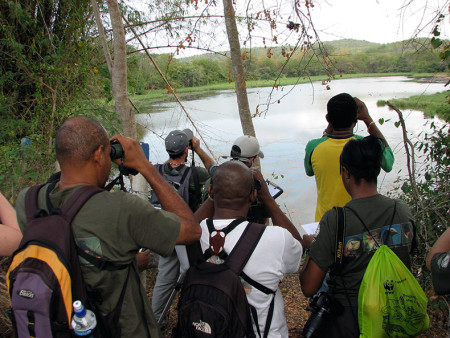
There are very large gaps in our knowledge of waterbirds and the sites they use for migration, breeding, and wintering in the Caribbean. Observations during the main CWC count period are very valuable, but only help monitor winter populations. Thus, we strongly encourage you to carry out additional CWC counts at other times of the year (spring and fall migration periods and the summer breeding season) in as many wetland sites as possible. If you can carry out 2 or more, or monthly counts, that’s even better. It is the best way to gather information at the local and regional level about what species are migrating to and through the islands and when, their numbers, and the sites they are using—all vitally important information for conservation and management. As more and more people participate we will be able to provide detailed information on waterbird migration and distributions in the region during all parts of the year. To see our summary report on the first 5 years of census data and the value of the CWC, click here.
HOW to Conduct CWC Counts
The CWC is designed so that everyone can participate. To make this possible, the CWC protocol has been divided into several levels of increasing difficulty with the user choosing the protocol and extent of participation in the program that is best suited to their objectives and available resources. Level 1 counts are the simplest and can be done by anyone.
If you are interested in attempting Level 2 or Level 3 counts, please review the protocols and manual available for download here. It’s perfectly fine if you are just getting started to spend a year getting to know your site (visit and count birds as often as possible!), training your counters, and refining your protocol (how specifically you will count each site), within the general guidelines. However, if you can carry out Level 2 counts (point counts or area searches with some measure of detection probability), that’s even better.
The two types of Level 1 counts are the Point Count, and Traveling Count. Forms for recording your data and more detailed instructions can be found here. The eBird Mobile app is a fantastic resource for recording your data in the field (checklists can be submitted when you have internet access later). Be sure to join the Caribbean Waterbird Census project in ebird AND be sure to choose the project for all your CWC lists. You can find out more about joining and used the CWC project in eBird here.
Here are basic instructions on these 2 count methods:
1. CWC Point Count
Best for: Small wetlands or areas easily observed from a fixed point (e.g., salt ponds, lagoons). Also suitable for covering larger wetlands with multiple fixed points.
How it works:
- Choose a location with a clear view of the wetland (“count station”).
- Count all birds seen or heard for 6–12 minutes (extend up to 20 minutes if needed). You may move short distances from your station (e.g.,<30m) to improve visibility.
- For larger wetlands or wetlands with dense vegetation, set up multiple stations at least 400 meters apart to avoid double-counting.
2. CWC Traveling Count
Best for: Wetlands with roads, trails, or boardwalks, or stretches of shoreline or beach.
How it works:
- Move along a defined route, recording all birds within your defined area along the route.
- Recommended survey distance is up to 1 km per section. For larger sites, divide the count into sections.
- Aim for 20 minutes per section, adjusting as needed for site conditions and bird numbers.
- Avoid double-counting by tracking flocks and individual birds while moving in one direction. If you drive or walk back along the same route, only record birds on the return if you are sure these are new birds.
- If traveling out and back along a linear route (e.g. a beach), your total survey distance for eBird is the “one-way” distance of your survey.
A Note about the CWC Area Search
The CWC Area Search protocol was previously available for counts where it was possible to move through the habitat on a predetermined route to count all the birds in the area. Now that eBird allows you to enter the size of the area you have surveyed this option is no longer needed. You can replace ‘Area Search’ with a CWC Traveling Count at sites with an extensive network of paths, boardwalks, navigable waterways, etc. Remember to enter ‘Surveyed Area’ (in hectares or acres) for your checklists.
Repeating the same survey over multiple days during the CWC 3-week period will begin to show how variable the birdlife is during this 3-week period and more importantly, will allow for us to also measure detectability (bias) which is extremely important in assessing populations and population changes. Also please remember to repeat these counts every year, following the same methods, during the CWC regional count. We request that you carry out counts as often as possible during the year, especially during fall and spring migration periods and during summer as this will provide more valuable data on the importance of the site for migratory and breeding resident species.
Entering Your Data
All our CWC data is stored on eBird, and in 2025 CWC became a project in eBird. This means that you need to be part of the project on eBird to ensure that your counts contribute to our database (see below). You can either record you data ‘live’ in the field, suing the eBird app. OR you can visit eBird, where you can enter your bird count data. You can add data as CWC counts if it was collected from within our CWC ‘core region’ which includes Bermuda, The Bahamas, the Greater Antilles, the Lesser Antilles, Aruba, Bonaire, Curaçao, Trinidad and Tobago, Providencia, San Andrés, Swan islands, and offshore islands and cays of Venezuela.
If you’ve ever submitted a checklist using a CWC protocol in the past you will have been automatically added to the project! Check out the CWC project pages here to confirm you’ve joined.
If you’re new to CWC or if for some reason you’ve not been joined, just visit the CWC Project Page and click “Learn how to join.” Review the info about the project, scroll to the end and then click “Join Project.” If you are not logged into eBird you will be prompted to “Login to Join Project.”
Once you’ve joined the CWC project, it’s easy to add your CWC lists to our database on the eBird app or on the website.
Here’s how:
CWC in the eBird Mobile App:
- Tap “Choose projects” above the “Start checklist”’ button.
- Select the CWC project, and, if you like, ask the app to remember this choice for future submissions. If you do this CWC will appear automatically above the “Start checklist” button next time you use App.
- Tap “Continue” and do your count (it’s that simple!)
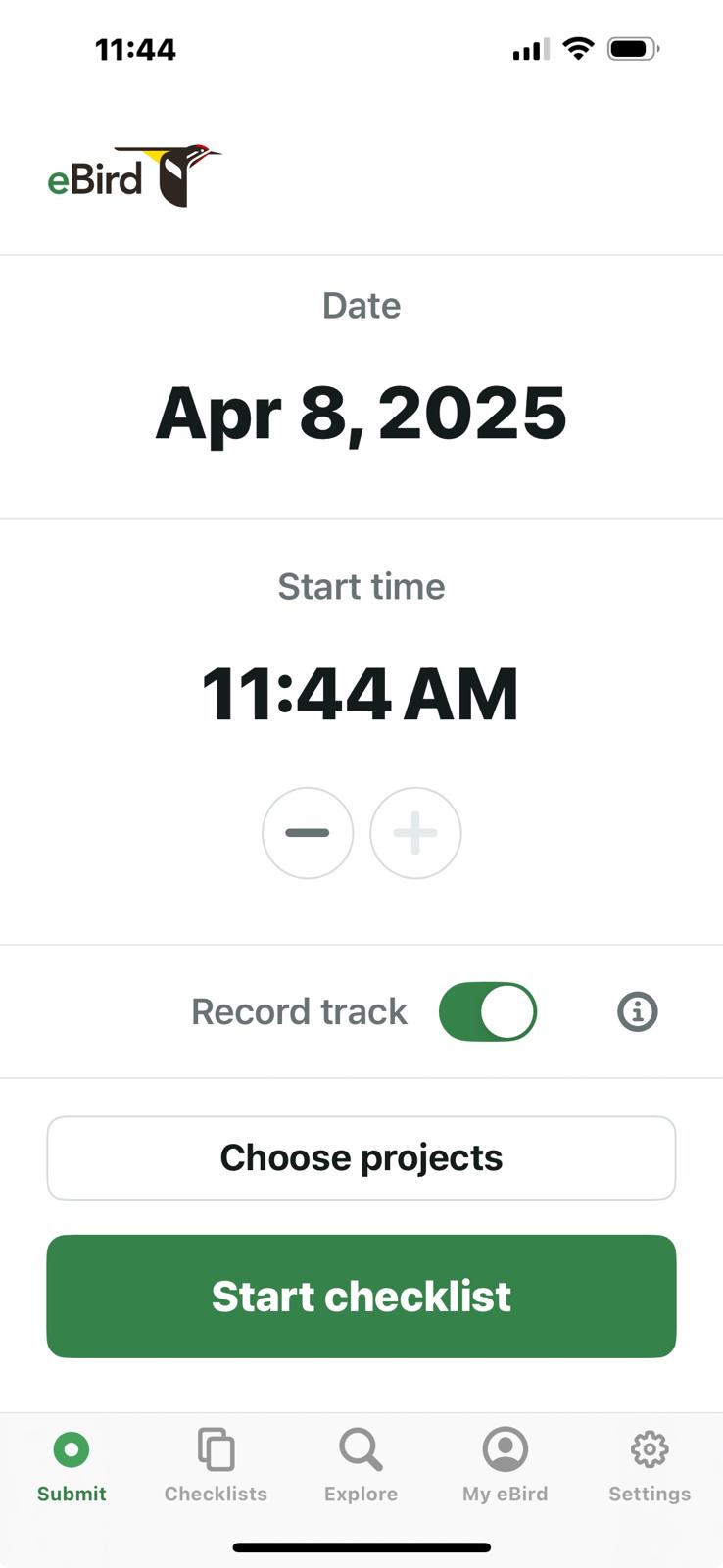
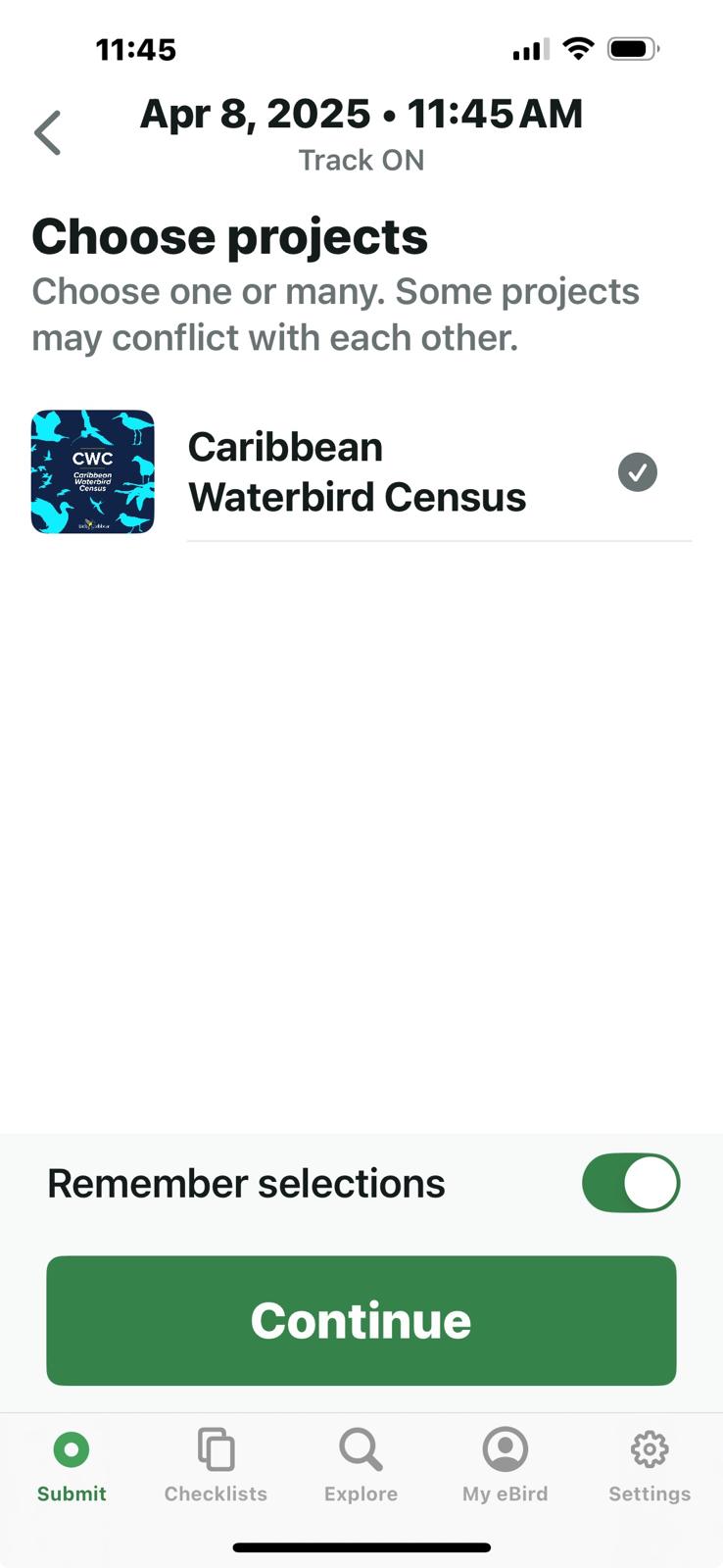
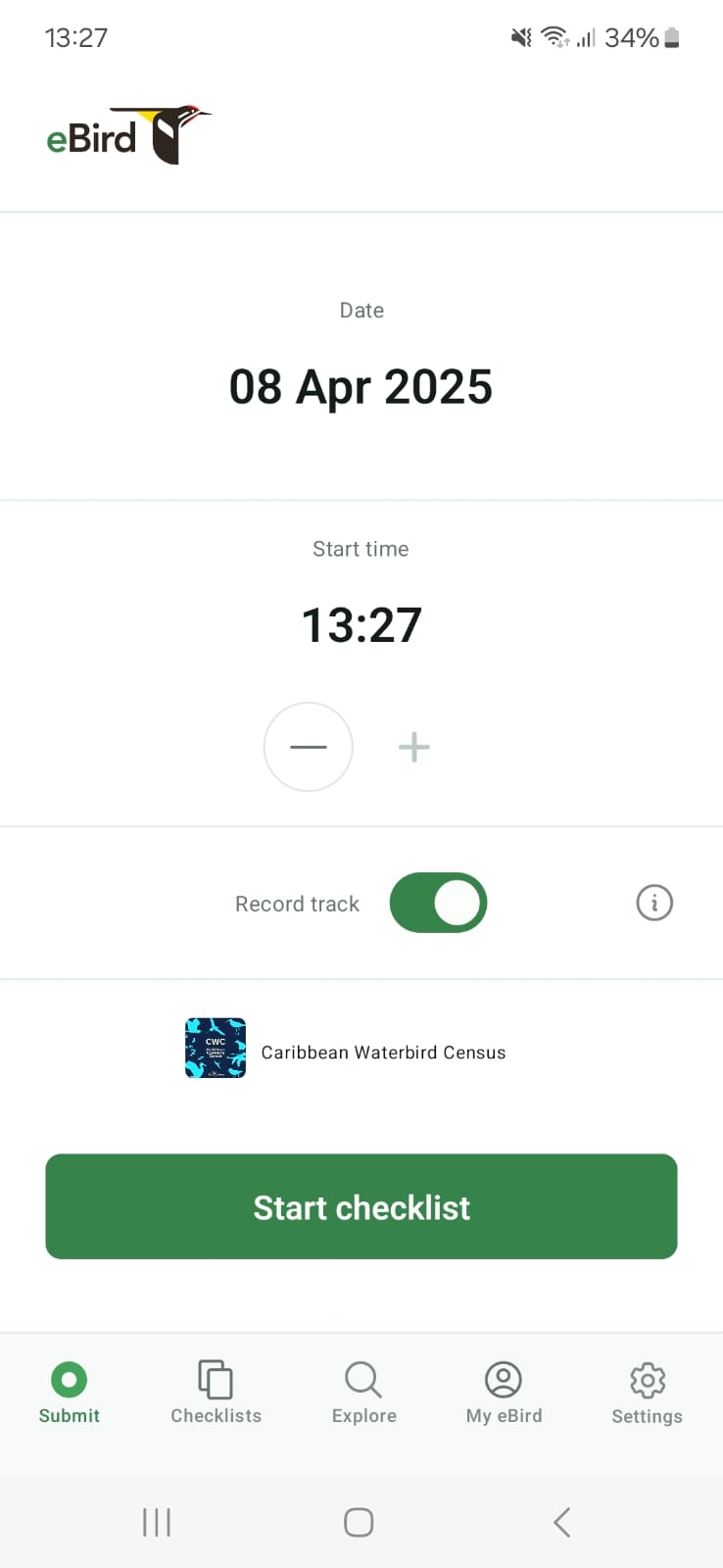
Next time you do a count at a Caribbean wetland, select “Caribbean Waterbird Census” above the “Start checklist” button.
CWC on the eBird Website:
- Go to the Submit page.
- Use the “Choose a Project” dropdown to check the box next to “Caribbean Waterbird Census.”
- Then follow the steps below to add your list details as normal.

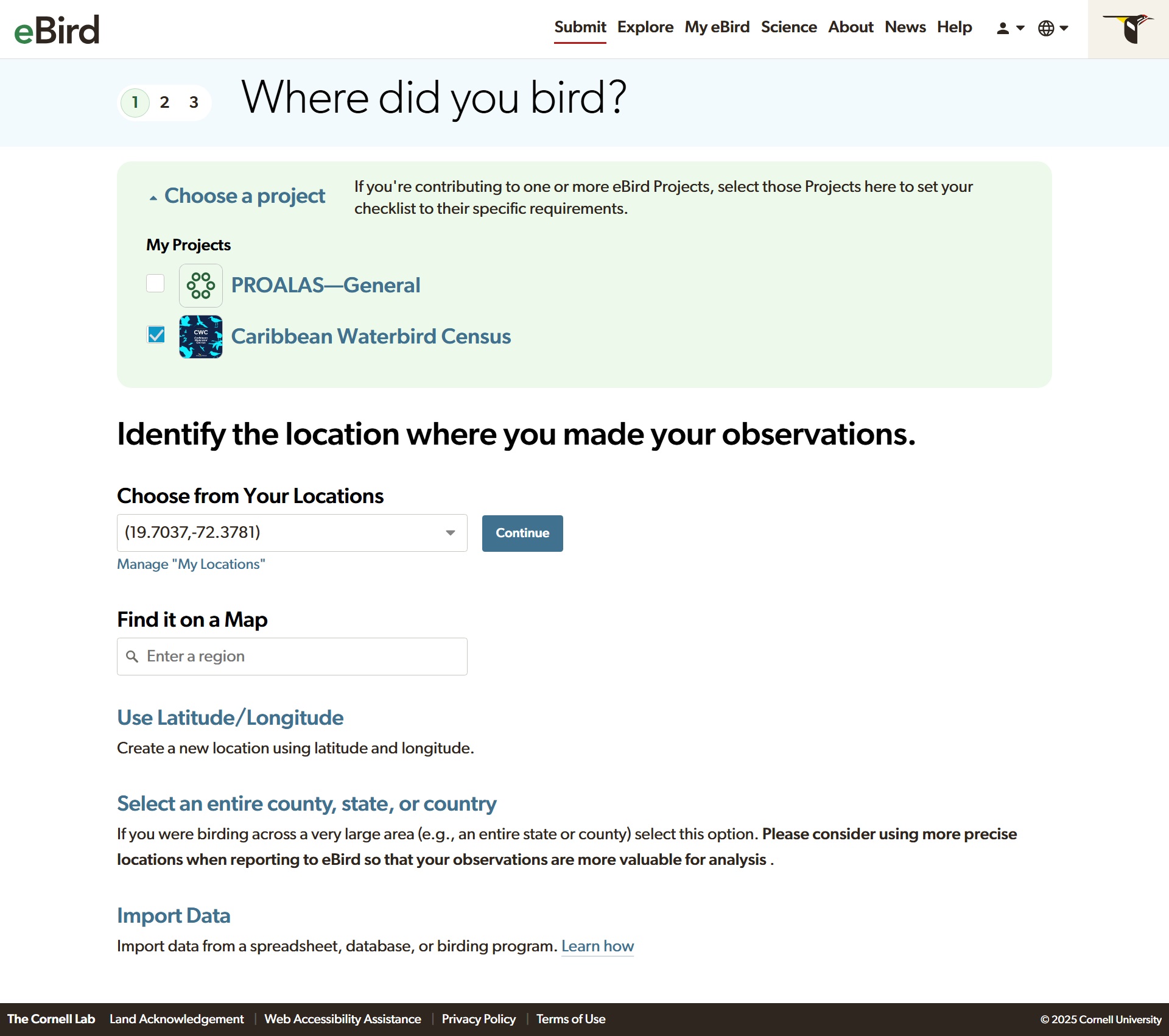
Now that CWC is a project there are no longer specific ‘CWC protocols’ in eBird, you just need to select the “Traveling” or “Stationary” protocol before submitting.
If you have any questions whatsoever or want us to review your plans, don’t hesitate to contact us. Also, if you need help getting started in eBird Caribbean, let us know (email Alex Sansom, our Waterbird Program Manager).
Finally, bring a digital camera in the field with you—if you are unsure of the identification of any of the birds you are seeing, don’t guess! Send us your photos and we will do our best to help (Send your photos to our Waterbird Working Group Discussion group and it will be good ID practice for all of us—shorebirds can be challenging to even very skilled birders!!!). Please post your photos also to our Flickr group, Caribbean Bird ID – Monitoring, to help us build this reference library! Below are links to many great resources to help you conduct CWC counts as well as information on how to contact us.
Sightings of Marked Birds
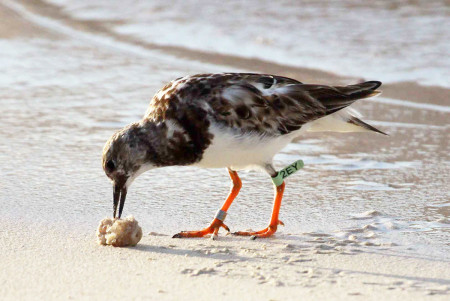
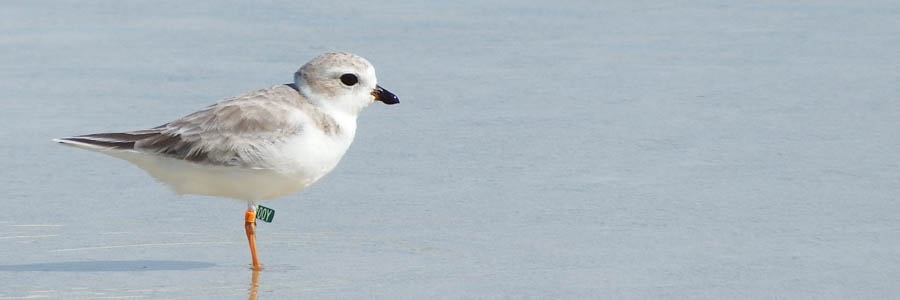
Be on the lookout for banded birds! The Caribbean provides important migration stopover and wintering habitat for a number of birds; we can contribute data on the locations and habitats used by these birds. In particular, look for bands on Ruddy Turnstones, Piping Plovers, Red Knots, Sanderlings, Semipalmated Sandpipers, and American Oystercatchers. Do your best to note the color and position of each band on the bird (e.g., right leg, left leg, upper and lower) and read any letters or numbers on the bands. For more information on species that have been banded and to report banded birds, visit the Shorebird Banding and Resighting Website. Magnficent Frigatebirds with Wing Tags – Sarah Trefry, graduate student at the University of New Brunswick put wing tags on frigatebirds in Barbuda. These birds are being spotted all over the Caribbean. If you see marked birds, please report them to Sarah (sarah.trefry@gmail.com). Great Egrets with wing tags and colored legbands – More than 1,500 Great Egrets have been color-marked in Ontario and resighting data shows that about 20% are wintering in the Caribbean. Read more about this project here. Send your sighting of marked birds to Chip Weseloh (Chip.Weseloh@ec.gc.ca).
International Shorebird Survey (ISS)
Is your survey site particularly good for shorebirds? If yes, then please share your count data with Manomet (an organization dedicated to shorebird conservation) – it’s easy to do this! After uploading your data to eBird Caribbean (using the CWC protocol on Step 2), share the checklist with the username “ISSData” which will flag the count as a joint ISS count for the folks at Manomet. In addition, we would like to invite you to schedule some extra counts during the migration season in the Caribbean and with that, become a volunteer for the International Shorebird Survey (ISS). Read more about how to participate in the ISS at this link.
Additional Notes
Help and assistance: If you have questions don’t hesitate to contact Alex Sansom, Lisa Sorenson or Jeff Gerbracht. Data forms: Forms for recording your count data and more detailed instructions for conducting the count are available in this file. More on the CWC: The CWC was established by BirdsCaribbean to promote conservation and monitoring of resident and migrant waterbirds and their wetland habitats in the insular Caribbean (including Bermuda and Trinidad and Tobago). Its objectives are to:
- Promote inventories, surveys and censuses of waterbirds and their habitats in all Caribbean countries,
- Monitor changes in waterbird numbers and distribution,
- Improve knowledge of little-known waterbird species and wetland sites,
- Encourage broad-based participation in waterbird counts including NGOs, governmental agencies, institutions, communities and volunteers,
- Ensure that as many internationally and nationally important sites as possible are conserved and monitored, and
- Increase awareness of conservation issues related to waterbirds and their wetland habitats at local, national and international levels, and what can be done to address these issues.
The CWC offers a hierarchical and flexible approach to monitoring (employing levels of monitoring) that enables the user to choose the protocol and extent of participation in the program that is best suited to their objectives, available resources and capacity. The basic CWC counts described here (Level 1 counts, area search and point count) are recommended for basic counts and site inventories. CWC Level 2 protocols are similar to Level 1 but include measures of detection probability, which are essential for accounting for bias in monitoring. Through this program, the Caribbean region will join Wetland International’s global program of wetland bird monitoring, with data from the Caribbean filling a major gap in the coverage of the International/Neotropical Waterbird Census. It can be used to promote site conservation, assess impacts of climate change and other threats on waterbirds and wetlands, and design programs to protect, manage and restore wetlands.